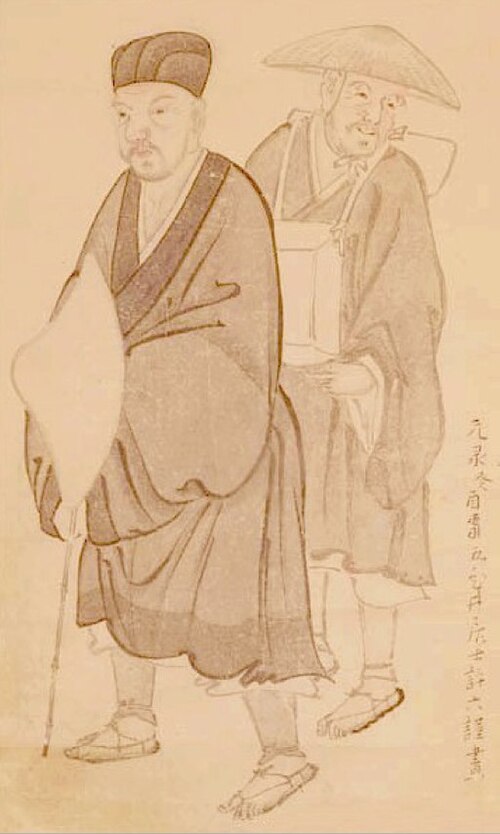
Literature · Famous Japanese people
Kobayashi Issa 小林一茶
こばやし いっさ
Kobayashi Issa (1763–1828) was a late Edo-period haiku poet, counted with Matsuo Bashō and Yosa Buson among the three classical masters. He left over 20,000 poems in everyday speech and dialect, full of humour, sorrow and compassion for small creatures such as frogs, flies and sparrows.
- Birthplace
- Kashiwabara, Shinano Province (now Shinano town, Nagano)
- Real name
- Kobayashi Nobuyuki, commonly Yatarō
- Field
- Haikai / haiku, haibun
A lonely childhood
Issa was born in 1763 in Kashiwabara, a post town on the Hokkoku Road in the snowy mountains of northern Shinano (now Shinano town, Nagano), into a middling farming family. His real name was Kobayashi Nobuyuki, commonly Yatarō.
His mother died when he was three. When he was eight his father remarried; the boy and his stepmother never got along, especially after a half-brother was born. These years marked his later poetry, as in the famous verse to an orphaned sparrow: "Come and play with me, / sparrow / without a parent."
In 1777, at about fourteen, he was sent to Edo to work, partly to end the family friction. Little is recorded of his first years there.
Apprenticeship and travels
Around the age of 25 Issa appears in Edo haikai circles, studying in the Katsushika school under masters such as Nisōan Chikua. He took the name Issa, "one cup of tea"; he explained it as evoking the vanishing foam of tea, an image of fleeting life.
From 1792 he spent six or seven years travelling in western Japan — Kyoto, Osaka, Shikoku and Kyushu — meeting provincial poets. His travel verses show him seeking his own voice, indebted to Bashō but closer to daily life.
Back in Edo he lived poorly, supported mainly by pupils and patrons in the Bōsō area (Chiba), an itinerant poet without a secure place in the urban haikai world.
Inheritance dispute and homecoming
In 1801 Issa returned home to nurse his gravely ill father, who died about a month later, leaving a will dividing the property between Issa and his half-brother. Issa recorded these days in Journal of My Father's Last Days, regarded as a pioneering, unflinching account of a family death in Japanese literature.
His stepmother and half-brother contested the will, and the dispute dragged on for over a decade. Only in 1813, with mediation by the village head and a temple, was the estate split, and Issa, now past fifty, settled in Kashiwabara.
This was his creative peak: the verse diary Shichiban nikki (1810–1818) records about 8,000 poems. At home he became a haikai teacher for poets across northern Shinano.
Family, loss and last years
In 1814, at 52, Issa married Kiku, aged 28. They had four children, all of whom died young. Their daughter Sato died of smallpox in 1819 before turning two, a grief recorded in Ora ga haru with the verse "This world of dew / is a world of dew, / and yet, and yet…"
Kiku died in 1823. A second marriage soon ended in divorce, and in 1826 he married his third wife, Yao. In 1827 a great fire destroyed his house; he lived in a surviving storehouse and died there of a stroke on the 19th day of the 11th month of Bunsei 10 (5 January 1828), aged 65. Months later Yao bore a daughter, Yata, his only surviving child.
Because the date falls in 1827 by the lunar calendar but 1828 by the Gregorian, sources differ on the year of his death.
Poetic style
Issa's poems differ from Bashō's quiet depth and Buson's painterly images. He used colloquial speech, Shinano dialect and slang to write of daily life — poverty, cold, mosquitoes, lice, children. His sympathy for the weak is famous: "Skinny frog, / don't give up — / Issa is here!" or "Don't swat it! / The fly wrings its hands, / wrings its feet."
Behind the humour lie sorrow, satire of the powerful and the Pure Land (Jōdo Shinshū) Buddhist faith of his family; Ora ga haru ends in surrender to Amida Buddha.
This manner is called Issa-chō, the Issa style. Some earlier critics found him crude; from the Meiji era Masaoka Shiki praised his humour and realism, helping restore him to the rank of master.
Legacy
Issa is now among Japan's best-loved haiku poets, taught in primary schools for his accessible, childlike verse. His hometown has the Issa Memorial Museum in Shinano town and the storehouse where he died, a national historic site.
Abroad he is known through translations by R. H. Blyth, Robert Hass (The Essential Haiku) and David G. Lanoue, who has translated thousands of his poems. His humanity and humour cross cultural barriers more easily than many classical poets.
Connection with Vietnam
Issa's poems regularly appear in Vietnamese haiku anthologies and introductions alongside Bashō and Buson. His frogs, flies and orphaned sparrows appeal to Vietnamese readers for their village feeling and familiar Buddhist compassion, and are often used as examples when teaching haiku to learners of Japanese.
Japanese corner
The pen name 一茶 (Issa) combines 一 "one" and 茶 "tea". The title おらが春 uses dialect: おら "I/my" (rustic) with the old possessive が — "My Spring". Its famous opening verse: めでたさも中くらいなりおらが春 ("My happiness, too, / is only middling — / my spring").
Vocabulary: 俳句 (haiku), 俳諧 (haikai), 季語 (kigo, season word), 蛙 (kaeru, frog), 蝿 (hae, fly), 雀 (suzume, sparrow), 露 (tsuyu, dew), 日記 (nikki, diary), 継母 (mamahaha, stepmother), 方言 (hōgen, dialect).
やせ蛙まけるな一茶これにあり
— Kobayashi Issa