Literature · Famous Japanese people
Sei Shōnagon 清少納言
せい しょうなごん
Sei Shōnagon was a Heian-period court lady and writer who served Empress Teishi from around the 990s. She wrote "The Pillow Book" (Makura no sōshi), regarded as the earliest and finest example of the zuihitsu, or miscellany essay, in Japanese literature. With Murasaki Shikibu she is one of the two great women writers of the Heian court.
- Period
- Mid-Heian period
- Family
- Father: poet Kiyohara no Motosuke
- Position
- Lady-in-waiting to Empress Teishi
Family and name
Sei Shōnagon was born around 966 into the Kiyohara, a middle-ranking aristocratic family with a literary tradition. Her father, Kiyohara no Motosuke, was one of the five compilers of the imperial anthology Gosen wakashū, and the poet Kiyohara no Fukayabu was her great-grandfather (or grandfather, by some accounts). She grew up fluent in waka and also well read in Chinese literature, which was unusual for a woman of her day.
"Sei Shōnagon" was a court sobriquet, not her real name: "Sei" is the first character of Kiyohara, while "Shōnagon" is the title of a minor councillor, though why she bore it is unknown. Her personal name was never recorded.
Around 981 she married Tachibana no Norimitsu and had a son, Norinaga. They later separated but stayed close; in her book she calls him her "elder brother". She later married Fujiwara no Muneyo and had a daughter.
At the court of Empress Teishi
Around 993 she entered service as a lady-in-waiting to Teishi, consort of Emperor Ichijō and daughter of the regent Fujiwara no Michitaka. Teishi's household was then a brilliant literary salon that prized quick repartee, allusions to Chinese poetry and refinement, and Sei Shōnagon soon became known for her wit and learning.
The most famous anecdote: one snowy day Teishi asked, "How is the snow on Xianglu Peak?" Instead of answering, Sei Shōnagon rose and rolled up the blind, alluding to Bai Juyi's line about raising the blind to see the snow on Xianglu Peak. The empress laughed in delight.
After Michitaka died in 995 and power passed to his brother Fujiwara no Michinaga, Teishi's family declined. For a time Sei Shōnagon was suspected of siding with Michinaga and withdrew to her home. Teishi died in childbirth in 1000, and Sei Shōnagon left court soon afterwards.
The Pillow Book
The Pillow Book was written over a period from the mid-990s to after Teishi's death. According to its afterword, she began writing on a bundle of fine paper the empress had given her while she was at home. It consists of some three hundred passages of varying length, usually grouped into three kinds: lists ("Hateful things", "Things that make the heart beat faster", "Elegant things"); diary-like recollections of life at Teishi's court; and reflections on nature and people.
It opens with perhaps the best-known line in classical Japanese literature, "In spring, the dawn", followed by the best moments of summer, autumn and winter. Her guiding aesthetic is okashi — the delightful, charming and bright — often contrasted with the mono no aware, the poignant sense of transience, of Murasaki Shikibu's Tale of Genji.
Notably, although written after Teishi's family fell from power, the book scarcely mentions that tragedy and records only bright moments, which many scholars read as her tribute to the empress. It survives in several manuscript lines (Sankan-bon, Nōin-bon, Maeda-bon, Sakai-bon) whose order and number of passages differ.
Poetry
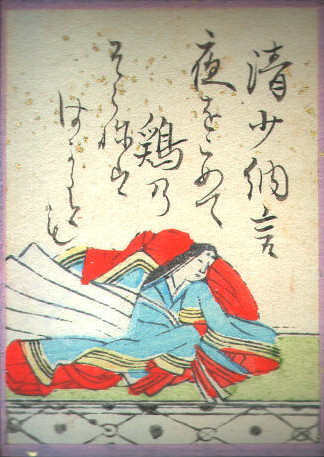
She was also an accomplished waka poet: some fourteen of her poems were chosen for imperial anthologies, and her personal collection, Sei Shōnagon shū, survives. The best known is poem no. 62 of the Ogura Hyakunin Isshu: 夜をこめて鳥のそら音ははかるともよに逢坂の関はゆるさじ.
It draws on the Chinese story of Lord Mengchang, whose retainer imitated a cock's crow to trick the guards into opening the Hangu Pass before dawn. Replying to Fujiwara no Yukinari, she says that no fake cock-crow will open the barrier of Ōsaka ("the slope of meeting") — that is, he will not get to meet her so easily. The poem shows off her wordplay and Chinese learning.
Later life and reputation
Little is recorded of her life after court. Many scholars believe she lived with her husband Fujiwara no Muneyo in Settsu, then in retirement near Tsukinowa on the eastern outskirts of Kyoto, where her father had once lived. Later tales of an aged, impoverished Sei Shōnagon wandering in poverty are generally treated as legend.
In her diary Murasaki Shikibu, who served Teishi's rival Shōshi, criticised Sei Shōnagon as smug, showing off her Chinese while making mistakes. This gave rise to the popular image of the two as rivals, although they probably never served at court at the same time.
Today The Pillow Book is ranked with Hōjōki and Tsurezuregusa as one of Japan's three great zuihitsu and appears in every high-school classical Japanese textbook. Her sharp, opinionated, detail-rich voice makes many modern readers see her as a kind of thousand-year-old blogger. The work has been widely translated; the English versions by Ivan Morris (1967) and Meredith McKinney (2006) are the best known.
Connections with Vietnam
In Vietnam her work is usually called "Sách gối đầu" (from the English title The Pillow Book) or, in Sino-Vietnamese reading, "Chẩm thảo tử". She and Murasaki Shikibu are covered in Japanese literature courses in Oriental and Japanese studies departments.
Vietnamese readers may notice a parallel: like pre-modern Vietnamese women writers, Sei Shōnagon worked in a Chinese-character culture, quoting Bai Juyi and Chinese classics, yet wrote in Japanese kana — much as Vietnamese authors used chữ Nôm to write in their mother tongue.
Language corner
清少納言 is read Sei Shōnagon and divided "Sei / Shōnagon", not "Seishō / Nagon". 枕草子 is read Makura no sōshi (The Pillow Book). The genre is 随筆 (zuihitsu, essay or miscellany).
Classical words: をかし (okashi, charming), あけぼの (akebono, dawn), 女房 (nyōbō, lady-in-waiting; today it means "wife"), 中宮 (chūgū, empress consort). 春はあけぼの (haru wa akebono) is the first classical passage many Japanese students memorise.
春はあけぼの。やうやう白くなりゆく山ぎは、少しあかりて、紫だちたる雲の細くたなびきたる。
— Sei Shōnagon
Vocabulary in this article
- 清少納言せいしょうなごんpen name of a mid-Heian period poet and…
- 枕草子まくらのそうしThe Pillow Book (Heian-period collectio…
- 随筆ずいひつessays; miscellaneous writings; literar…
- をかし
- 春はあけぼの
- 中宮定子
- 女房にょうぼうwife (esp. one's own wife)
- 平安時代へいあんじだいHeian period (794-1185)
- 百人一首ひゃくにんいっしゅ(Ogura) Hyakunin Isshu; classical Japan…
- 紫式部むらさきしきぶJapanese beautyberry (Callicarpa japoni…
- 香炉峰の雪