Science · Famous people of the world
Albert Einstein アインシュタイン
あいんしゅたいん
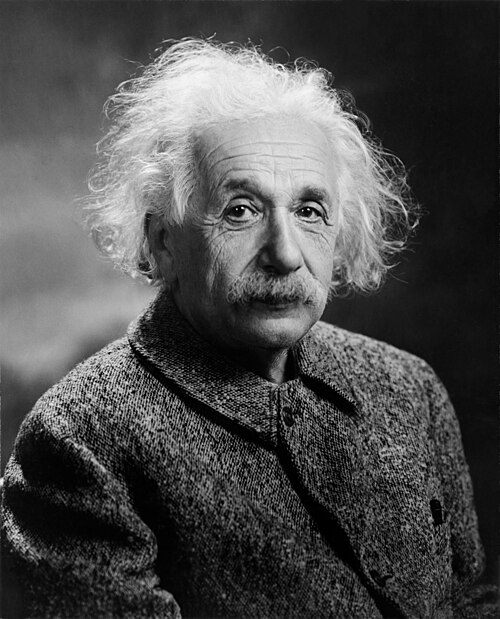
Albert Einstein (1879 – 1955) was a German-born theoretical physicist who developed special relativity (1905) and general relativity (1915), transforming our understanding of space, time and gravity. He received the 1921 Nobel Prize in Physics for explaining the photoelectric effect, a cornerstone of quantum theory. His name has become almost a synonym for genius.
- Birthplace
- Ulm, Kingdom of Württemberg, German Empire
- Citizenship
- German, Swiss, American (from 1940)
- Education
- ETH Zurich (1900); PhD, University of Zurich (1905)
Early life and education
Albert Einstein was born in Ulm, southern Germany, on 14 March 1879 to a non-observant Jewish family. The next year the family moved to Munich, where his father and uncle ran an electrical equipment firm. Einstein recalled being amazed, at about five, by a compass his father showed him; as a teenager he taught himself Euclidean geometry and calculus.
He disliked rote learning and rigid discipline at his Munich school, but the popular story that he failed mathematics is false — he excelled at it early. In 1894 the family moved to Italy for business; Einstein left school, later studied at Aarau in Switzerland, and in 1896 entered the Federal Polytechnic in Zurich (ETH).
He graduated in 1900 but could not get a university assistantship. He became a Swiss citizen in 1901 and in 1902 took a job as an examiner at the Federal Patent Office in Bern. In 1903 he married Mileva Marić, a fellow ETH student; they had two sons and divorced in 1919.
The miracle year, 1905
While still at the patent office, Einstein published four papers in Annalen der Physik in 1905, each of great importance. The first proposed that light consists of discrete quanta of energy, explaining the photoelectric effect. The second explained the Brownian motion of small particles in liquid, giving strong evidence for atoms.
The third founded special relativity on two principles: the laws of physics are the same in all inertial frames, and the speed of light in a vacuum is constant. Space and time thereby lost their absolute character: moving clocks run slow and moving objects contract along their direction of motion.
The fourth, a short addendum, showed that mass and energy are equivalent — later written as the famous E = mc². The same year he received his doctorate from the University of Zurich.
General relativity and world fame
The 1905 papers brought him into academia: he taught in Zurich and Prague, and in 1914 moved to Berlin as a member of the Prussian Academy of Sciences. There, after years of struggle with difficult mathematics, he completed general relativity in November 1915: gravity is not a Newtonian force but the curvature of spacetime produced by matter and energy.
The theory explained the puzzling shift in Mercury's orbit and predicted that light would bend when passing the Sun. In 1919 an eclipse expedition led by Arthur Eddington reported results consistent with the prediction, and the world press made Einstein a celebrity overnight.
In 1922 he was awarded the 1921 Nobel Prize in Physics "for his services to Theoretical Physics, and especially for his discovery of the law of the photoelectric effect" — not for relativity, which was still controversial. General relativity also predicted gravitational waves, directly detected in 2015, a century later.
Exile, war and Princeton
As a prominent Jew and pacifist, Einstein became a target of antisemitic attacks in Germany. When Hitler took power in 1933 he was in the United States and chose not to return, taking a post at the Institute for Advanced Study in Princeton, where he worked for the rest of his life. He became a U.S. citizen in 1940.
In 1939, at the urging of the physicist Leó Szilárd, he signed a letter to President Franklin D. Roosevelt warning that Nazi Germany might build an atomic bomb — one of the steps leading to the Manhattan Project. He did not work on the bomb himself. He later called signing the letter a great mistake, while saying there had been justification given the danger of Germany getting it first.
At Princeton he spent decades seeking a unified field theory combining gravity and electromagnetism, without success. He never fully accepted the probabilistic interpretation of quantum mechanics, a stance often summed up as "God does not play dice". He died in Princeton of an aortic aneurysm on 18 April 1955, aged 76.
Views and public life
Beyond science, Einstein spoke out for peace, nuclear disarmament and civil rights. He supported the fight against racism in America, calling it "a disease of white people". Days before his death in 1955 he signed the Russell–Einstein Manifesto urging scientists and governments to prevent nuclear war.
He supported cultural Zionism and helped found the Hebrew University of Jerusalem; in 1952 he was offered the presidency of Israel and declined. On religion, he did not believe in a personal God who intervenes in human affairs, speaking instead of a "cosmic religious feeling" before the order of nature.
Connections with Japan and Vietnam
Einstein had no direct link with Vietnam, but he is familiar to Vietnamese students through physics textbooks (E = mc² and the photoelectric effect in the final year of high school), and his biographies and essays have been published in Vietnamese.
Japan was the scene of a famous visit. Invited by the publisher Kaizōsha, he and his wife Elsa arrived in Kobe on 17 November 1922 and stayed 43 days, lecturing in Tokyo, Sendai, Nagoya, Kyoto, Osaka, Fukuoka and elsewhere. He learned of his Nobel Prize aboard ship on the way. The tour set off an "Einstein boom" in Taishō Japan, and he wrote warmly of Japanese culture.
After the atomic bombings of Hiroshima and Nagasaki in 1945, the 1939 letter linked his name with the bomb for many Japanese; Einstein expressed regret and campaigned actively for nuclear disarmament.
Legacy
Relativity and light quanta are two pillars of modern physics. GPS must correct for both special and general relativity to be accurate, and black holes, the expanding universe and gravitational waves all trace back to his equations. Element 99, einsteinium, is named after him.
In 1999 Time magazine named him "Person of the Century". The centenary of the miracle year, 2005, was declared the World Year of Physics. The image of his untidy white hair and the 1951 photograph of him sticking out his tongue have become pop-culture icons.
Japanese corner
His name is written アインシュタイン, in full アルベルト・アインシュタイン.
Key words: 相対性理論 (theory of relativity), 特殊相対性理論 / 一般相対性理論 (special / general relativity), 光電効果 (photoelectric effect), 光量子 (light quantum), 物理学者 (physicist), 重力波 (gravitational wave), 天才 (genius).
Vocabulary in this article
- アインシュタイン
- 相対性理論そうたいせいりろんtheory of relativity
- 特殊相対性理論とくしゅそうたいせいりろんspecial theory of relativity
- 一般相対性理論いっぱんそうたいせいりろんgeneral theory of relativity
- 光電効果こうでんこうかphotoelectric effect
- 光量子こうりょうしlight quantum; photon
- 物理学者ぶつりがくしゃphysicist
- 重力波じゅうりょくはgravitational wave; gravity wave
- 時空じくうspace-time; spacetime
- ノーベル物理学賞ノーベルぶつりがくしょうNobel Prize in Physics
- 天才てんさいgenius; prodigy; natural gift