Business & technology · Famous people of the world
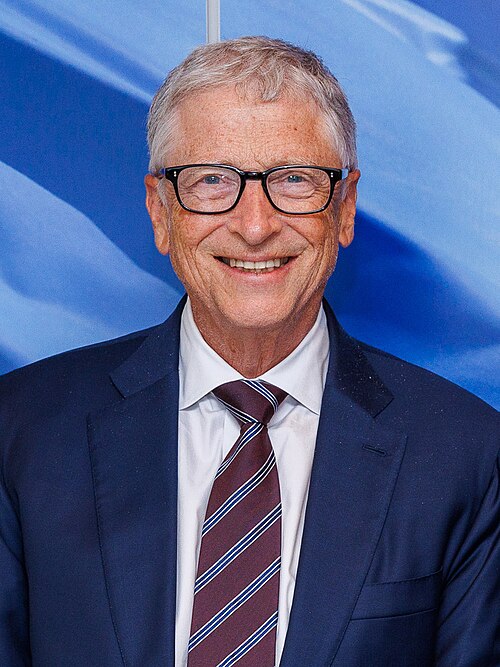
Bill Gates ビル・ゲイツ
びる・げいつ
Bill Gates (born 1955) is an American businessman and philanthropist who co-founded Microsoft with Paul Allen in 1975. Microsoft's MS-DOS and Windows helped bring personal computers to hundreds of millions of homes and offices, and for many years he was the world's richest person. Since 2008 he has worked full-time at his foundation, focusing on global health, vaccines and climate change.
- Full name
- William Henry Gates III
- Birthplace
- Seattle, Washington, USA
- Education
- Lakeside School; Harvard University (left in 1975)
Youth and a passion for computers
William Henry Gates III was born on 28 October 1955 in Seattle, Washington, to a well-off family: his father William H. Gates Sr. was a lawyer and his mother Mary Maxwell Gates a businesswoman active on corporate and charitable boards. He has two sisters.
At thirteen, at the private Lakeside School, he gained access to a terminal linked to a mainframe computer — rare in the 1960s. With an older schoolmate, Paul Allen, he became absorbed in programming, writing class-scheduling software for the school and starting a small company, Traf-O-Data, to analyse traffic data.
He entered Harvard in 1973. In January 1975, when Popular Electronics featured the Altair 8800 personal computer, Gates and Allen wrote a BASIC interpreter for it and sold it to the manufacturer, MITS. He left Harvard to pursue the business; Harvard gave him an honorary doctorate in 2007.
Microsoft and the PC revolution
Gates and Allen founded Microsoft (first written Micro-Soft) in 1975 in Albuquerque, New Mexico, moving to the Seattle area in 1979. The turning point came in 1980 when IBM sought an operating system for its IBM PC. Microsoft bought 86-DOS from a small firm, developed it into MS-DOS and licensed it to IBM — while keeping the right to sell it to others. As the market for IBM-compatible PCs exploded, MS-DOS became the standard.
In 1985 Microsoft launched Windows, a graphical interface running on DOS. Windows 3.0 (1990) and above all Windows 95 were huge successes, and with the Microsoft Office suite (Word, Excel, PowerPoint) the company came to dominate PC software. Microsoft went public in 1986; the next year Gates became the world's youngest billionaire at 31.
Forbes ranked him the world's richest person in 18 of the 24 years from 1995 to 2017. He was known as a leader of formidable memory and technical skill, but also demanding and fiercely competitive. His 1995 memo "The Internet Tidal Wave" redirected the whole company towards the Internet.
Antitrust and stepping back
Microsoft's dominance drew criticism. In 1998 the U.S. Justice Department and many states sued the company for monopolistic conduct, notably bundling Internet Explorer with Windows to squeeze out Netscape. In 2000 a trial court ruled that Microsoft had violated the Sherman Antitrust Act and ordered a break-up; the break-up was overturned on appeal and the case settled in 2001. The European Union also fined Microsoft several times.
In 2000 Gates handed the CEO role to Steve Ballmer, remaining chairman and chief software architect. In July 2008 he gave up day-to-day work at Microsoft for full-time philanthropy. He stepped down as chairman in 2014 to become technology adviser to CEO Satya Nadella, and left the board in 2020.
The Gates Foundation and philanthropy
The Bill & Melinda Gates Foundation (since 2024 the Gates Foundation) grew out of foundations set up in 1994 and took its name in 2000, quickly becoming one of the largest private charities in the world. It focuses on global health (vaccines, malaria, tuberculosis, HIV, polio), agricultural development, sanitation and U.S. education. It was a founding donor of Gavi, the Vaccine Alliance (2000), which has helped immunise hundreds of millions of children in low-income countries.
In 2010 Gates, Melinda French Gates and Warren Buffett launched the Giving Pledge, urging the very rich to commit more than half their wealth to philanthropy. He also founded Breakthrough Energy (2015) to invest in clean-energy technology and has written books on climate change and pandemic prevention. In 2025 he announced he would give virtually all his wealth to the foundation, which will close in 2045.
Gates and Melinda French Gates divorced in 2021 after 27 years of marriage; she left the foundation in 2024. He has three children.
Assessment and debate
Gates is credited as one of the shapers of the PC era: Microsoft's early goal of "a computer on every desk and in every home" came true. Health organisations credit his philanthropy with saving millions of lives.
He has also been criticised for Microsoft's monopolistic practices in the 1990s, and critics argue that large private foundations like his wield outsized influence over global health policy without the accountability of governments. During the COVID-19 pandemic he became the target of baseless conspiracy theories about vaccines.
Connections with Vietnam and Japan
In April 2006 Gates made his first visit to Vietnam: arriving in Hanoi on the night of 21 April, he met Prime Minister Phan Văn Khải the next morning, spoke with students at Hanoi University of Science and Technology, met IT businesses at the Opera House and launched the OneClick project in Bắc Ninh. The visit drew enormous press and youth interest. In 2007 he returned with Melinda, meeting Prime Minister Nguyễn Tấn Dũng to discuss health and immunisation. The foundation has supported health programmes in Vietnam, which has benefited from Gavi vaccine support.
In Japan, the launch of the Japanese Windows 95 in November 1995 brought midnight queues in Tokyo's Akihabara electronics district, an iconic image of the 1990s PC boom. Microsoft has a large Japanese subsidiary, and the Gates Foundation has partnered with the Japan International Cooperation Agency (JICA) on programmes such as polio eradication.
Japanese corner
His name is written ビル・ゲイツ; Microsoft is マイクロソフト and Windows ウィンドウズ.
Key words: 創業者 (founder), 実業家 (businessman), 慈善家 (philanthropist), 財団 (foundation), 寄付 (donation), 長者番付 (rich list), ソフトウェア (software), 独占禁止法 (antitrust law), 中退 (dropping out).
Vocabulary in this article
- ビル・ゲイツ
- マイクロソフトMicrosoft
- ウィンドウズ
- 創業者そうぎょうしゃfounder (of a company)
- 実業家じつぎょうかbusinessperson; businessman; businesswo…
- 慈善家じぜんかcharitable person; philanthropist
- 財団ざいだんfoundation (institution); syndicate; gr…
- 寄付きふcontribution; donation
- 長者番付ちょうじゃばんづけlist of the richest people; billionaire…
- ソフトウェアsoftware
- 独占禁止法どくせんきんしほうantitrust law; Antitrust Act
- 中退ちゅうたいleaving school during a term