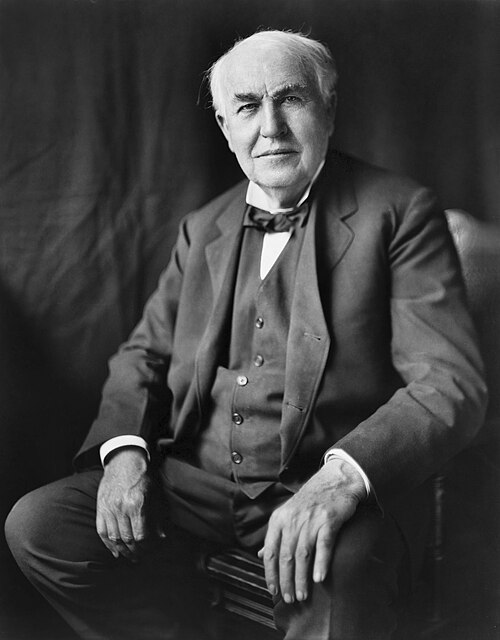
Famous people of the world
James Watt ワット
わっと
James Watt (1736–1819) was a Scottish engineer and inventor. His key improvement, the separate condenser (conceived 1765, patented 1769), made steam engines far more fuel-efficient and helped drive the Industrial Revolution. The unit of power, the watt (W), is named after him.
- Birthplace
- Greenock, Scotland
- Field
- Mechanical engineering, instrument making
- Inventions
- Separate condenser; rotary-motion engine; the 'horsepower' concept
From instrument maker to inventor
Watt was born in Greenock near Glasgow; his father was a shipwright and merchant. He trained as a mathematical-instrument maker in London and then became instrument maker to the University of Glasgow.
In 1763–64, repairing the university's model Newcomen engine, he saw that it wasted much steam because the cylinder was heated and cooled with every stroke. In 1765 he hit on the solution: condense the steam in a separate chamber so the cylinder stays hot.
Boulton & Watt and the Industrial Revolution
It took years and capital to turn the idea into a product. From 1775 Watt partnered with the Birmingham manufacturer Matthew Boulton; their engines first pumped water from mines and then, with rotary-motion gearing, powered textile mills, flour mills and factories.
To sell his engines Watt compared their output with that of horses, giving rise to 'horsepower'. He also devised a letter-copying press and adapted the centrifugal governor for engines. Watt did not invent the steam engine, but his improvements made it the key power source of the industrial age.
Legacy
In 1882 the British Association for the Advancement of Science named the unit of power the watt, which became part of the SI system in 1960. Watt and Boulton appeared together on the Bank of England £50 note.
In Vietnam and Japan
Vietnamese people see Watt's name daily as 'oát' on light bulbs, fans and rice cookers (60 W, 1,000 W). The Industrial Revolution and 'Giêm Oát's' steam engine are taught in school history.
In Japan ワット is likewise a familiar unit on household appliances. Japan adopted steam power from the late Edo and early Meiji periods, building railways and factories on British models.
Vocabulary corner
Name: Japanese ジェームズ・ワット, Vietnamese James Watt or Giêm Oát.
Vocabulary: 蒸気機関 (jōki kikan, steam engine), 産業革命 (sangyō kakumei, Industrial Revolution), 凝縮器 (gyōshukuki, condenser), 馬力 (bariki, horsepower), ワット (watto, watt), 特許 (tokkyo, patent).