History & politics · Famous Japanese people
Itō Hirobumi 伊藤博文
いとう ひろぶみ
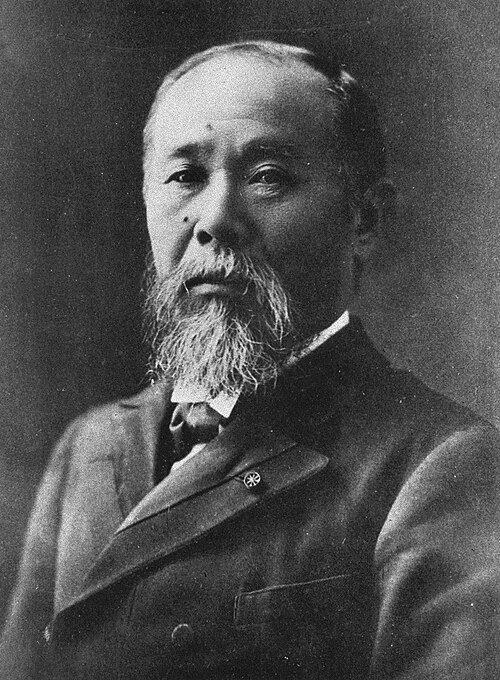
Itō Hirobumi (1841–1909) was the leading statesman of Meiji Japan, its first prime minister (1885) and the chief drafter of the Meiji Constitution (1889). He served four times as prime minister, founded the Rikken Seiyūkai party, became the first Resident-General of Korea, and was assassinated at Harbin in 1909 by the Korean independence activist An Jung-geun.
- Birthplace
- Suō Province, Chōshū domain (now Hikari, Yamaguchi)
- Other names
- Risuke, Shunsuke; pen name Shunpo
- Field
- Politics
Early life
Itō was born in 1841 in the village of Tsukari, Suō Province (now Hikari, Yamaguchi Prefecture), to a poor farming family; his childhood name was Risuke, later Shunsuke. His father was adopted into a low-ranking samurai family named Itō in the Chōshū domain, giving the family the lowest samurai status.
He studied at Yoshida Shōin's private academy Shōka Sonjuku, which trained reformers such as Takasugi Shinsaku and Kido Takayoshi. He joined the sonnō jōi movement ("revere the emperor, expel the barbarians") and took part in burning the British legation under construction in Edo in 1862.
Study in Britain and the Restoration
In 1863 Itō, Inoue Kaoru and three other young men from Chōshū secretly sailed to Britain to study, defying the shogunate's ban on foreign travel; they became known as the Chōshū Five. Seeing London's industrial power convinced him that expelling the West was unrealistic.
In 1864, hearing that a British, French, Dutch and American fleet was about to attack Chōshū, he hurried home to urge opening the country and served as interpreter in the peace talks. After the Meiji Restoration (1868) his English won him diplomatic and financial posts; he was governor of Hyōgo and a member of the Iwakura Mission to the US and Europe (1871–73).
After the deaths of Kido Takayoshi and Saigō Takamori (1877) and the assassination of Ōkubo Toshimichi (1878), Itō succeeded Ōkubo as Home Minister and became the central figure of the Meiji government.
First prime minister and the Constitution
In 1882 Itō went to Europe to study constitutions, mainly with German and Austrian scholars such as Rudolf von Gneist and Lorenz von Stein. He chose a Prussian-style constitutional monarchy with sovereign power in the emperor, rather than British parliamentary government.
In December 1885 the old Council of State was replaced by a cabinet system and Itō, aged 44, became the first prime minister. With Inoue Kowashi, Itō Miyoji and Kaneko Kentarō he drafted the constitution, then chaired the new Privy Council that reviewed it.
The Constitution of the Empire of Japan was promulgated on 11 February 1889 and the first Diet met in 1890, making Japan Asia's first constitutional state. He also wrote the official commentary, Kenpō gige.
Later cabinets and the Seiyūkai
During his second cabinet (1892–96) Japan fought the First Sino-Japanese War; Itō and Foreign Minister Mutsu Munemitsu signed the Treaty of Shimonoseki with Li Hongzhang, under which Qing China recognised Korean independence, ceded Taiwan and paid an indemnity. His government also ended British extraterritoriality through the 1894 treaty.
His third cabinet in 1898 was brief. Seeing the need for a stable party to manage the Diet, he founded the Rikken Seiyūkai in 1900 and formed his fourth cabinet (1900–01). The Seiyūkai became one of the two main prewar parties, and Itō remained an influential genrō who helped choose prime ministers.
Resident-General of Korea and death
After the Russo-Japanese War, Japan forced the Korean Empire in 1905 to sign the Eulsa Treaty, stripping Korea of its diplomatic rights, and Itō became the first Resident-General. In 1907, after Emperor Gojong sent secret envoys to the Hague Peace Conference, Itō forced him to abdicate and disbanded the Korean army.
Itō resigned in 1909. On 26 October 1909, arriving at Harbin station in Manchuria to meet the Russian finance minister Kokovtsov, he was shot dead by An Jung-geun. Japan annexed Korea the following year. Itō received a state funeral and was buried in Shinagawa, Tokyo.
His role in Korea remains contested: some Japanese historians argue he favoured indirect rule and was cautious about immediate annexation, while in Korea he is seen as an architect of colonial rule and An Jung-geun is honoured as a national hero.
Assessment and legacy
In Japan Itō is remembered as the builder of the modern state's institutions: cabinet, constitution, Diet and political parties. His portrait appeared on the 1,000-yen note from 1963 to 1984, and his former home in Hagi is preserved near Shōka Sonjuku.
Scholars also point to limits: his constitution placed supreme command of the military directly under the emperor, which the armed forces later used to escape civilian control. He was also known for his fondness for drink and women, a staple of anecdotes.
Connection with Vietnam
Itō had no direct ties with Vietnam, but the Meiji reforms he helped lead and Japan's victory over Russia in 1905 inspired early-20th-century Vietnamese patriots such as Phan Bội Châu to launch the Đông Du (Go East) movement, sending young people to study in Japan. Vietnamese history textbooks mention him in lessons on the Meiji Restoration and the 1889 Constitution.
Japanese corner
Name: 伊藤博文 (Itō Hirobumi); earlier name 俊輔 (Shunsuke). Prime minister is 内閣総理大臣 (naikaku sōri daijin), shortened to 首相 (shushō) or 総理 (sōri).
Vocabulary: 明治維新 (Meiji Restoration), 憲法 (kenpō, constitution), 大日本帝国憲法 (Meiji Constitution), 内閣 (naikaku, cabinet), 元老 (genrō, elder statesman), 政党 (seitō, party), 長州藩 (Chōshū domain), 統監 (tōkan, resident-general), 暗殺 (ansatsu, assassination).
Vocabulary in this article
- 伊藤博文
- 内閣総理大臣ないかくそうりだいじんprime minister (as the head of a cabine…
- 首相しゅしょうprime minister; chancellor (Germany, Au…
- 明治維新めいじいしんMeiji Restoration (1868)
- 憲法けんぽうconstitution
- 大日本帝国憲法だいにっぽんていこくけんぽうConstitution of the Empire of Japan; Me…
- 内閣ないかくcabinet (of a government); ministry
- 元老げんろうelder statesman; doyen; old-timer; auth…
- 政党せいとうpolitical party
- 長州藩
- 統監とうかんsupervision; supervisor
- 暗殺あんさつassassination