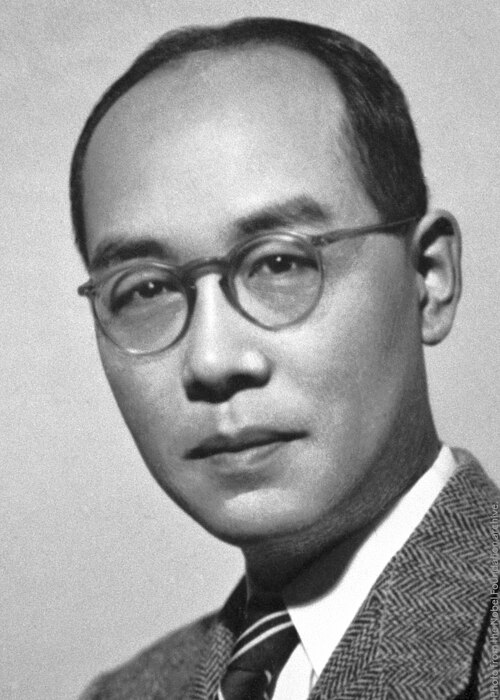
Science & business · Famous Japanese people
Kitasato Shibasaburō 北里柴三郎
きたさと しばさぶろう
Kitasato Shibasaburō (1853–1931) was a bacteriologist often called the father of modern Japanese medicine. He grew the tetanus bacillus in pure culture (1889), laid the foundations of serum therapy with Emil von Behring (1890) and identified the plague bacterium in Hong Kong in 1894, at the same time as Alexandre Yersin. Since July 2024 his portrait has appeared on the new 1,000-yen note.
- Birthplace
- Kitasato, Oguni, Higo Province (now Kumamoto)
- Education
- Kumamoto Medical School; University of Tokyo (1883); trained under Robert Koch in Berlin (1885–1892)
- Field
- Bacteriology, immunology, public health

Early life
Kitasato was born on 29 January 1853 (the 20th day of the 12th month of Kaei 5 in the old calendar) in the village of Kitasato in the Oguni district of Higo Province, now the town of Oguni in Kumamoto Prefecture. His father was the village head. As a boy he preferred martial arts and dreamed of a military career; his parents sent him to relatives to study the Chinese classics.
In 1871 he entered Kumamoto Medical School, where the Dutch teacher Constant George van Mansvelt showed him a microscope and encouraged him to pursue medicine. The experience turned the would-be swordsman towards science.
In 1875 he went to Tokyo to study at the school that became the University of Tokyo's medical faculty, graduating in 1883. As a student he wrote that medicine's task was to prevent disease, not only to cure it, a conviction he kept all his life. After graduating he joined the Hygiene Bureau of the Home Ministry.
Berlin years with Koch
In 1885 he was sent to Germany and joined the laboratory of Robert Koch, discoverer of the tuberculosis and cholera bacteria. Koch's rigour and his methods of culturing bacteria on solid media became the foundation of Kitasato's career.
In 1889 he became the first to grow the tetanus bacillus (Clostridium tetani) in pure culture, an anaerobic organism others had failed to isolate. He devised an apparatus for culturing in a hydrogen atmosphere.
In 1890, with Emil von Behring, he showed that the serum of immunised animals contained antitoxins that neutralised tetanus and diphtheria toxins — the basis of serum therapy and passive immunisation. In 1901 Behring received the first Nobel Prize in Physiology or Medicine for diphtheria serum therapy; Kitasato was among the nominees but was not honoured, a decision still cited as an example of the biases of the time.
Return to Japan
Kitasato returned in 1892 with an international reputation but was not immediately welcomed, partly because of an earlier clash with Tokyo University scholars over the cause of beriberi. The educator Fukuzawa Yukichi helped him set up a private Institute for Infectious Diseases in Shiba, Tokyo; it later received Home Ministry support and became a national institute.
When plague broke out in Hong Kong in 1894, the government sent him to investigate, and within days he reported finding the causative bacterium. Almost at the same time Alexandre Yersin isolated it too. Because Kitasato's early descriptions were unclear, many sources credit Yersin (the organism is named Yersinia pestis), while others credit both.
His institute trained leading scientists, among them Shiga Kiyoshi (discoverer of the dysentery bacillus), Hata Sahachirō (co-developer of Salvarsan with Paul Ehrlich) and Noguchi Hideyo, and produced serums and vaccines for the nation.
Kitasato Institute, Keiō and the Medical Association
In 1914 the government abruptly moved the institute from the Home Ministry to the Ministry of Education and merged it into Tokyo Imperial University without consulting him. Kitasato resigned in protest and his staff followed him. That year he founded the private Kitasato Institute with his own funds, the forerunner of today's Kitasato University.
To repay Fukuzawa Yukichi, he founded Keiō University's medical school in 1917 and served as its first dean without pay. He was also the first president of the Japan Medical Association (founded as Dai Nihon Ishikai in 1916 and reorganised in 1923), working on public health and campaigns against tuberculosis and infectious disease.
He became a member of the Imperial Academy (1906), sat in the House of Peers and was made a baron in 1924. He died of a cerebral haemorrhage in Tokyo on 13 June 1931, aged 78.
Ideas and legacy
Kitasato is remembered for his ideal of preventive medicine and his insistence that research serve treatment. Students described him as strict and hot-tempered yet devoted to his staff; his nickname "Donner-sensei" (from German Donner, thunder) reflected this.
The Kitasato Shibasaburō Memorial Museum stands on the Kitasato University campus in Shirokane, Tokyo, and his hometown of Oguni preserves his birthplace and the library he donated. The Kitasato Institute remains a major research centre; its scientist Ōmura Satoshi won the 2015 Nobel Prize in Medicine.
His selection for the 1,000-yen note from 2024, replacing his own former student Noguchi Hideyo, honours his contribution to modern medicine and public health. Historians still differ over credit for the plague bacterium, but his role in serum therapy is widely recognised.
Connection with Vietnam
The 1894 Hong Kong plague links Kitasato with Alexandre Yersin, who spent most of his later life in Nha Trang, founded the Pasteur Institute there and is revered in Vietnam. Many Vietnamese cities have a Yersin Street, so Vietnamese readers often meet Kitasato's name as the co-discoverer of the plague bacterium.
The new 1,000-yen note bearing his portrait is handled daily by Vietnamese living in Japan, making his name familiar to trainees and students.
Japanese corner
His name is written 北里柴三郎 (Kitasato Shibasaburō): 北 north, 里 village, 柴 brushwood, 三郎 third son, a traditional male name. The surname matches his home village.
Vocabulary: 細菌 (saikin, bacterium), 細菌学 (bacteriology), 破傷風 (hashōfū, tetanus), 血清療法 (kessei ryōhō, serum therapy), 抗毒素 (kōdokuso, antitoxin), ペスト菌 (plague bacterium), 伝染病 (densenbyō, infectious disease), 予防医学 (yobō igaku, preventive medicine), 千円札 (sen'en-satsu, 1,000-yen note).