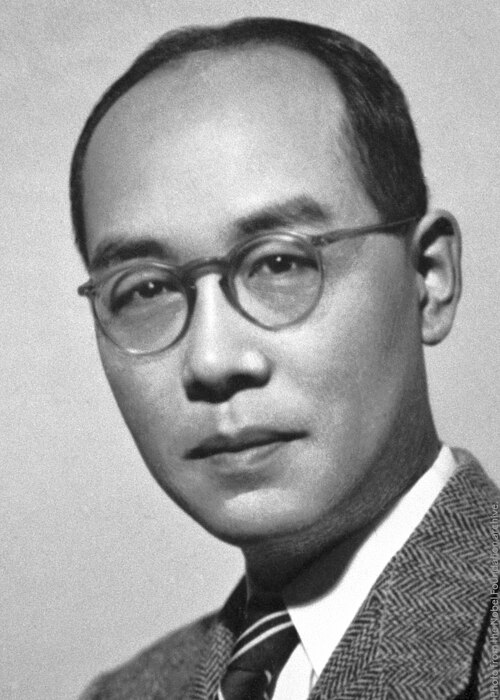
Science & business · Famous Japanese people
Shuji Nakamura 中村修二
なかむら しゅうじ
Shuji Nakamura (born 1954) is a Japanese-born engineer and materials scientist, now a US citizen, who in 1993, while at Nichia, created the first high-brightness blue LED suitable for mass production. The invention paved the way for energy-saving white LED lighting, blue lasers and Blu-ray discs. He shared the 2014 Nobel Prize in Physics with Isamu Akasaki and Hiroshi Amano.
- Birthplace
- Ikata (Seto), Ehime Prefecture
- Nationality
- American (Japanese-born)
- Education
- University of Tokushima (BEng 1977, MEng 1979, PhD 1994)

Early life and education
Shuji Nakamura was born on 22 May 1954 in a fishing village on the Sadamisaki peninsula, Ehime Prefecture (now Ikata town), on the island of Shikoku. He grew up in the countryside, fond of mathematics and physics but not an exam-driven star pupil.
In 1973 he entered the electronic engineering department of the University of Tokushima, graduating in 1977 and completing a master's degree in 1979. He had hoped to stay in research at the university, but being married and wishing to remain in Shikoku, he took a job with a local company.
Years at Nichia
In 1979 Nakamura joined Nichia Chemical Industries (now Nichia Corporation) in Anan, Tokushima, a small maker of phosphors. For about ten years he developed semiconductor materials such as gallium phosphide and gallium arsenide; the products worked but sold poorly against large competitors.
In 1988 he proposed to company president Nobuo Ogawa a project to develop the blue LED, a goal large corporations had long failed to reach, and won substantial funding. That year he spent about a year at the University of Florida learning MOCVD crystal growth.
Back home he chose gallium nitride (GaN), while most researchers bet on zinc selenide. He rebuilt his MOCVD reactor with a "two-flow" method that produced high-quality GaN films.
The blue LED
Red and green LEDs had existed for decades, but without a bright blue LED white light could not be made. Isamu Akasaki and Hiroshi Amano at Nagoya University had grown good-quality GaN and achieved p-type GaN (1989) using electron-beam irradiation. Nakamura developed a simple thermal-annealing process to make p-type GaN at production scale, and his team identified hydrogen as the cause of acceptor passivation.
Combined with an indium gallium nitride (InGaN) light-emitting layer, this led Nichia in 1993 to announce and produce the world's first commercially viable high-brightness blue LED. Green LEDs, white LEDs (blue LEDs coated with phosphor) and, between 1995 and 1999, blue-violet semiconductor lasers – the basis of Blu-ray – followed.
Nichia's revenues grew from about ¥20 billion (1993) to about ¥80 billion (2001), much of it from blue LED products. In 1994 Tokushima awarded him a doctorate in engineering based on his published work.
The Nichia lawsuit and move to the US
Under company rules Nakamura received a bonus of only about ¥20,000 for his key patent. In 1999 he left Nichia for the University of California, Santa Barbara (UCSB), becoming a professor of materials and of electrical and computer engineering.
In 2001 he sued Nichia for fair compensation. In 2004 the Tokyo District Court ordered Nichia to pay ¥20 billion, a sensational figure. Nichia appealed, and in 2005 the parties settled at the Tokyo High Court for about ¥840 million including interest, reportedly the largest sum a Japanese company had paid an employee for an invention.
The case fuelled debate on employee inventors' rights and contributed to revisions of the employee-invention provisions of Japan's Patent Act. Nakamura became known for blunt criticism of exam-based education and Japanese corporate culture; Nichia, for its part, stressed the role of teamwork and company investment.
Nobel Prize and later work
On 7 October 2014 the Royal Swedish Academy of Sciences awarded the Nobel Prize in Physics to Isamu Akasaki, Hiroshi Amano and Shuji Nakamura "for the invention of efficient blue light-emitting diodes which has enabled bright and energy-saving white light sources". Japan awarded him the Order of Culture the same year. Having become a US citizen in the mid-2000s, he is often described as a Japanese-born American scientist.
At UCSB he continues work on LEDs, lasers and GaN materials. In 2008 he co-founded the lighting company Soraa and in 2022 Blue Laser Fusion, which pursues laser-driven fusion energy. Other honours include the Millennium Technology Prize (2006), the Prince of Asturias Award (2008), the Charles Stark Draper Prize (2015) and the Queen Elizabeth Prize for Engineering (2021).
Significance
White LEDs use far less electricity than incandescent and fluorescent lamps and last much longer; they are now everywhere, from room lighting to phone and TV screens, car lights and traffic signals. The Nobel committee stressed that lighting accounts for a significant share of world electricity use, so LEDs save energy and, with solar power, bring light to off-grid regions.
Nakamura's story – a provincial company engineer from outside the elite universities beating major corporations – is often told as a model of persistence. Scientists also stress that the blue LED was the work of several groups, with Akasaki and Amano's foundational research playing a key role.
Connection with Vietnam
As in many countries, LEDs are now the common light source in Vietnam, from street lights to household bulbs, and are promoted in energy-saving programmes. Vietnamese media widely reported the 2014 physics Nobel of the three Japanese-born scientists.
Japanese corner
Name: 中村修二 (Nakamura Shūji). Co-laureates: 赤﨑勇 (Akasaki Isamu) and 天野浩 (Amano Hiroshi). Company: 日亜化学工業 (Nichia Kagaku Kōgyō).
Vocabulary: 青色発光ダイオード (aoiro hakkō daiōdo, blue LED), 窒化ガリウム (chikka gariumu, gallium nitride), 半導体 (handōtai, semiconductor), 省エネ (shōene, energy saving), 職務発明 (shokumu hatsumei, employee invention), 特許 (tokkyo, patent), ノーベル物理学賞 (Nobel Prize in Physics).
Vocabulary in this article
- 中村修二
- 青色発光ダイオードあおいろはっこうダイオードblue light-emitting diode; blue LED
- 発光ダイオードはっこうダイオードlight-emitting diode; LED
- 窒化ガリウムちっかガリウムgallium nitride
- 半導体はんどうたいsemiconductor
- 省エネしょうエネenergy conservation; economical use of …
- 職務発明しょくむはつめいinvention by an employee; employee inve…
- 特許とっきょpatent
- 日亜化学工業にちあかがくこうぎょうNichia Corporation (Japanese chemical m…
- ノーベル物理学賞ノーベルぶつりがくしょうNobel Prize in Physics
- 文化勲章ぶんかくんしょうOrder of Culture (Japan); Order of Cult…