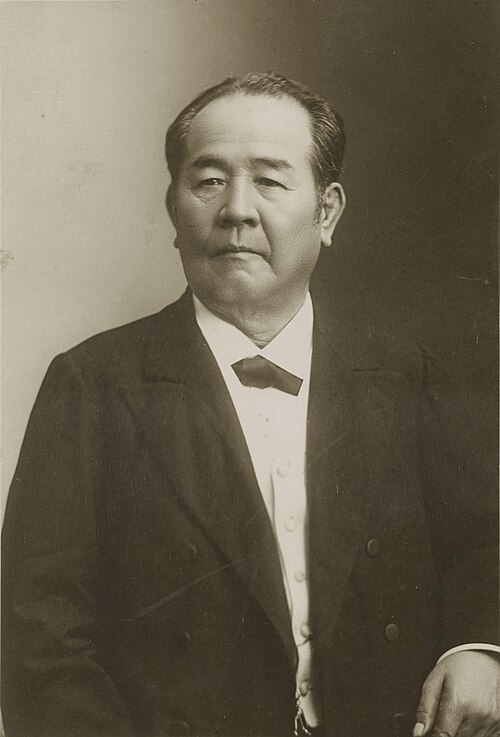
Science & business · Famous Japanese people
Konosuke Matsushita 松下幸之助
まつした こうのすけ
Konosuke Matsushita (1894–1989) founded Matsushita Electric, today's Panasonic, and is known in Japan as the "God of Management" (経営の神様). An apprentice who left school at nine, he built one of the world's largest electronics makers. He also founded the PHP Institute, the Matsushita Institute of Government and Management and the Japan Prize.
- Birthplace
- Wasa village, Kaisō District, Wakayama (now Wakayama City)
- Place of death
- Moriguchi, Osaka
- Nationality
- Japanese

Childhood and apprenticeship
Konosuke Matsushita was born on 27 November 1894 in Wasa village, Kaisō District, Wakayama, the youngest child of a landowning family. While he was small his father lost the family's fortune speculating in rice, and they had to sell their land and move to town. Several of his siblings died young of illness, and he himself was frail.
At nine, before finishing primary school, he was sent to Osaka as an apprentice (decchi bōkō), first at a shop selling hibachi braziers and then at a bicycle shop. There he absorbed the merchant culture of Osaka: serving customers, keeping one's word and watching every coin.
In 1910, impressed by Osaka's new electric trams, he joined Osaka Electric Light (Osaka Dentō) as an apprentice wireman. He rose quickly to inspector and studied at night at the Kansai Commercial and Technical School.
Founding and early growth
In 1917 he quit to make an improved light socket of his own design, without success. On 7 March 1918 he founded the Matsushita Electric Appliance Manufacturing Works in Osaka with his wife Mumeno and her brother Iue Toshio, who later founded Sanyo. Their first hits were an attachment plug and a two-way socket (futamata socket) that were cheaper and handier than rivals.
In 1923 he launched a bullet-shaped battery lamp for bicycles that lasted dozens of hours; it sold well and turned the workshop into a recognised firm. The National brand appeared in 1927 with a square lamp.
In 1933 the company moved to Kadoma, Osaka, and introduced a divisional system (jigyōbu-sei) in which each product group handled its own development, production and sales, ahead of many Western firms. In 1935 it was incorporated as Matsushita Electric Industrial with him as president.
War, recovery and boom
During the Second World War the company was made to build wooden ships and aircraft. After 1945 the occupation authorities listed Matsushita among the zaibatsu and restricted him; his union and dealers petitioned on his behalf, and the restrictions were lifted by 1950.
He toured the United States and Europe in 1951, and in 1952 formed a joint venture with Philips, Matsushita Electronics, to bring in technology. In the high-growth years the "three sacred treasures" – black-and-white TV, washing machine and refrigerator – and a nationwide network of National stores made the firm a leader in home appliances.
In 1965 he introduced the five-day week, earlier than most Japanese companies. He became chairman in 1961 and stepped back as an adviser in 1973. He died in Moriguchi on 27 April 1989, aged 94. The company was renamed Panasonic Corporation in 2008.
Management philosophy
On 5 May 1932 he declared the company's "true mission", later called the "tap-water philosophy" (suidō tetsugaku): to produce goods as plentiful and cheap as tap water so as to end poverty and bring prosperity. The company counts 1932 as year one of its "era of mission awareness".
He held that a company is a "public entity of society" and that profit is society's reward for contribution. He is also associated with "dam management" – keeping reserves of capital, staff and stock to absorb shocks – and the motto "make people before making products".
He wrote dozens of books; his collection of short essays Michi o Hiraku (1968) has sold more than five million copies in Japan, according to its publisher PHP.
PHP, the Matsushita Institute and the Japan Prize
In 1946, amid postwar ruin, he founded the PHP Institute – Peace and Happiness through Prosperity – to study and spread ideas about people and society; it publishes the magazine PHP and many books.
In 1979 he used his own money to found the Matsushita Institute of Government and Management in Chigasaki, Kanagawa, which took its first students in 1980. Its alumni include former Prime Minister Yoshihiko Noda and many legislators, governors and mayors.
In 1985 he donated personal funds to establish the Japan Prize, an international award for science and technology that benefits humanity.
Assessment and legacy
Matsushita is often grouped with Honda Soichiro, Morita Akio of Sony and Inamori Kazuo among the defining Japanese business leaders of the 20th century. His rise from apprentice to tycoon made him the most cited role model in Japanese management writing.
There have also been criticisms: the company was mocked as "Mane-shita" ("just copies") for following rivals' products and outselling them through its distribution network, and some question the record of his political academy. Few dispute, however, his role in bringing electrical appliances into Japanese homes.
The Konosuke Matsushita Museum, now part of the Panasonic Museum in Kadoma, Osaka, presents his life and early products.
Connection with Vietnam
In Vietnam the National and later Panasonic brands are familiar to many households through fans, rice cookers and TVs. Panasonic has factories and R&D centres in Hanoi, Binh Duong and Ho Chi Minh City.
Several of Matsushita's books have been translated into Vietnamese, including Michi o Hiraku, and he is frequently cited in self-help books and Japanese-style management courses for Vietnamese companies.
Japanese corner
Name: 松下幸之助 (Matsushita Kōnosuke). Nickname: 経営の神様 (keiei no kamisama, god of management). The old company name 松下電器 (Matsushita Denki) is often shortened to 松下.
Vocabulary: 丁稚奉公 (decchi bōkō, live-in apprenticeship), 創業者 (sōgyōsha, founder), 二股ソケット (futamata socket, two-way socket), 水道哲学 (suidō tetsugaku, tap-water philosophy), 事業部制 (jigyōbu-sei, divisional system), 週休二日制 (shūkyū futsuka-sei, five-day week), 社会の公器 (shakai no kōki, a public instrument of society).