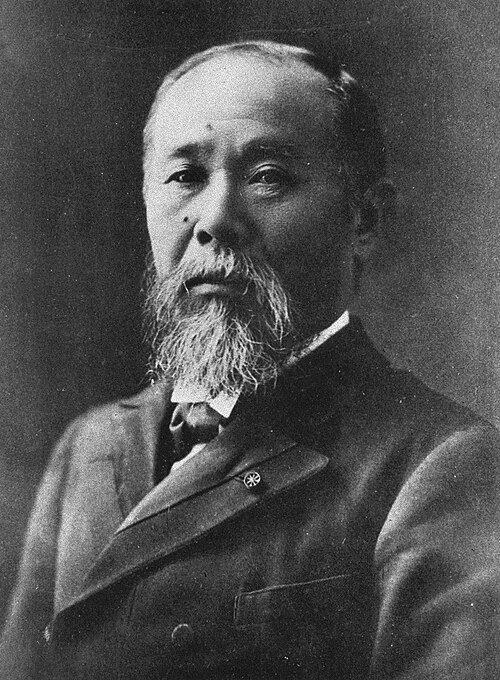
History & politics · Famous Japanese people
Saigō Takamori 西郷隆盛
さいごう たかもり
Saigō Takamori (1828–1877) was a Satsuma samurai and, with Ōkubo Toshimichi and Kido Takayoshi, one of the "Three Great Nobles" of the Meiji Restoration. He was the key military leader in toppling the Tokugawa shogunate and arranged the bloodless surrender of Edo Castle. After leaving the Meiji government in 1873 he led the Satsuma Rebellion of 1877 and died at Shiroyama, becoming Japan's beloved image of the "last samurai".
- Birthplace
- Kajiya-chō, Kagoshima, Satsuma Domain
- Period
- Bakumatsu – early Meiji
- Field
- Military, politics

Early life
Saigō was born into a poor, low-ranking samurai family in Kajiya-chō, Kagoshima – the same small quarter that produced Ōkubo Toshimichi and other Restoration figures. As eldest son he had many younger siblings to support, and at 18 he took a minor post in the domain's agricultural administration.
He often submitted memorials on the lives of farmers. According to Kagoshima Prefecture, the reforming lord Shimazu Nariakira noticed his ability and made him a niwakata (garden attendant), a post that gave him direct access to the lord and let him act as a confidential political agent in Edo and Kyoto.
Two exiles
In 1858 Shimazu Nariakira died suddenly just as the shogunate's chief minister Ii Naosuke launched the Ansei Purge. Saigō leapt into Kinkō Bay with the monk Gesshō, who was wanted by the shogunate; Gesshō died but Saigō was revived, and Satsuma hid him on Amami Ōshima.
On the island he lived at Tatsugō, married a local woman, Aikana, and had children. Recalled in 1862, he soon clashed with Shimazu Hisamitsu, father of the new lord, and was exiled again, to Tokunoshima and then Okinoerabu, where for a time he was confined in a small open-air cage.
These hard years are often seen as the period that tempered his thinking, and many accounts link his motto "revere heaven, love people" to this self-cultivation. Amami and Okinoerabu still preserve the sites of his exile.
Leading the overthrow of the shogunate
Recalled again in 1864, Saigō became Satsuma's military commander. He helped repel Chōshū forces in the Kinmon Incident of 1864 but then moved toward reconciliation. In January 1866, with Sakamoto Ryōma and Nakaoka Shintarō as go-betweens, he and Kido Takayoshi concluded the Satsuma–Chōshū alliance, uniting the two strongest anti-shogunate domains.
After shogun Tokugawa Yoshinobu returned power to the emperor in 1867, the Satsuma–Chōshū camp proclaimed the restoration of imperial rule. In the Boshin War (1868–1869) Saigō was a leading staff officer of the imperial army. In March 1868 he met the shogunate's representative Katsu Kaishū and agreed that Edo Castle would be handed over without a fight, sparing a city of over a million people.
In the Meiji government and the Korea debate
After a spell back in Kagoshima, Saigō joined the central government in 1871 as a State Councillor and commanded the Imperial Guard, the force that ensured the abolition of the domains went smoothly. While the Iwakura Mission (with Ōkubo, Kido and Itō) toured the West, he was the central figure of the "caretaker government", and in 1873 he became an Army General.
That year the cabinet split over relations with Korea (seikanron). Saigō proposed going to Korea himself as envoy; historians still debate whether he sought a war or a peaceful settlement. When the Iwakura Mission returned, Ōkubo and Iwakura insisted that domestic reform came first and overturned the plan. Saigō and many officials resigned in the Political Crisis of 1873 and he went home to Kagoshima.
The Satsuma Rebellion and death
Back in Kagoshima, Saigō set up private schools (shigakkō) for samurai youth and farmed newly cleared land. Meanwhile Meiji policies – ending the right to wear swords and commuting stipends – angered the samurai class, and revolts broke out in Saga, Kumamoto and Hagi.
In early 1877 students of the schools raided government arsenals; Saigō was drawn in and agreed to lead them. The Satsuma army besieged Kumamoto Castle without taking it and lost the Battle of Tabaruzaka to a modern conscript army. After about six months of fighting, on 24 September 1877 Saigō was wounded at Shiroyama in Kagoshima and took his own life, ending Japan's last major civil war.
Legacy and assessment
Though he died a rebel, Saigō was pardoned in 1889, on the promulgation of the Meiji Constitution, and posthumously given Senior Third Rank. In 1898 a bronze statue by Takamura Kōun showing him in casual dress walking his dog was unveiled in Tokyo's Ueno Park and became a famous meeting spot; Kagoshima has a uniformed statue at the foot of Shiroyama.
Japanese see him as a model of sincerity, simplicity and indifference to wealth and rank, and the Nanshū-ō Ikun, a collection of his sayings, is still widely read. Some historians note that this image is partly idealised, and later nationalists' use of the "conquer Korea" debate makes him a contested figure in Korea.
His life has inspired many works, including the 2018 NHK drama Segodon, and the character Katsumoto in the Hollywood film The Last Samurai (2003) is partly based on him.
Connections with Vietnam
Saigō had no direct link with Vietnam, but the Meiji Restoration he helped bring about was the model that early 20th-century Vietnamese patriots such as Phan Bội Châu looked to when they launched the Đông Du movement. For Vietnamese readers of Japanese history, his name usually appears alongside Sakamoto Ryōma and Ōkubo Toshimichi.
Japanese corner
In Kagoshima he is affectionately called 西郷どん (Segodon); "don" is a respectful yet familiar suffix in Kagoshima dialect. His pen name was 南洲 (Nanshū).
Vocabulary: 明治維新 (Meiji ishin, Meiji Restoration), 維新三傑 (ishin sanketsu, three heroes of the Restoration), 倒幕 (tōbaku, overthrowing the shogunate), 無血開城 (muketsu kaijō, bloodless surrender of a castle), 征韓論 (seikanron, the Korea debate), 西南戦争 (Seinan sensō, Satsuma Rebellion), 敬天愛人 (keiten aijin, revere heaven, love people).
敬天愛人
— Saigō Takamori