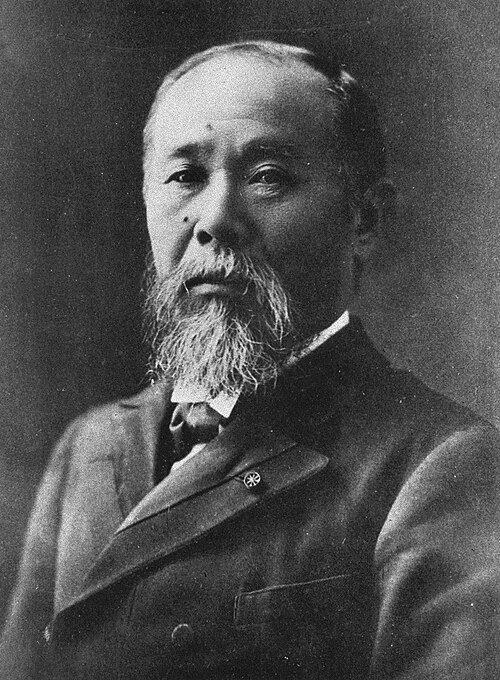
History & politics · Famous Japanese people
Tanaka Kakuei 田中角栄
たなか かくえい
Tanaka Kakuei (1918–1993) was prime minister of Japan from July 1972 to December 1974, a politician from rural Niigata who reached the top without a university education. He normalised relations with China in 1972, promoted his Plan for Remodeling the Japanese Archipelago, and his government established diplomatic ties with North Vietnam in 1973; yet he also became the symbol of money politics through the Lockheed scandal.
- Birthplace
- Kariwa District, Niigata (now part of Kashiwazaki)
- Education
- Higher elementary school; civil engineering at Chūō Kōgakkō (1936)
- Party
- Liberal Democratic Party (independent from 1976)

Background and youth
Tanaka was born on 4 May 1918 to a farming family in Kariwa District, Niigata, a snowbound region on the Sea of Japan coast, much poorer than the Pacific belt. His father dealt in livestock without success. He stammered as a child and finished only higher elementary school.
Around the age of 15 he went to Tokyo, working by day and studying at night, and graduated in civil engineering from Chūō Kōgakkō in 1936. After army service in Manchuria cut short by illness, he founded the construction firm Tanaka Doken – reference works give 1938 or 1943 – which prospered on wartime contracts.
Entering politics
In 1947 Tanaka won a seat in the House of Representatives for Niigata's third district, which he held until he retired in 1990. He was an energetic legislator who drafted many bills himself, especially on roads, housing and regional development, such as the gasoline tax earmarked for road building.
In 1957, aged 39, he became Posts and Telecommunications Minister in the Kishi cabinet, one of the youngest ministers of the postwar era. From 1962 to 1965 he was Finance Minister under Ikeda and Satō, in the middle of the high-growth era. He also served as LDP Secretary-General (1965–66 and 1968–71) and Minister of International Trade and Industry (1971–72), building a powerful faction of his own.
As prime minister
In July 1972 Tanaka beat Fukuda Takeo for the LDP presidency and became prime minister at 54. With no university degree and a strong Niigata accent, he was dubbed “Imataikō” – a modern-day Hideyoshi, after the humbly born unifier – and enjoyed very high approval in his first months.
In September 1972 he went to Beijing, met Premier Zhou Enlai and signed the Japan–China Joint Communiqué normalising relations; Japan at the same time ended official diplomatic ties with Taiwan.
At home his 1972 book Plan for Remodeling the Japanese Archipelago became a bestseller. It proposed expressways, a Shinkansen network and new industrial cities to move people and jobs from Tokyo and Osaka to regions like Niigata. But it sent land prices soaring, and with the 1973 oil shock inflation surged (the “crazy prices” era), forcing the plan to be shelved and eroding his popularity.
Resignation and the Lockheed scandal
In 1974 the monthly Bungei Shunjū ran journalist Tachibana Takashi's investigation of the web of money and land deals around Tanaka (the “money veins” affair). Public anger followed, and later that year he announced his resignation; Miki Takeo's cabinet took over in December 1974.
In 1976 US Senate hearings revealed that Lockheed had paid money to sell airliners in Japan. In July 1976 Tanaka was arrested for accepting ¥500 million in bribes – the first former Japanese prime minister to be arrested – and left the LDP. In October 1983 a district court sentenced him to four years in prison and ordered him to forfeit ¥500 million. He appealed, and the case was still before the Supreme Court when he died in 1993.
The “shadow shogun” and final years
Though convicted and out of the party, Tanaka remained a Diet member, re-elected by huge margins in Niigata. The Tanaka faction was the LDP's largest and was decisive in choosing prime ministers Ōhira, Suzuki and Nakasone, earning him the nickname “yami shōgun” – the shadow shogun.
In February 1985 Takeshita Noboru and many faction members formed their own study group; soon afterwards Tanaka suffered a stroke that ended his political activity, and most of the faction moved to Takeshita. He did not stand in 1990 and died of pneumonia in Tokyo on 16 December 1993, aged 75.
Assessment
Tanaka is one of the most controversial figures in postwar Japanese politics. Critics see him as the embodiment of money politics – trading cash and public works for votes – and blame that model for later scandals and land speculation.
Supporters, especially in Niigata, remember a “commoners' prime minister” who brought the Jōetsu Shinkansen, the Kan-etsu Expressway and mountain tunnels to snow country. His nickname, the “computerised bulldozer,” reflects his memory for figures and his drive. A wave of more sympathetic books about him appeared in Japan in the 2010s, showing that opinion is still divided.
Connection with Vietnam
On 21 September 1973, under the Tanaka cabinet, Japan and the Democratic Republic of Vietnam exchanged notes in Paris establishing diplomatic relations, after contacts begun in 1971. Both countries still mark that date as the start of Japan–Vietnam diplomatic relations; the 50th anniversary was celebrated in 2023.
According to the memoir of the late Vietnamese ambassador Võ Văn Sung, who negotiated in Paris, it was Prime Minister Tanaka who decided to push ahead with establishing relations with North Vietnam. The step came soon after normalisation with China and just months after the Paris Peace Accords of early 1973.
Japanese corner
His name is written 田中角栄 and read Tanaka Kakuei; he was familiarly called “Kaku-san.” Nicknames: 今太閤 (Imataikō, modern Hideyoshi), 闇将軍 (yami shōgun, shadow shogun), コンピューター付きブルドーザー (computerised bulldozer).
Vocabulary: 首相 (shushō, prime minister), 派閥 (habatsu, faction), 金権政治 (kinken seiji, money politics), 日中国交正常化 (Japan–China normalisation), 列島改造 (rettō kaizō, archipelago remodeling), 収賄 (shūwai, taking bribes), 公共事業 (kōkyō jigyō, public works), 国交樹立 (kokkō juritsu, establishing diplomatic relations).
Vocabulary in this article
- 田中角栄
- 首相しゅしょうprime minister; chancellor (Germany, Au…
- 日中国交正常化
- 日本列島改造論にほんれっとうかいぞうろんA Plan for Remodeling the Japanese Arch…
- ロッキード事件ロッキードじけんLockheed bribery scandal (uncovered in …
- 金権政治きんけんせいじmoney politics; plutocracy
- 派閥はばつclique; faction
- 今太閤
- 闇将軍やみしょうぐんpower behind the throne; éminence grise…
- 収賄しゅうわいaccepting a bribe
- 国交樹立こっこうじゅりつestablishment of diplomatic relations