
Arts & culture · Famous people of the world
Leonardo da Vinci レオナルド・ダ・ヴィンチ
れおなるど・だ・ゔぃんち
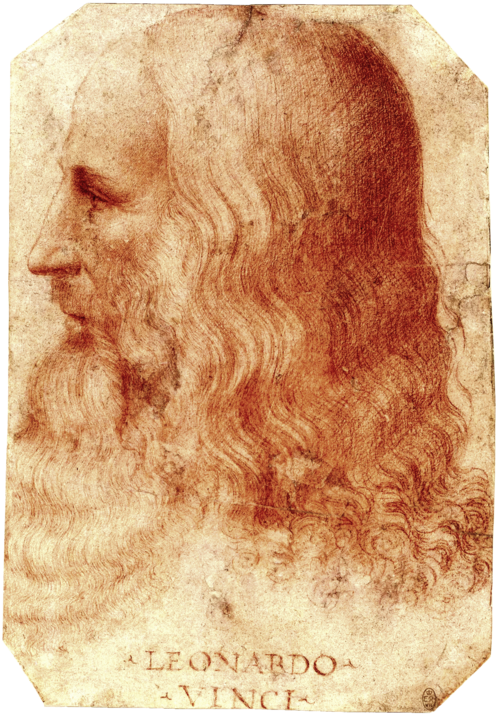
Leonardo da Vinci (1452–1519) was an Italian Renaissance painter, inventor and investigator, creator of the Mona Lisa and The Last Supper. His thousands of notebook pages on anatomy, mechanics, water and flight have made him the archetype of the Renaissance 'universal man'.
- Birthplace
- Vinci (or nearby Anchiano), Tuscany
- Place of death
- Clos Lucé, Amboise, France
- Nationality
- Republic of Florence (Italy)
Origins and training
Leonardo was born on 15 April 1452 in or near Vinci in Tuscany, the illegitimate son of Ser Piero da Vinci, a Florentine notary, and Caterina, a young peasant woman. 'Da Vinci' is not a surname but means 'from Vinci'. His illegitimacy kept him from a formal Latin education and from following his father's profession; he later called himself an 'unlettered man'.
Around the age of 14 he entered the workshop of Andrea del Verrocchio in Florence, one of the leading studios of the day, learning painting, sculpture, metal casting and mechanics. According to a story told by Vasari, after Leonardo painted an angel in his master's Baptism of Christ, Verrocchio gave up painting, outdone by his pupil. In 1472 he was enrolled in the Florentine painters' guild.
The Milan years
In 1482 Leonardo moved to Milan to serve Duke Ludovico Sforza. In his letter of introduction he stressed his skill at building bridges, siege engines and weapons, mentioning painting only at the end. At the Sforza court he staged festivities, studied architecture and hydraulics, and made a huge clay model of a horse for a monument to Francesco Sforza; the bronze set aside for it was used for cannon, and the model was destroyed when the French took Milan.
This period produced the Virgin of the Rocks and the mural The Last Supper (c. 1495–98) in the convent of Santa Maria delle Grazie, capturing the moment Jesus announces that one disciple will betray him. Leonardo used tempera and oil on dry plaster instead of true fresco, so the paint began flaking within decades; the latest major restoration took more than 20 years and ended in 1999.
The drawing Vitruvian Man (c. 1490), illustrating human proportions after the Roman architect Vitruvius, also dates from Milan and is now one of the most recognisable images in the world.
Florence, the Mona Lisa and wandering years
When the French took Milan in 1499, Leonardo left for Mantua and Venice, then returned to Florence. In 1502 he worked as military engineer for Cesare Borgia, producing a map of Imola of rare accuracy for its time.
Around October 1503 he began a portrait thought to be of Lisa Gherardini, wife of the merchant Francesco del Giocondo: the Mona Lisa, or La Gioconda. He never delivered it, keeping and reworking it for years. His sfumato technique, soft smoky transitions without hard outlines, creates the elusive smile. The painting is now in the Louvre; its global fame owes something to its theft in 1911 and recovery in 1913.
At the same time Florence commissioned him to paint the Battle of Anghiari in the Palazzo Vecchio, opposite Michelangelo's Battle of Cascina; neither was finished. He then returned to Milan (1506–13) and lived in Rome (1513–16) under the patronage of Giuliano de' Medici.
Final years in France
In 1516 King Francis I invited Leonardo to France and housed him at Clos Lucé near the royal château of Amboise, with the title 'first painter, engineer and architect to the king'. He brought the Mona Lisa and a few other paintings, along with his pupil Francesco Melzi.
Leonardo died at Clos Lucé on 2 May 1519, possibly of a stroke. Vasari's story that he died in the king's arms is doubted by many historians. Melzi inherited his manuscripts. He was buried at Amboise; the grave was damaged in later upheavals, and remains believed to be his now lie in the château's Chapel of Saint-Hubert.
Notebooks and scientific work
Leonardo left thousands of notebook pages (estimates of what survives range from over 4,000 to about 7,000 sheets, only part of his output), written in mirror script from right to left, perhaps because he was left-handed. Famous collections include the Codex Atlanticus in Milan, the Codex Leicester (bought by Bill Gates in 1994) and the drawings in the Royal Collection at Windsor.
He dissected human corpses to draw bones, muscles, the heart and the foetus with accuracy far ahead of his time, and studied flowing water, geology, optics and the flight of birds. His drawings of flapping-wing machines, an 'aerial screw' resembling a helicopter, a parachute and an armoured vehicle are often cited, though most stayed on paper and many could not have worked with the technology of the day.
Because the notebooks were never published, many of his findings had no influence on the science of his time; they were studied systematically only from the 19th century.
Assessment and legacy
Only some 15–20 paintings are accepted by scholars as Leonardo's, but they transformed European painting through pyramidal composition, sfumato, aerial perspective and the study of emotion in faces. Raphael and other High Renaissance painters learned from him directly.
Contemporaries criticised his habit of leaving projects unfinished, and his stature as an 'inventor' is sometimes inflated in popular culture. The attribution of some works is disputed, notably Salvator Mundi, sold at auction in 2017 for about US$450.3 million, a record for a painting, though many experts believe much of it is workshop production.
In 2019 many countries marked the 500th anniversary of his death, and the Louvre staged its largest-ever Leonardo exhibition.
Connections with Vietnam and Japan
In Vietnam, Leonardo and the Mona Lisa appear in art and world-history textbooks on the Renaissance, and Dan Brown's novel The Da Vinci Code (translated into Vietnamese) helped make his name familiar to younger readers, although its story is fiction.
In Japan, the Mona Lisa was lent by France to the Tokyo National Museum in 1974, where it drew enormous crowds. Full-size reproductions of The Last Supper are displayed in some Japanese museums, and his name appears in countless books, films and anime.
Japanese corner
Japanese name: レオナルド・ダ・ヴィンチ, often shortened to ダ・ヴィンチ.
Vocabulary: 万能の人 (bannō no hito, universal man), ルネサンス (runesansu, Renaissance), 最後の晩餐 (saigo no bansan, The Last Supper), 手稿 (shukō, manuscript), 鏡文字 (kagami-moji, mirror writing), 解剖学 (kaibōgaku, anatomy), 遠近法 (enkinhō, perspective), 微笑 (bishō, smile).


