
Arts & culture · Famous people of the world
William Shakespeare ウィリアム・シェイクスピア
うぃりあむ・しぇいくすぴあ
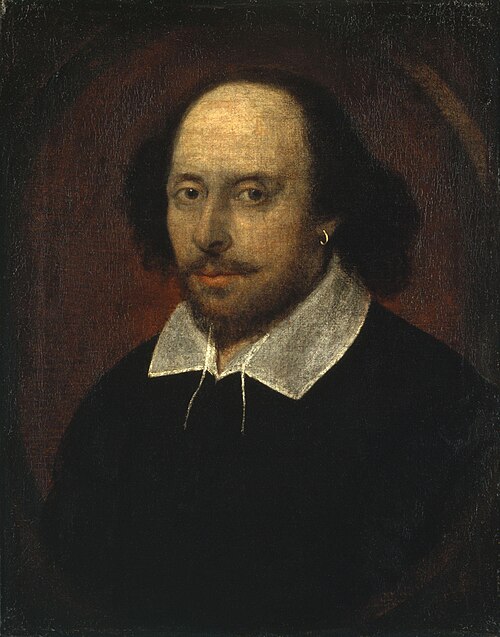
William Shakespeare (1564–1616) was an English playwright, poet and actor, widely regarded as the greatest writer in the English language. He left about 39 plays, 154 sonnets and three long narrative poems, including Romeo and Juliet, Hamlet, Othello, King Lear and Macbeth; his plays have been translated into every major language and are performed more often than those of any other playwright.
- Birthplace
- Stratford-upon-Avon, Warwickshire, England
- Nationality
- English
- Field
- Drama, poetry; acting
Origins and family
Shakespeare was baptised on 26 April 1564 in Stratford-upon-Avon, a market town in the English Midlands. His exact birth date is not recorded; by tradition it is marked on 23 April. His father, John Shakespeare, was a glover who held office on the town council; his mother, Mary Arden, came from a prosperous farming family.
He very probably attended Stratford's grammar school, where pupils studied Latin and classical authors such as Ovid, an influence clearly visible in his later verse. He did not go to university.
In 1582, aged 18, he married Anne Hathaway, eight years his senior. They had three children: Susanna (1583) and the twins Hamnet and Judith (1585). Hamnet died in 1596 at the age of 11.
The 'lost years' and the London career
From about 1585 to 1592 almost nothing is recorded of Shakespeare; scholars call these the 'lost years', and theories abound (schoolmaster, service in a noble household and so on), none proven. By 1592 he was well enough known in the London theatre to be mocked by the writer Robert Greene as an 'upstart crow'.
When the playhouses closed for plague (1592–1594) he wrote two long poems, Venus and Adonis and The Rape of Lucrece, dedicated to the Earl of Southampton. From 1594 he was an actor, writer and part-owner of the Lord Chamberlain's Men, which in 1599 built the Globe Theatre on the south bank of the Thames.
In 1603 James I came to the throne and became the company's patron, renaming it the King's Men. Shakespeare prospered and bought New Place, one of the largest houses in Stratford. Around 1613 he retired there; he died on 23 April 1616 and was buried in Holy Trinity Church.
Periods of his work
In his early period, up to the mid-1590s, Shakespeare wrote mainly comedies and histories: Richard III, the Henry VI plays, A Midsummer Night's Dream and The Merchant of Venice, as well as the tragic love story Romeo and Juliet. His history plays about English kings did much to shape the English sense of their national past.
Around 1600–1608 came the great tragedies: Hamlet, Othello, King Lear and Macbeth, along with Julius Caesar and Antony and Cleopatra, plays that probe ambition, jealousy, power, doubt and death more deeply than any others.
In his final period he wrote tragicomedies or 'romances' such as Cymbeline, The Winter's Tale and The Tempest, centred on forgiveness and reconciliation; some late plays were written with collaborators such as John Fletcher. He also left 154 sonnets, published in 1609, many addressed to a young man and a mysterious 'Dark Lady'.
Language and art
Shakespeare's plays are written mostly in blank verse (unrhymed iambic pentameter), with prose for everyday scenes and lower-class characters. He mixed tragedy and comedy, the sublime and the bawdy within a single play, and created characters with complex inner lives who think aloud in famous soliloquies.
His influence on English is immense. Many words and phrases are first recorded in his works and remain in use, such as 'break the ice', 'wild-goose chase' and 'the green-eyed monster' for jealousy. Linguists note, however, that many may have existed earlier and simply survive first in his plays.
Reputation, legacy and debates
In 1623, seven years after his death, his fellow actors John Heminges and Henry Condell published the First Folio, containing 36 plays; without it about half of them might have been lost. In a prefatory poem the dramatist Ben Jonson praised him as 'not of an age, but for all time'.
Shakespeare's reputation rose sharply from the eighteenth century and reached near-worship in the Romantic era. Today his plays are staged constantly around the world and adapted into films, operas, ballets and musicals (West Side Story is based on Romeo and Juliet). A reconstruction of the Globe opened near the original site in London in 1997.
Because so few personal records survive, much of his private life, including his religion, sexuality and appearance, remains a matter of speculation. Since the nineteenth century there has also been an 'authorship question', proposing that others (such as Francis Bacon or the Earl of Oxford) wrote the plays; mainstream scholarship, however, holds that Shakespeare of Stratford was the author.
Connections with Vietnam and Japan
In Vietnam, Romeo and Juliet and Hamlet are among the best-known works of foreign literature and appear in school literature courses; an extract from Romeo and Juliet has featured in Vietnamese literature textbooks. Many of the plays have been translated into Vietnamese and staged by Vietnamese drama theatres.
In Japan his name was sometimes abbreviated as 沙翁 (Sa-ō) in the Meiji era. The first complete translation of a play was Kawashima Keizō's Julius Caesar, serialised in an Osaka newspaper in 1883. Tsubouchi Shōyō later translated the complete plays, followed by complete translations by Odashima Yūshi and Matsuoka Kazuko. Kurosawa Akira turned Macbeth into Throne of Blood (1957) and King Lear into Ran (1985), both set in Japan's Warring States period.
Japanese corner
Japanese name: ウィリアム・シェイクスピア (also written シェークスピア). Play titles: ロミオとジュリエット (Romeo and Juliet), ハムレット (Hamlet), 四大悲劇 (shidai higeki, the four great tragedies), 夏の夜の夢 (A Midsummer Night's Dream).
Vocabulary: 劇作家 (gekisakka, playwright), 戯曲 (gikyoku, play), 悲劇 (higeki, tragedy), 喜劇 (kigeki, comedy), 独白 (dokuhaku, soliloquy), 翻訳 (hon'yaku, translation), 上演 (jōen, staging). Famous line: 生きるべきか死ぬべきか、それが問題だ。 – To be, or not to be.
生きるべきか死ぬべきか、それが問題だ。(『ハムレット』第3幕第1場)
— William Shakespeare

