
Eras & science · The world of dinosaurs
Fossil 化石
かせき
Fossils are the preserved remains or traces of ancient life in rock, such as bones, teeth, shells, footprints or eggs. Fossils are how we know dinosaurs existed and what they looked like.
- Main types
- Body fossils; trace fossils (footprints, nests, dung)
- Typically found in
- Sedimentary rock (sandstone, shale, limestone)
- Dating
- Radiometric dating of nearby volcanic layers
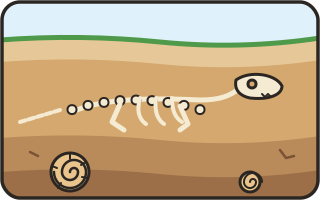
How fossils form
When an animal dies, its flesh usually rots or is eaten. If the body is buried quickly by mud or sand, hard parts like bones and teeth can survive. Over millions of years, minerals in groundwater seep in and gradually replace the bone material, turning it to stone.
Because special conditions are needed, only a tiny fraction of living things ever become fossils.
Kinds of fossils
Body fossils include bones, teeth, shells and sometimes skin and feather impressions. Trace fossils record behaviour: footprints show whether dinosaurs walked fast or slow, alone or in herds; eggs and nests reveal parenting; fossil dung shows what they ate. Amber can even preserve insects, and once a feathered piece of dinosaur tail.
In Japan
Japan has several famous fossil sites: the Katsuyama dinosaur quarry and the Fukui Prefectural Dinosaur Museum, Mukawa in Hokkaido where Kamuysaurus was found, and Iwaki in Fukushima, home of Futabasaurus. Some places let visitors try fossil digging.
Vocabulary corner
Japanese: 化石 (fossil), 足跡化石 (fossil footprint), 堆積岩 (sedimentary rock), こはく (amber), 発掘体験 (fossil-dig experience).
Vietnamese: hoá thạch (fossil), hoá thạch dấu chân (fossil footprint), đá trầm tích (sedimentary rock), hổ phách (amber), trải nghiệm đào hoá thạch (fossil-dig experience).