
Core ideas · Mathematics
Set (mathematics) 集合
しゅうごう
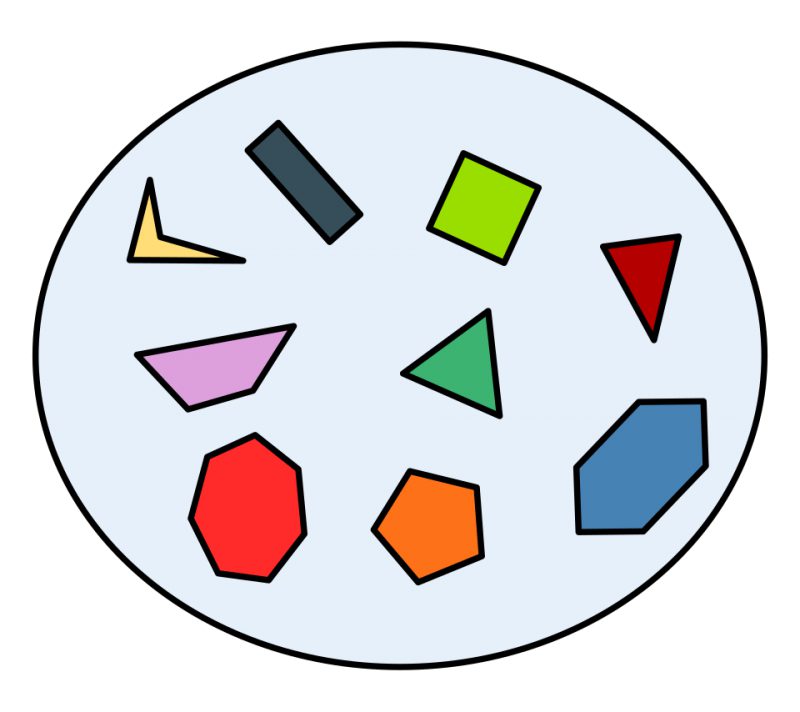
A set is a well-defined collection of objects called elements, such as the even numbers or the students in a class. Set theory is the foundation of modern mathematics.
- Founder
- Georg Cantor (19th century)
- Visual tool
- Venn diagram
Elements and notation
A = {1, 2, 3} is a set with three elements; 2 ∈ A means 2 belongs to A. Sets can be described by listing or by a property, such as "natural numbers less than 4".
Set operations
The union A ∪ B contains elements in A or B; the intersection A ∩ B those in both. If A is students who like football and B those who like badminton, A ∩ B is those who like both.
Venn diagrams
John Venn used overlapping circles to picture sets: the overlap is the intersection and the whole shape the union. Venn diagrams are common in survey problems and logic.
Foundation of mathematics
Numbers, functions and geometry can all be defined using sets. In the early 20th century Russell's paradox showed naive set theory leads to contradictions, prompting rigorous axiom systems such as ZFC.
Japanese – English terms
Key terms (Japanese – English – Vietnamese): 集合 (しゅうごう) – set – tập hợp; 要素 (ようそ) – element – phần tử; 部分集合 (ぶぶんしゅうごう) – subset – tập con; 和集合 (わしゅうごう) – union – hợp; 共通部分 (きょうつうぶぶん) – intersection – giao; 空集合 (くうしゅうごう) – empty set – tập rỗng; ベン図 (ベンず) – Venn diagram – biểu đồ Venn.