
Sport · 日本名人
Ichiro Suzuki 鈴木一朗
すずき いちろう
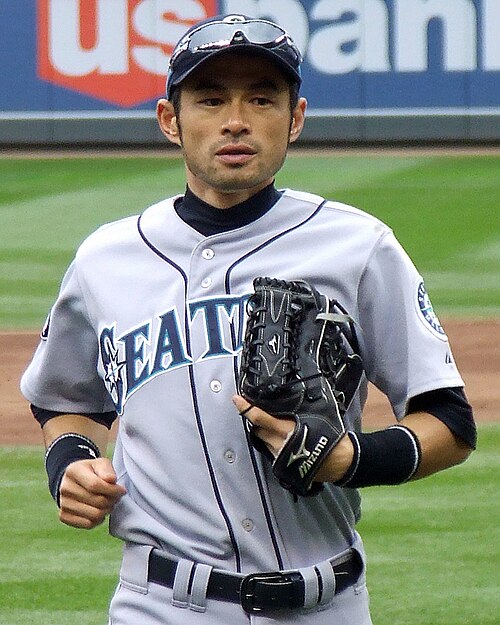
Ichiro (Suzuki Ichirō, born 1973) is a Japanese baseball player and one of the greatest hitters in history. After nine seasons with Orix and seven straight batting titles, he joined MLB in 2001, winning Rookie of the Year and MVP together, set the single-season record of 262 hits (2004) and reached 3,000 hits. In 2025 he became the first Asian player elected to the US Baseball Hall of Fame, one vote short of unanimity.
- Hometown
- Toyoyama, Nishikasugai District, Aichi
- Position
- Right fielder; bats left, throws right
- Teams
- Orix BlueWave (1992–2000), Seattle Mariners (2001–12, 2018–19), New York Yankees (2012–14), Miami Marlins (2015–17)
Childhood and school years
Suzuki Ichirō was born on 22 October 1973 in Toyoyama, Aichi, near Nagoya. From the third grade he practised every day with his father, Nobuyuki: catch and throwing in the park after school, and batting-cage sessions almost every evening, a story later held up as a model of daily effort.
He attended Aikōdai Meiden High School in Nagoya, a baseball powerhouse, and played twice at the national Kōshien tournament. Despite his hitting, his slight build meant Orix BlueWave picked him only in the fourth round of the 1991 draft.
Star in Japan
In his first two seasons with Orix (1992–93) Ichiro was mostly in the minors because the manager disliked his unusual pendulum (furiko) swing. In 1994 new manager Akira Ōgi promoted him and registered him under the katakana name "イチロー" instead of the common surname Suzuki. That year he collected 210 hits, the first 200-hit season in Japanese professional baseball, and became a national sensation.
From 1994 to 2000 he won seven straight Pacific League batting titles and three straight league MVPs (1994–96). In 1995, after the Great Hanshin–Awaji earthquake devastated Kobe, Orix won the Pacific League under the slogan "Ganbarō Kobe", then took the Japan Series in 1996. In nine seasons he recorded 1,278 hits and a .353 average in Japan.
Conquering MLB
In 2001, via the posting system, Ichiro joined the Seattle Mariners as the first Japanese position player to play regularly in MLB. Many doubted a player under 80 kg could handle American pitching, but in his first season he led the AL with a .350 average and 56 steals, winning both Rookie of the Year and MVP, a feat previously achieved only by Fred Lynn (1975). The Mariners won a record-tying 116 games.
In 2004 he collected 262 hits, breaking George Sisler's 84-year-old record of 257 (1920). He had at least 200 hits in ten straight seasons (2001–10), playing in the All-Star Game and winning a Gold Glove in each of them thanks to his strong arm and right-field defence.
Traded to the New York Yankees in mid-2012, he joined the Miami Marlins in 2015. On 7 August 2016 he recorded his 3,000th MLB hit, a triple at Coors Field, Denver, becoming the 30th player to reach the mark.
National team and retirement
Ichiro was a mainstay of the Japanese teams that won the first two World Baseball Classics in 2006 and 2009. In the 2009 final against South Korea, his tenth-inning single drove in the two decisive runs after a tournament in which he had struggled.
In 2018 he returned to the Mariners, mainly as special assistant to the chairman. He played his last games in the 2019 season-opening series against the Oakland Athletics at the Tokyo Dome and announced his retirement on the night of 21 March 2019, aged 45, before a home crowd. He has since continued working for the Mariners and often coaches school teams in Japan.
Style and approach
Ichiro epitomised "small ball": precise contact hitting, speed, many infield hits, base stealing and superb defence, at a time when MLB prized home runs. His 2001 "laser beam" throw from right field to third base became a classic play.
He was known for near-ritual preparation: pointing his bat at the pitcher before each at-bat, and following the same stretching, eating and training routines every day for years. He often spoke of piling up small things as the only way to reach great ones, an idea widely quoted in Japanese education and business.
Legacy and honours
Ichiro proved that an Asian hitter without great size could dominate MLB, paving the way for later Japanese stars such as Shohei Ohtani. His combined total of 4,367 hits in Japan and MLB exceeds Pete Rose's MLB record of 4,256, although combining two leagues remains controversial.
In January 2025 he was elected to the National Baseball Hall of Fame in his first year of eligibility with 393 of 394 votes (99.7%), one short of unanimity, becoming the first Asian-born inductee. The Mariners also retired his number 51. In Japan the government offered him the People's Honour Award three times (2001, 2004, 2019), and he declined each time, saying he was still playing or did not yet deserve it.
Japanese corner
Real name 鈴木一朗 (Suzuki Ichirō); playing name in katakana, イチロー. 一朗 combines 一 (one, often used for a first son) and 朗 (bright, cheerful). Writing a name in katakana gives it a modern, brand-like feel.
Vocabulary: 野球 (yakyū, baseball), 安打 (anda, hit), 首位打者 (shuidasha, batting champion), 打率 (daritsu, batting average), 盗塁 (tōrui, stolen base), 新人王 (shinjin-ō, rookie of the year), 殿堂入り (dendō-iri, Hall of Fame induction), 引退 (intai, retirement), 国民栄誉賞 (Kokumin Eiyoshō, People's Honour Award).


