Science · 世界名人
Archimedes アルキメデス
あるきめです
Archimedes of Syracuse (c. 287 – 212 BC) was a Greek mathematician, physicist and engineer, often regarded as the greatest mathematician of antiquity. He approximated π, found the volume and surface area of the sphere, and founded hydrostatics (Archimedes' principle) and the theory of the lever. He was killed by a Roman soldier when Syracuse fell.
- Birthplace
- Syracuse, Sicily (now Italy)
- Father
- Phidias, an astronomer
- Fields
- Mathematics, physics, astronomy, engineering
Life
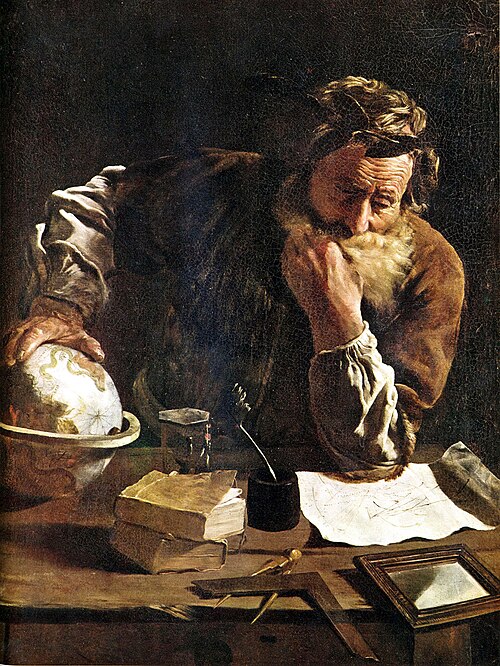
Archimedes was born around 287 BC in Syracuse, a wealthy Greek city on Sicily. What we know of his life comes mainly from writers centuries later — Polybius, Plutarch, Livy, Cicero — so many details are anecdotal. In The Sand Reckoner he names his father as the astronomer Phidias.
He probably studied in Alexandria, the intellectual centre of the Hellenistic world, with Euclid's successors. Back in Syracuse he kept sending results to mathematicians in Alexandria such as Conon of Samos and Eratosthenes, once deliberately including two false theorems to test them.
He was close to — and according to Plutarch related to — King Hiero II of Syracuse, who asked him to turn theory into practical machines, from pulley systems for hauling ships to defensive weapons.
Mathematical achievements
In Measurement of a Circle he used inscribed and circumscribed polygons of up to 96 sides to show that π lies between 3 10/71 and 3 1/7 (about 3.1408 to 3.1429). The familiar value 22/7 comes from this.
In On the Sphere and Cylinder he proved that a sphere's volume and surface area are both two-thirds of those of its circumscribing cylinder — the result he prized most, wanting a sphere in a cylinder carved on his tomb. He also found the area of a parabolic segment and studied the spiral now named after him and solids of revolution.
His refinement of the method of exhaustion — approximating a figure by ever closer simple shapes — anticipated integral calculus by nearly two thousand years. In The Sand Reckoner he devised a system for naming huge numbers to estimate how many grains of sand would fill the universe.
Physics: levers and floating bodies
In On the Equilibrium of Planes he proved the law of the lever geometrically and found the centres of gravity of many figures. The saying attributed to him — "Give me a place to stand and I will move the Earth" — is recorded in various forms by ancient writers such as Pappus. Plutarch says he used compound pulleys to haul a fully laden ship single-handed.
In On Floating Bodies he stated the principle that bears his name: a body immersed in a fluid is buoyed up by a force equal to the weight of the fluid it displaces. It is the foundation of hydrostatics, explaining why ships float and underpinning density measurement.
The most famous anecdote, told by the Roman architect Vitruvius, says King Hiero suspected a goldsmith of mixing silver into a gold crown. Archimedes saw how to test it when he stepped into a bath and the water rose, and ran through the streets shouting "Eureka!" ("I have found it!"). Scholars think the bath detail is probably embellished, and that if he tested the crown he more likely used a hydrostatic balance based on his principle.
Engineer and the siege of Syracuse
Archimedes is credited with the screw that bears his name — a helical tube turned about an axis to lift water — a principle still used in pumps and conveyors. He also built a planetarium-like sphere showing the motions of the Sun, Moon and planets, described by Cicero.
In the Second Punic War Syracuse sided with Carthage and was attacked by Roman forces under Marcellus from 214 BC, with the siege lasting until 212 BC. According to Polybius and Plutarch, Archimedes' machines — catapults and cranes with iron grapples (the "Claw") that lifted and capsized ships — terrified the Romans. The story of mirrors focusing sunlight to burn Roman ships appears only in much later sources, and modern experiments suggest it was hardly practical.
Death and tomb
In 212 BC, after about two years of siege, Syracuse fell. Plutarch gives several versions of Archimedes' death; the best known says he was absorbed in a geometric diagram when a Roman soldier burst in and killed him. The line "do not disturb my circles" appears in no ancient source; the closest is Valerius Maximus (1st century AD), with different wording. Marcellus, who had ordered him spared, is said to have mourned him.
As he wished, his tomb bore a sphere inscribed in a cylinder. In 75 BC Cicero, serving in Sicily, found the overgrown tomb by this carving and had it cleared.
Legacy and the Archimedes Palimpsest
His works were translated into Arabic and medieval Latin and deeply influenced Renaissance scientists such as Galileo and Kepler; Galileo called him "superhuman" and "my master". Many historians rank him with Newton and Gauss among the three greatest mathematicians. The Fields Medal, mathematics' most prestigious prize, bears his portrait.
In 1906 the Danish scholar Johan Ludvig Heiberg identified in Constantinople a thirteenth-century prayer book written over a tenth-century copy of Archimedes' works, including The Method, thought lost. It shows that he found results by "mechanical" reasoning — weighing thin slices of figures — before proving them geometrically. The Archimedes Palimpsest was auctioned in 1998 and recovered with multispectral imaging by American researchers in the 2000s.
Connections with Vietnam and Japan
Vietnamese students meet him in lower-secondary physics in the lesson on "Lực đẩy Ác-si-mét" (Archimedes' buoyant force), using a spelling based on the French Archimède. The Eureka story is also common in children's books.
In Japan Archimedes' principle is taught in junior-high science. Mita Norifusa's manga Archimedes no Taisen ("Archimedes' Great War"), filmed in 2019, borrows his name for the story of a mathematical genius in the Imperial Japanese Navy before World War II.
Japanese corner
His name is written アルキメデス.
Key words: アルキメデスの原理 (Archimedes' principle), 浮力 (buoyancy), てこの原理 (principle of the lever), 支点 (fulcrum), 円周率 (pi), 体積 (volume), 数学者 (mathematician), エウレカ/ユリイカ (Eureka).