
Science · 世界名人
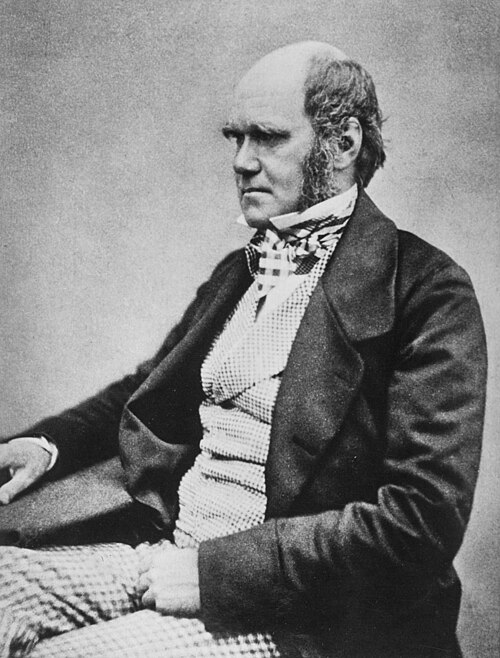
Charles Darwin ダーウィン
だーうぃん
Charles Darwin (1809 – 1882) was an English naturalist who proposed the theory of evolution by natural selection. His voyage around the world on HMS Beagle (1831 – 1836) gave him key observations, and On the Origin of Species (1859) transformed our understanding of life. Evolution is now the foundation of all modern biology.
- Birthplace
- Shrewsbury, Shropshire, England
- Education
- University of Edinburgh (medicine, unfinished); Christ's College, Cambridge
- Fields
- Natural history, geology, biology
Early life
Charles Robert Darwin was born on 12 February 1809 in Shrewsbury, England — the same day as Abraham Lincoln. His father, Robert Darwin, was a wealthy doctor; his grandfather Erasmus Darwin was a naturalist and poet with early ideas about evolution; his maternal grandfather was the potter Josiah Wedgwood. His mother died when he was eight.
In 1825 he went to Edinburgh to study medicine but was bored by lectures and could not bear surgery without anaesthesia, so he left. There he learned taxidermy and met naturalists. His father then sent him to Christ's College, Cambridge (1828), to prepare for the Anglican ministry. At Cambridge he became an avid beetle collector and was deeply influenced by the botanist John Stevens Henslow.
The Beagle voyage (1831 – 1836)
Through Henslow's recommendation, the 22-year-old Darwin joined the Royal Navy survey ship HMS Beagle as companion and naturalist to Captain Robert FitzRoy. The ship left Plymouth on 27 December 1831 and returned on 2 October 1836. The nearly five-year voyage mainly surveyed the South American coast before crossing the Pacific, Australia and the Indian Ocean. Darwin later called it "by far the most important event in my life".
He spent most of his time ashore: he collected fossils of extinct giant mammals in Argentina, witnessed an earthquake in Chile and saw the coast raised, and read Charles Lyell's Principles of Geology, which convinced him the Earth changes gradually over immense time.
In 1835, in the Galápagos Islands, he noted mockingbirds, giant tortoises and finches that differed from island to island. Only after returning and having experts classify his specimens did he grasp the significance. His journal, published in 1839 as The Voyage of the Beagle, made his name as a scientist and travel writer.
Developing natural selection
From 1837 Darwin kept secret notebooks on the "transmutation of species". In 1838, reading Thomas Malthus's Essay on the Principle of Population — which argued that population outstrips food, causing a struggle for existence — he hit on the key idea: in that struggle favourable variations are preserved and accumulate over generations, while unfavourable ones are eliminated. This was natural selection.
In 1839 he married his cousin Emma Wedgwood; they had ten children. In 1842 the family moved to Down House in the village of Downe, Kent, where he lived and worked for the rest of his life. A chronic, hard-to-diagnose illness (stomach pains, vomiting, fatigue) kept him mostly at home. The death of his daughter Annie in 1851, aged ten, was a heavy blow that many scholars believe eroded his religious faith.
He drafted his theory in 1842 – 44 but delayed publication for nearly twenty years, partly fearing religious and social reaction and partly to amass evidence — including an eight-year study of barnacles and pigeon-breeding experiments.
Wallace and the Origin (1859)
In June 1858 Darwin received a letter from the young naturalist Alfred Russel Wallace, working in the Malay Archipelago, enclosing an essay setting out almost exactly the theory of natural selection. On the suggestion of Lyell and the botanist Joseph Hooker, Wallace's paper and extracts from Darwin's manuscripts were presented together at the Linnean Society in London on 1 July 1858.
Darwin hurried to write an abstract of his big book, and On the Origin of Species by Means of Natural Selection appeared on 24 November 1859; the first printing sold out at once. It argued that all species share common ancestry and change gradually through natural selection, drawing on evidence from breeding, biogeography, fossils and embryology.
The book caused fierce debate, most famously the 1860 Oxford exchange between Bishop Samuel Wilberforce and the biologist Thomas Huxley, "Darwin's bulldog". The Origin said almost nothing about humans; only in The Descent of Man (1871) did Darwin argue that humans too evolved from ancestors shared with other primates.
Later years
At Down House he kept researching and publishing: on orchid pollination, insectivorous and climbing plants, the expression of emotions in humans and animals (1872), and a final book on earthworms and soil formation (1881) that sold as well as the Origin. He received the Copley Medal, the Royal Society's highest honour, in 1864.
Darwin died at Down House on 19 April 1882, aged 73. He wished to be buried at Downe, but at the request of colleagues and members of Parliament he was given a state funeral in Westminster Abbey, near Isaac Newton.
Assessment and legacy
By Darwin's death most scientists accepted that species evolve, but the central role of natural selection was firmly established only in the 1930s and 1940s, when the "modern synthesis" joined Darwinism with Mendelian genetics. Today, with evidence from fossils, comparative anatomy and above all DNA, evolution is the unifying principle of biology; as the geneticist Theodosius Dobzhansky wrote, nothing in biology makes sense except in the light of evolution.
His theory was also misused: late nineteenth- and early twentieth-century "social Darwinism" and eugenics applied the idea of the "survival of the fittest" — a phrase coined by Herbert Spencer — to justify inequality, colonialism and racism, ideas modern science rejects. In some places teaching evolution in schools remains contested on religious grounds.
Connections with Vietnam and Japan
In Vietnam Darwin's theory is taught in high-school biology. In the early twentieth century, social-Darwinist ideas of the "struggle for survival" — reaching Vietnam mainly through Chinese "new books" such as Yan Fu's translation of Huxley, Tianyan lun — influenced patriotic scholars such as Phan Bội Châu and Phan Châu Trinh, spurring calls for reform so that the nation would not be "eliminated".
In Japan evolution was introduced by the American zoologist Edward S. Morse in lectures at the University of Tokyo from 1877 and was quickly taken up by Meiji intellectuals. Terms such as 適者生存 (survival of the fittest) and 自然淘汰 (natural selection) entered Japanese and spread from there into Chinese and Vietnamese.
Japanese corner
His name is written ダーウィン, in full チャールズ・ダーウィン.
Key words: 進化論 (theory of evolution), 自然選択/自然淘汰 (natural selection), 適者生存 (survival of the fittest), 種の起源 (On the Origin of Species), 博物学者 (naturalist), 化石 (fossil), 突然変異 (mutation), 共通祖先 (common ancestor).
文中词汇
- ダーウィンDarwin (a city in Australia)
- 進化論しんかろんevolutionary theory; theory of evolution
- 自然選択しぜんせんたくnatural selection
- 自然淘汰しぜんとうたnatural selection
- 適者生存てきしゃせいぞんsurvival of the fittest
- 種の起源しゅのきげんOn the Origin of Species (Charles Darwi…
- 博物学者はくぶつがくしゃnaturalist; natural historian
- 化石かせきfossil
- ガラパゴス諸島ガラパゴスしょとうthe Galapagos Islands
- 共通祖先きょうつうそせんcommon ancestor
- 突然変異とつぜんへんいmutation

