
Dinosaurs · 恐龙世界
Archaeopteryx 始祖鳥
しそちょう
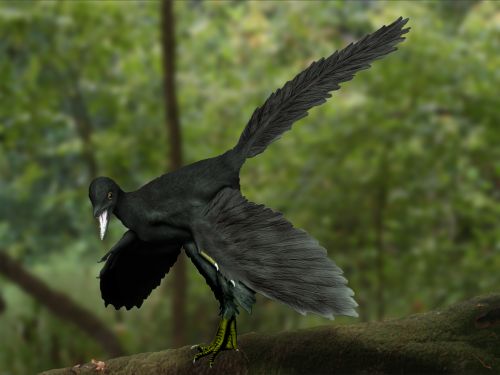
Archaeopteryx was a part-bird, part-dinosaur animal from the Late Jurassic, with feathers and wings like a bird but also teeth, clawed fingers and a long bony tail. It is famous evidence for the link between dinosaurs and birds.
- Length
- about 50 cm
- Estimated weight
- about 0.5–1 kg
- Diet
- Small animals, insects
Discovery and name
In 1861, just two years after Darwin published On the Origin of Species, a skeleton with feather impressions was found in fine-grained limestone in Germany. About a dozen specimens are now known, the most famous being the "Berlin" and "London" specimens.
Body and features
It was about the size of a raven. Its wing feathers were shaped like the flight feathers of modern birds, yet its skeleton closely resembled small dinosaurs such as Velociraptor, with toothed jaws, three clawed fingers and a long bony tail.
How it lived
It could probably fly or glide short distances, though not as well as modern birds. Its home was then a chain of tropical islands in a warm, shallow sea.
Vocabulary corner
Japanese: 始祖鳥 (Archaeopteryx (first bird)), 翼 (wing), 羽毛 (feather), 石灰岩 (limestone), 進化 (evolution).
Vietnamese: thuỷ tổ chim (Archaeopteryx (first bird)), cánh (wing), lông vũ (feather), đá vôi (limestone), tiến hoá (evolution).