
Eras & science · 恐龙世界
Palaeontology 古生物学
こせいぶつがく
Palaeontology is the science of prehistoric life, studied through fossils. Palaeontologists work out what dinosaurs and other ancient organisms looked like, how they lived and how they evolved.
- Founders
- Georges Cuvier (France), Mary Anning (England) and others
- Related fields
- Geology, biology, evolution
- Modern tools
- CT scanning, computer modelling, chemical analysis
History
In the early 1800s French scientist Georges Cuvier showed that some animals had gone extinct. In 1842 Richard Owen in England coined "Dinosauria", meaning "terrible lizards". In the late 1800s the "Bone Wars" between Marsh and Cope in the US led to dozens of new dinosaurs being named.
What palaeontologists do
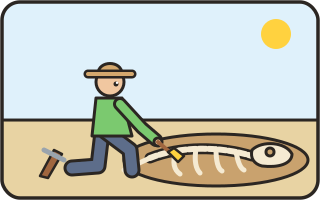
They search for fossils in the field, excavate them carefully, then clean and study them in the lab. Today they use CT scanners to look inside skulls, microscopes to read growth rings in bone (like tree rings) to tell an animal's age, and computers to simulate how dinosaurs moved.
In Japan
Japan has several dinosaur research centres, including the Fukui Prefectural Dinosaur Museum, one of the largest dinosaur museums in Asia, and the Hokkaido University Museum, where Kamuysaurus was studied. Many important Japanese finds began with amateur collectors.
Vocabulary corner
Japanese: 古生物学 (palaeontology (paleontology)), 古生物学者 (palaeontologist), 恐竜 (dinosaur), 成長線 (growth line), 研究室 (laboratory).
Vietnamese: cổ sinh vật học (palaeontology (paleontology)), nhà cổ sinh vật học (palaeontologist), khủng long (dinosaur), vân tăng trưởng (growth line), phòng thí nghiệm (laboratory).