
Eras & science · 恐龙世界
Triassic 三畳紀
さんじょうき
The Triassic (about 252–201 million years ago) was the first period of the Mesozoic Era. The first dinosaurs, pterosaurs and mammals all appeared during it.
- Name means
- "three layers", after three rock units in Germany
- Typical life
- Early dinosaurs (Eoraptor, Herrerasaurus), ichthyosaurs, pterosaurs
- Key events
- Began after the Permian extinction; ended with the end-Triassic extinction
Overview
The Triassic began right after the end-Permian extinction, the greatest extinction in Earth's history, which wiped out roughly 90% of marine species. Life had to rebuild, opening the way for new groups.
Earth at the time
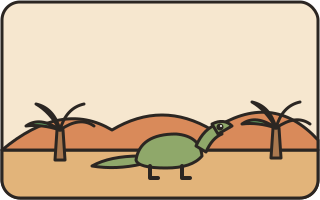
The continents were joined in a single supercontinent, Pangaea. The climate was hot and dry, with deserts across the interior. There were no flowering plants yet; ferns, conifers and cycads dominated.
The first dinosaurs
The first dinosaurs appeared about 230 million years ago as small, two-legged animals such as Eoraptor from Argentina. At first they were not in charge; crocodile relatives were more dominant. The end-Triassic extinction removed many rivals, letting dinosaurs rise in the Jurassic.
In Japan
A notable Triassic fossil from Japan is the ichthyosaur Utatsusaurus from Miyagi Prefecture, one of the oldest ichthyosaurs in the world.
Vocabulary corner
Japanese: 三畳紀 (Triassic), 中生代 (Mesozoic Era), 超大陸 (supercontinent), 大量絶滅 (mass extinction), 哺乳類 (mammal).
Vietnamese: kỷ Tam Điệp (Triassic), Đại Trung Sinh (Mesozoic Era), siêu lục địa (supercontinent), đại tuyệt chủng (mass extinction), động vật có vú (mammal).