
Eras & science · 恐龙世界
Cretaceous–Paleogene extinction 白亜紀末の大量絶滅
はくあきまつのたいりょうぜつめつ
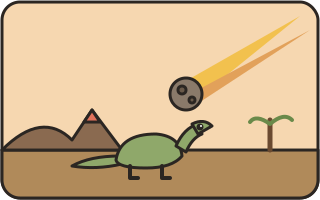
About 66 million years ago an asteroid roughly 10 km wide struck Mexico's Yucatán Peninsula, triggering a mass extinction that wiped out about three quarters of Earth's species, including all non-bird dinosaurs.
- Main cause
- Asteroid impact (Chicxulub crater)
- Scale
- about 75% of species lost
- Notable victims
- Non-bird dinosaurs, pterosaurs, mosasaurs, plesiosaurs, ammonites
The evidence
In 1980 father and son Luis and Walter Alvarez found a thin worldwide clay layer rich in iridium, an element rare on Earth's surface but common in asteroids. In the early 1990s the Chicxulub crater, about 180 km across, was confirmed beneath the Yucatán Peninsula.
What happened
The impact caused wildfires, huge tsunamis and threw dust and sulphur gases into the sky. Sunlight was blocked for months to years, Earth cooled, plants stopped photosynthesising and food chains collapsed. Massive volcanic eruptions in India, the Deccan Traps, may have made matters worse.
After the disaster
Small animals that could eat many foods or burrow had better chances. Afterwards mammals diversified rapidly and filled the space left by dinosaurs, eventually leading to humans tens of millions of years later. Dinosaurs did not vanish entirely: birds are their descendants.
Vocabulary corner
Japanese: 大量絶滅 (mass extinction), 小惑星 (asteroid), 衝突 (impact), クレーター (crater), 子孫 (descendant).
Vietnamese: đại tuyệt chủng (mass extinction), tiểu hành tinh (asteroid), va chạm (impact), hố va chạm (crater), hậu duệ (descendant).