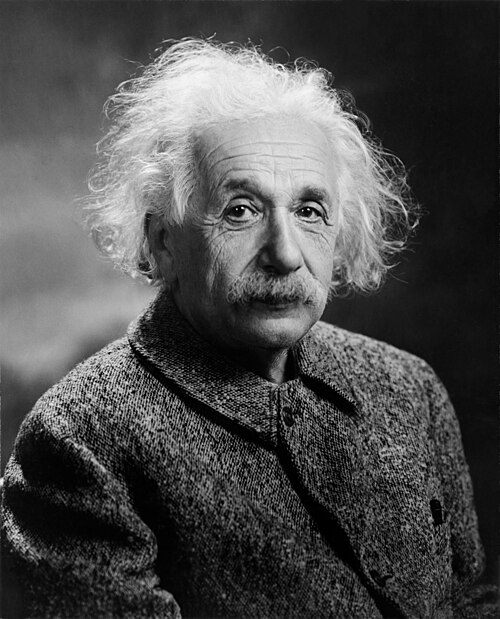
Famous people of the world
Max Planck プランク
ぷらんく
Max Planck (1858–1947) was a German theoretical physicist who originated quantum theory. In 1900, to explain black-body radiation, he assumed that energy is emitted in discrete packets, introducing the constant h that bears his name. He received the Nobel Prize in Physics in 1918.
- Birthplace
- Kiel (now Germany)
- Field
- Theoretical physics, thermodynamics
- Major achievements
- Planck's radiation law; Planck constant h; founding quantum theory
Life and career
Planck was born in Kiel into a family of scholars and grew up in Munich. When he chose physics, a professor reportedly told him the field had little left to discover; he went ahead anyway. From 1889 he taught at the University of Berlin for decades.
He was an early supporter of Einstein's relativity and helped bring Einstein to Berlin. As president of the Kaiser Wilhelm Society from 1930 he tried to protect German science under the Nazis; in 1933 he met Hitler to intercede for the Jewish chemist Fritz Haber, without success.
The energy quantum
By the late 19th century classical physics could not explain the spectrum of black-body radiation. On 14 December 1900 Planck presented a formula matching experiment, assuming that energy is exchanged only in multiples of hf (h a constant, f the frequency).
Planck himself first saw this as a mathematical device. In 1905 Einstein used it to explain the photoelectric effect, and Niels Bohr applied it to the atom, paving the way for quantum mechanics. Since 2019 the kilogram has been defined by a fixed value of the Planck constant.
Personal tragedy and legacy
Planck's private life was marked by loss: his first wife died early, his elder son was killed in the First World War and two daughters died in childbirth. His son Erwin was executed by the Nazis in 1945 for links to the 20 July 1944 plot against Hitler.
After the war the Kaiser Wilhelm Society was renamed the Max Planck Society, now one of the world's leading research networks. The European Space Agency's Planck satellite and the Planck units also bear his name.
In Vietnam and Japan
Vietnamese students meet the Planck constant (h ≈ 6.626 × 10⁻³⁴ J·s) in the grade 12 physics chapter on light quanta, with the photon energy formula ε = hf.
In Japan the same material appears in high-school physics, and many Japanese scientists have worked at Max Planck institutes in Germany.
Vocabulary corner
Name: Japanese マックス・プランク, Vietnamese Max Planck.
Vocabulary: 量子 (ryōshi, quantum), 量子論 (ryōshiron, quantum theory), プランク定数 (Puranku teisū, Planck constant), 黒体放射 (kokutai hōsha, black-body radiation), 振動数 (shindōsū, frequency), 光子 (kōshi, photon).