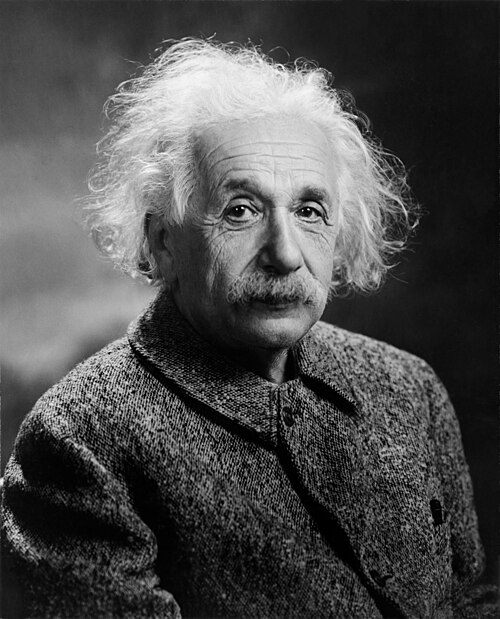
Famous people of the world
Niels Bohr ボーア
ぼーあ
Niels Bohr (1885–1962) was a Danish physicist who proposed the Bohr model of the atom in 1913, with electrons in fixed stationary orbits. His institute in Copenhagen was the centre where quantum mechanics took shape, and he won the Nobel Prize in Physics in 1922.
- Birthplace
- Copenhagen, Denmark
- Field
- Atomic physics, quantum mechanics
- Major achievements
- Bohr model; complementarity principle; Copenhagen interpretation
Life
Bohr was born in Copenhagen, the son of a physiology professor. He studied at the University of Copenhagen and then worked in England with J. J. Thomson in Cambridge and Ernest Rutherford in Manchester.
In 1921 he founded the Institute for Theoretical Physics in Copenhagen (now the Niels Bohr Institute), which attracted young physicists such as Heisenberg and Pauli. In 1943, at risk under the German occupation because of his mother's Jewish descent, he escaped to Sweden and then to Britain and the US, serving as an adviser to the Manhattan Project.
The atom and quantum mechanics
Building on Rutherford's nuclear atom and Planck's quantum, Bohr proposed in 1913 that electrons move only in orbits of fixed energy, emitting or absorbing light when they jump between them. The model explained the line spectrum of hydrogen.
He later formulated the principle of complementarity: light and matter show wave or particle properties depending on how they are observed. With Heisenberg he is associated with the Copenhagen interpretation of quantum mechanics, and his long debates with Einstein over the theory are a famous chapter of 20th-century science.
For an open world
After the Second World War Bohr worried about the nuclear arms race and in 1950 sent an 'Open Letter to the United Nations' calling for international cooperation and openness in science. He helped found CERN. The element bohrium (Bh, number 107) is named after him.
In Vietnam and Japan
Vietnamese students learn the 'Bo model' and Bohr's postulates in grade 10 chemistry and grade 12 physics to explain hydrogen's line spectrum.
In Japan, the physicist Nishina Yoshio worked at Bohr's institute in the 1920s and with Oskar Klein derived the Klein–Nishina formula. Back home he mentored the next generation, including Yukawa Hideki and Tomonaga Shin'ichirō. Bohr visited Japan in 1937.
Vocabulary corner
Name: Japanese ニールス・ボーア, Vietnamese Niels Bohr or Bo.
Vocabulary: 原子模型 (genshi mokei, atomic model), 電子 (denshi, electron), 軌道 (kidō, orbit), 量子力学 (ryōshi rikigaku, quantum mechanics), 相補性 (sōhosei, complementarity), スペクトル (supekutoru, spectrum).