
Atoms & bonds · Chemistry
Atom 原子
げんし
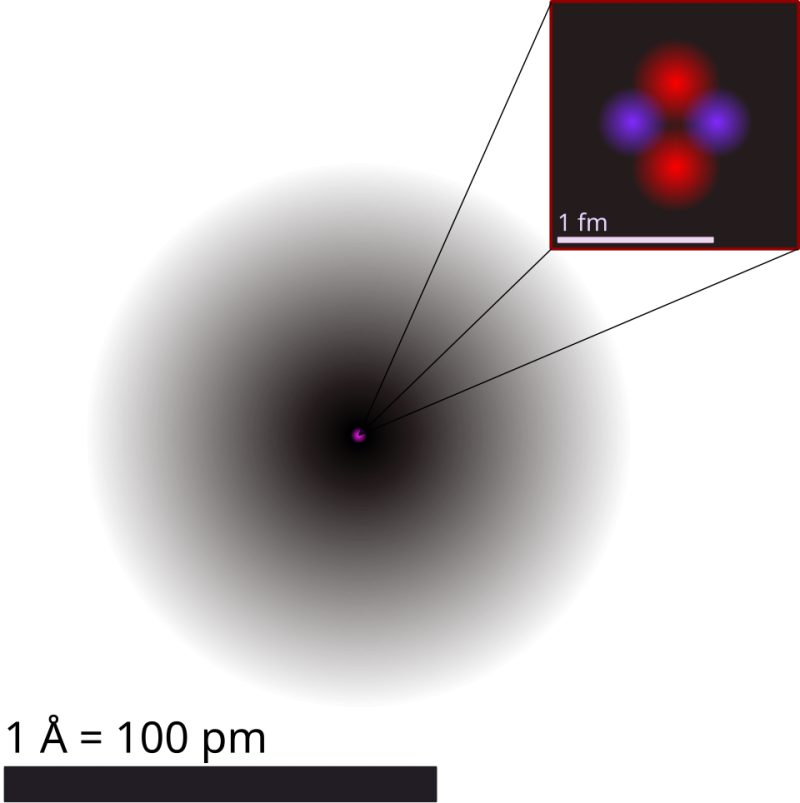
An atom is the smallest unit of a chemical element, made of a nucleus of protons and neutrons with electrons moving around it.
- Components
- Protons, neutrons, electrons
- Size
- About 0.1 nanometre
- Key models
- Dalton, Thomson, Rutherford, Bohr
What is an atom?
Everything around us, from a glass of water to the human body, is made of atoms. They are so small that hundreds of thousands lined up would match the width of a hair.
Each element, such as hydrogen, oxygen or iron, has its own kind of atom.
Structure of the atom
At the centre is a positive nucleus containing protons (charge +1) and neutrons (no charge). Around it are negatively charged electrons. An atom is neutral because it has equal numbers of protons and electrons.
The nucleus is tiny yet holds almost all the mass. If an atom were the size of a stadium, the nucleus would be like a pea at the centre.
Atomic number and mass number
The number of protons is the atomic number, which decides the element: an atom with 6 protons is always carbon. Mass number = protons + neutrons.
History of atomic models
In the early 19th century John Dalton pictured atoms as solid, indivisible spheres. J. J. Thomson discovered the electron (1897), Ernest Rutherford the nucleus (1911), and Niels Bohr proposed fixed electron orbits (1913). Today quantum mechanics describes electrons with orbitals.
Japanese – English terms
原子 (げんし) – atom; 原子核 (げんしかく) – atomic nucleus; 陽子 (ようし) – proton; 中性子 (ちゅうせいし) – neutron; 電子 (でんし) – electron; 原子番号 (げんしばんごう) – atomic number; 質量数 (しつりょうすう) – mass number.