
Eras & science · The world of dinosaurs
Dinosaurs and birds 恐竜と鳥
きょうりゅうととり
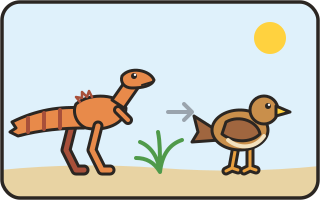
Modern science shows that birds are direct descendants of theropod dinosaurs, so birds are, in effect, living dinosaurs. Feathered dinosaur fossils from China since the 1990s have strongly confirmed this.
- Closest relatives
- Paravians (Velociraptor, Microraptor and others)
- Key fossils
- Archaeopteryx (1861), Sinosauropteryx (1996)
- Shared features
- Feathers, hollow bones, wishbone, egg-laying and brooding
History of the idea
Soon after Archaeopteryx was found in 1861, scientist Thomas Huxley noticed that birds closely resembled small dinosaurs. The idea fell out of favour for decades until John Ostrom revived it in the late 1960s after studying Deinonychus.
Feathered dinosaurs
In 1996 Sinosauropteryx from Liaoning, China, became the first non-bird dinosaur confirmed to have feathers. Dozens more followed: four-winged Microraptor, and Yutyrannus, a feathered tyrannosaur about 9 m long. Studies of pigment cells have even revealed colours, such as Sinosauropteryx's reddish-brown and white striped tail.
The dinosaurs around us
Chickens, ducks, sparrows and ostriches are all dinosaurs. Birds keep many ancestral traits: scaly legs, hollow bones, hard-shelled eggs and brooding. That is why scientists say "non-avian dinosaurs" when talking about the extinct ones.
Vocabulary corner
Japanese: 羽毛恐竜 (feathered dinosaur), 鳥類 (birds (Aves)), 非鳥類恐竜 (non-avian dinosaur), 祖先 (ancestor), 叉骨 (wishbone (furcula)).
Vietnamese: khủng long có lông vũ (feathered dinosaur), chim (lớp Chim) (birds (Aves)), khủng long không phải chim (non-avian dinosaur), tổ tiên (ancestor), xương chạc (wishbone (furcula)).