
Cells & genetics · Biology
The cell 細胞
さいぼう
The cell is the smallest unit of life. Every organism, from bacteria to humans, is made of one or more cells.
- Discovered
- Robert Hooke, 1665
- Two main types
- Prokaryotic and eukaryotic
Cell theory
In 1665 Robert Hooke looked at cork under a microscope and called the tiny compartments "cells". In the 19th century Schleiden, Schwann and Virchow completed cell theory: all living things are made of cells, and new cells come only from existing cells.
Prokaryotes and eukaryotes
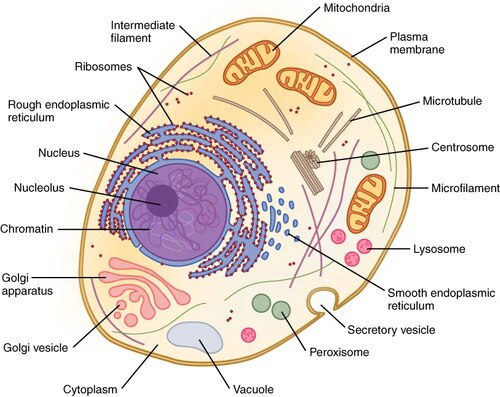
Prokaryotic cells such as bacteria are small and lack a true nucleus; their DNA floats in the cytoplasm. Eukaryotic cells in animals, plants and fungi are larger, with a nucleus and many membrane-bound organelles.
The cell as a factory
Think of a cell as a factory: the nucleus is the head office holding the blueprints (DNA), ribosomes are protein assembly lines, mitochondria are power stations making ATP, the Golgi apparatus is the packaging department, and the cell membrane is the security gate.
Plant cells also have a cellulose wall, chloroplasts for photosynthesis and a large water-filled vacuole.
Japanese–English vocabulary
Terms used in this article: 細胞 (さいぼう) – cell; 細胞膜 (さいぼうまく) – cell membrane; 核 (かく) – nucleus; ミトコンドリア – mitochondrion; 葉緑体 (ようりょくたい) – chloroplast; 細胞壁 (さいぼうへき) – cell wall.