
Cells & genetics · Biology
DNA DNA
でぃーえぬえー
DNA (deoxyribonucleic acid) is the double-helix molecule that stores genetic information in almost all organisms, like an instruction book written in four letters: A, T, G and C.
- Double-helix model
- Watson and Crick, 1953
- Monomer
- Nucleotide
Structure
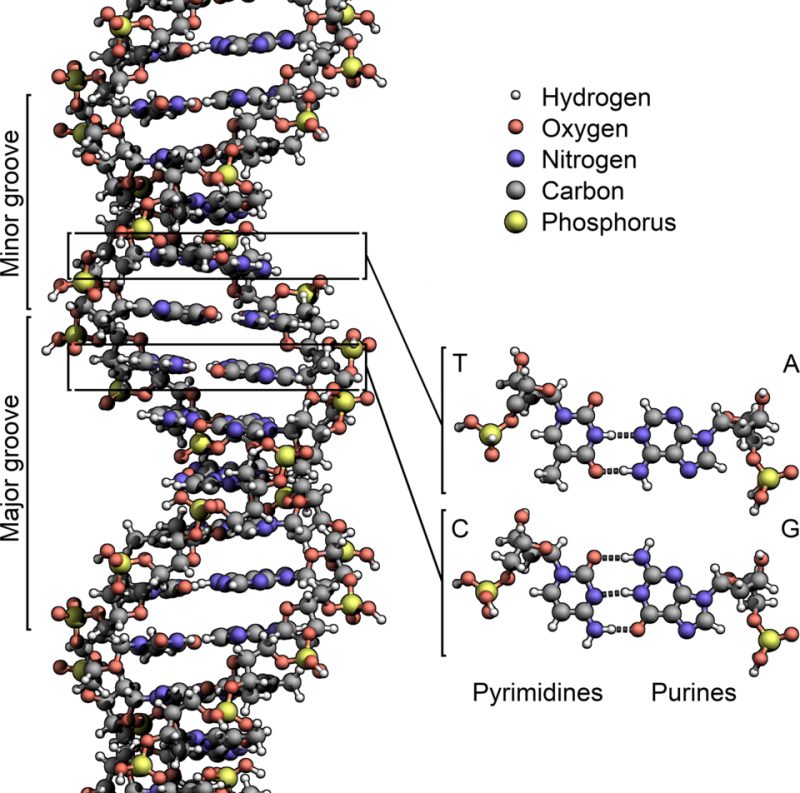
DNA has two strands of nucleotides twisted like a spiral ladder. Each nucleotide has a deoxyribose sugar, a phosphate and one of four bases: A, T, G or C. Bases pair by the complementary rule: A with T, G with C.
Rosalind Franklin's X-ray diffraction images were key evidence for the model Watson and Crick proposed in 1953.
DNA replication
Before a cell divides, the two DNA strands separate like a zipper and each serves as a template for a new strand. The result is two identical DNA molecules, each keeping one old strand (semi-conservative replication).
DNA in everyday life
DNA testing is used to establish family relationships, identify people in forensics, and trace the origin of crops and livestock. Each person's DNA sequence is almost unique, except for identical twins.
Japanese–English vocabulary
Terms used in this article: DNA (でぃーえぬえー) – DNA; 二重らせん (にじゅうらせん) – double helix; 塩基 (えんき) – base; ヌクレオチド – nucleotide; 複製 (ふくせい) – replication; 相補的 (そうほてき) – complementary.