
Core ideas · Mathematics
Derivative 微分
びぶん
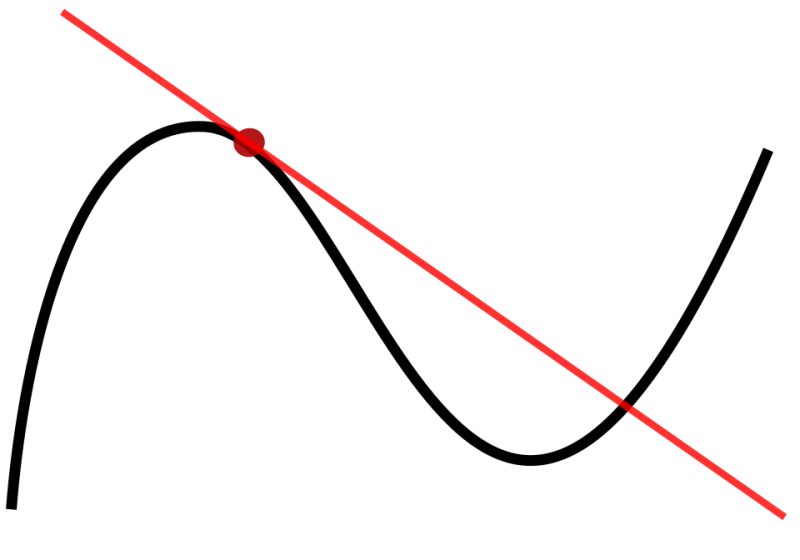
The derivative measures the instantaneous rate of change of a quantity; geometrically it is the slope of the tangent to a graph. It is one of the two main tools of calculus.
- Founders
- Newton and Leibniz (17th century)
- Notation
- f'(x), dy/dx
- Applications
- Velocity, optimization, machine learning
Intuition
A car's speedometer shows the speed right now, not the average over the trip. The derivative is the speedometer for any function: how fast it is changing at that instant.
How it is computed
Divide the change in y by the change in x over a tiny interval and let the interval shrink to zero (a limit). For example the derivative of x² is 2x, so at x = 3 the graph of y = x² has slope 6.
Finding maxima and minima
At a peak or valley the tangent is horizontal, so the derivative is 0. This lets us find the box with the most volume for the least material, or the price that maximizes profit, using a table of variations.
History and uses
Newton and Leibniz independently developed differential calculus in the late 17th century; Leibniz's dy/dx notation is still used. Today derivatives appear in physics, economics and in training neural networks by gradient descent.
Japanese – English terms
Key terms (Japanese – English – Vietnamese): 微分 (びぶん) – differentiation – đạo hàm, vi phân; 導関数 (どうかんすう) – derivative – đạo hàm; 接線 (せっせん) – tangent line – tiếp tuyến; 傾き (かたむき) – slope – hệ số góc; 極限 (きょくげん) – limit – giới hạn; 増減表 (ぞうげんひょう) – table of variations – bảng biến thiên; 極値 (きょくち) – extremum – cực trị.