
Core ideas · Mathematics
Integral 積分
せきぶん
Integration means adding up infinitely many tiny pieces to find areas, volumes or distances. It is the reverse operation of differentiation.
- Notation
- ∫ f(x) dx
- Precursor
- Archimedes' method of exhaustion
- Key theorem
- Fundamental theorem of calculus
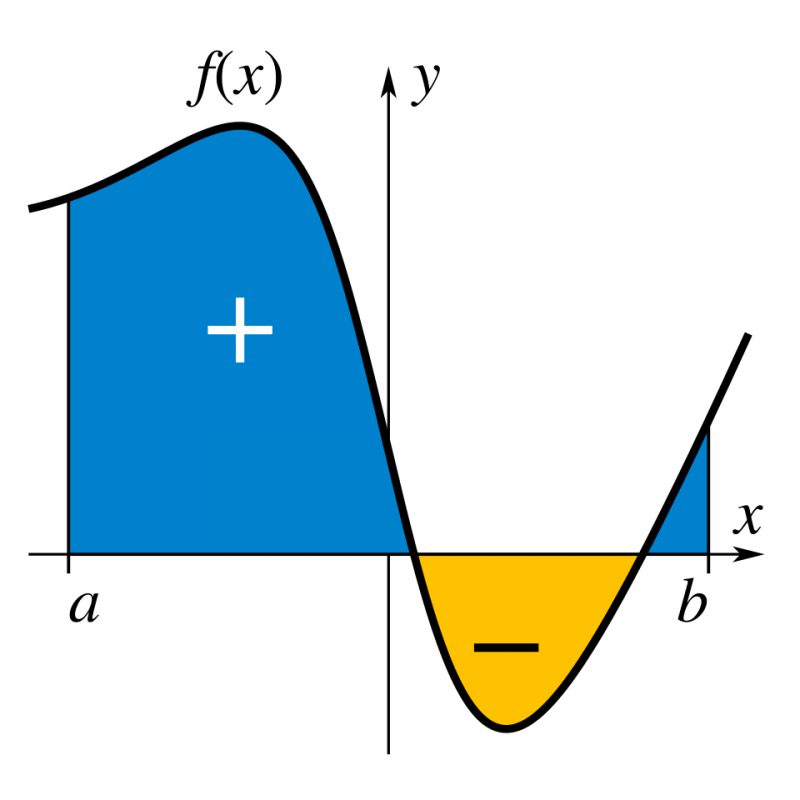
The idea
To find the area of a plot with a curved edge, cut it into many thin rectangular strips and add them. The thinner the strips, the better; in the limit you get the integral.
Antiderivatives and definite integrals
An antiderivative F of f satisfies F' = f; for 2x it is x² + C. The definite integral from a to b equals F(b) − F(a). The area under y = 2x from 0 to 3 is 9 − 0 = 9.
The fundamental theorem
The fundamental theorem of calculus says differentiation and integration are inverse operations. So instead of adding millions of strips we just find an antiderivative, a breakthrough of Newton and Leibniz.
Applications
Integrals give distance from velocity, the volume of a vase as a solid of revolution, work done by a force, probabilities under the normal curve, and total rainfall from rainfall rate.
Japanese – English terms
Key terms (Japanese – English – Vietnamese): 積分 (せきぶん) – integral – tích phân; 原始関数 (げんしかんすう) – antiderivative – nguyên hàm; 不定積分 (ふていせきぶん) – indefinite integral – tích phân bất định; 定積分 (ていせきぶん) – definite integral – tích phân xác định; 面積 (めんせき) – area – diện tích; 体積 (たいせき) – volume – thể tích.