
Famous theorems & problems · Mathematics
Fermat's Last Theorem フェルマーの最終定理
フェルマーのさいしゅうていり
Fermat's Last Theorem states that xⁿ + yⁿ = zⁿ has no positive whole-number solutions when n is greater than 2. It stood for over 350 years until Andrew Wiles proved it in 1994.
- Stated by
- Pierre de Fermat (c. 1637)
- Proved by
- Andrew Wiles (1994, published 1995)
- Key tool
- Taniyama–Shimura conjecture
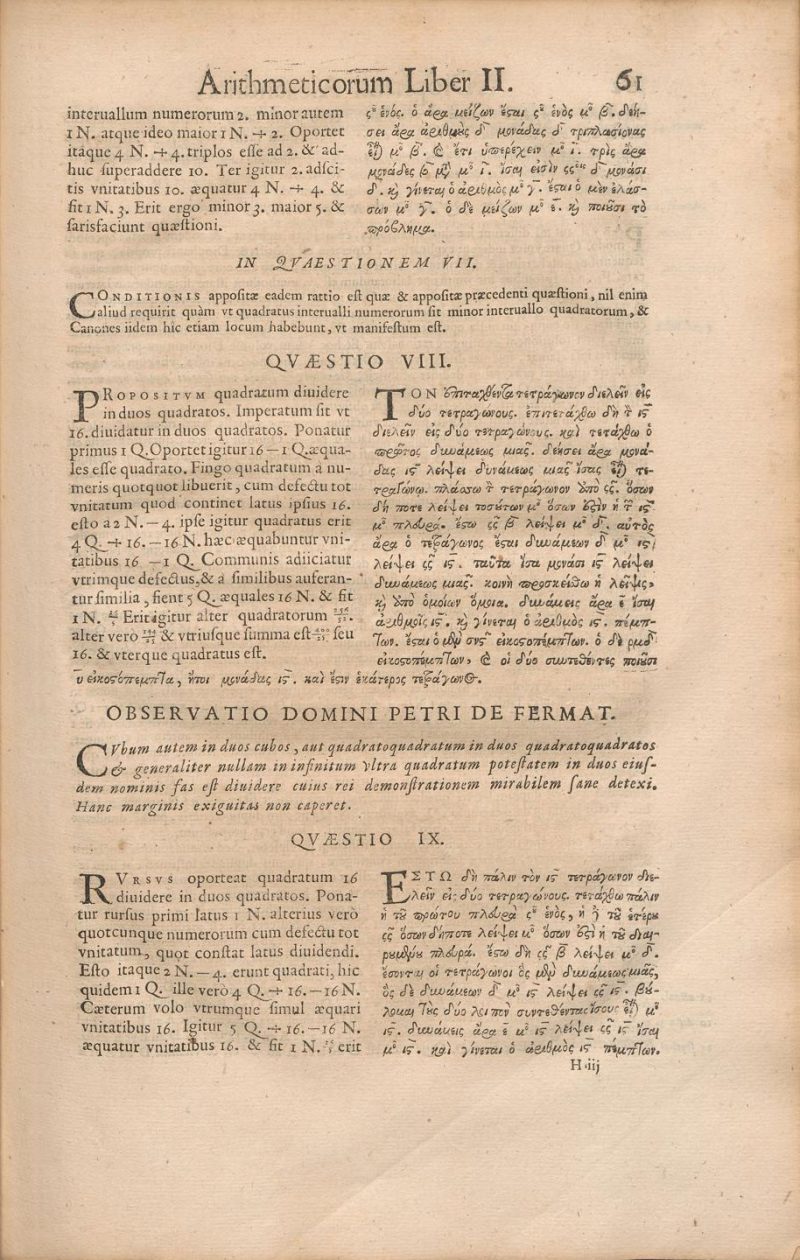
The margin note
Fermat wrote in a book's margin that he had "a truly marvellous proof" but the margin was too narrow to hold it. No such proof was ever found, and mathematicians failed for centuries.
Why was it hard?
For n = 2 there are endless solutions like 3² + 4² = 5², but for n = 3, 4, 5… there are none. Individual cases were proved (Fermat for n = 4, Euler for n = 3) but no method worked for all n.
Japanese contribution
Japanese mathematicians Yutaka Taniyama and Goro Shimura proposed a conjecture linking elliptic curves and modular forms. Wiles proved enough of it to deduce Fermat's theorem.
Wiles's journey
Wiles was fascinated by the problem from age 10 and worked on it secretly for about seven years. A gap was found in his 1993 announcement; with his former student Richard Taylor he fixed it in 1994.
Japanese – English terms
Key terms (Japanese – English – Vietnamese): 定理 (ていり) – theorem – định lí; 予想 (よそう) – conjecture – giả thuyết; 整数 (せいすう) – integer – số nguyên; 証明 (しょうめい) – proof – chứng minh; 楕円曲線 (だえんきょくせん) – elliptic curve – đường cong elliptic; 整数論 (せいすうろん) – number theory – lý thuyết số.