
Famous theorems & problems · Mathematics
Fibonacci sequence and the golden ratio フィボナッチ数列
フィボナッチすうれつ
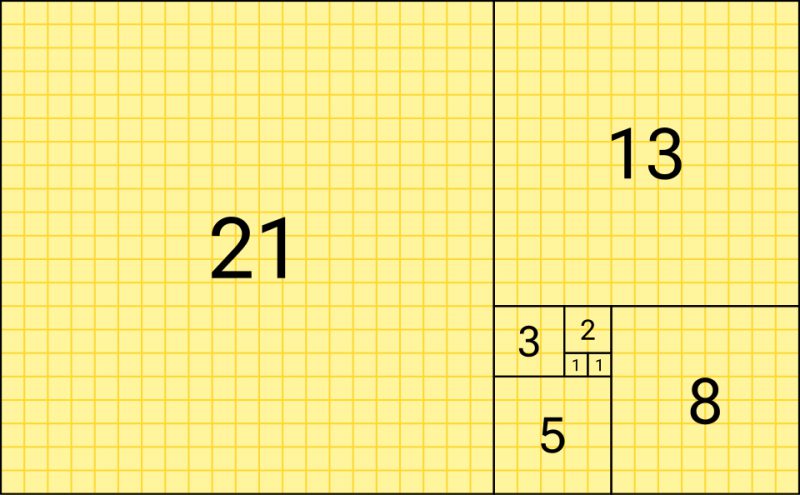
In the Fibonacci sequence 1, 1, 2, 3, 5, 8, 13… each number is the sum of the two before. The ratio of consecutive terms approaches the golden ratio ≈ 1.618.
- Named after
- Leonardo Fibonacci (book of 1202)
- Golden ratio
- (1 + √5)/2 ≈ 1.618
The rabbit problem
In Liber Abaci (1202) Fibonacci asked how many pairs of rabbits there would be after a year if each pair produces a new pair monthly from its second month. The monthly counts give 1, 1, 2, 3, 5, 8… The sequence was known earlier to Indian mathematicians.
The golden ratio
13/8 = 1.625, 21/13 ≈ 1.615, 34/21 ≈ 1.619… the ratios approach φ = (1 + √5)/2 ≈ 1.618. A rectangle with this side ratio is a golden rectangle, often said to look balanced.
In nature
Many flowers have a Fibonacci number of petals (3, 5, 8…), and spirals in sunflower heads and pine cones often come in consecutive Fibonacci pairs such as 34 and 55, packing seeds efficiently.
Caveats and uses
Many claims that pyramids or famous paintings use the golden ratio are exaggerated and poorly supported. In computing, Fibonacci numbers are a classic recursion exercise and appear in some search algorithms.
Japanese – English terms
Key terms (Japanese – English – Vietnamese): 数列 (すうれつ) – sequence – dãy số; フィボナッチ数 (フィボナッチすう) – Fibonacci number – số Fibonacci; 黄金比 (おうごんひ) – golden ratio – tỉ lệ vàng; 比 (ひ) – ratio – tỉ số; らせん (らせん) – spiral – đường xoắn ốc; 再帰 (さいき) – recursion – đệ quy.