
Famous theorems & problems · Mathematics
Pythagorean theorem 三平方の定理
さんへいほうのていり
In a right triangle, the square of the hypotenuse equals the sum of the squares of the other two sides: a² + b² = c². It is one of the most famous and useful theorems.
- Named after
- Pythagoras (6th century BC)
- Formula
- a² + b² = c²
- Name in Japan
- Sanheihō no teiri
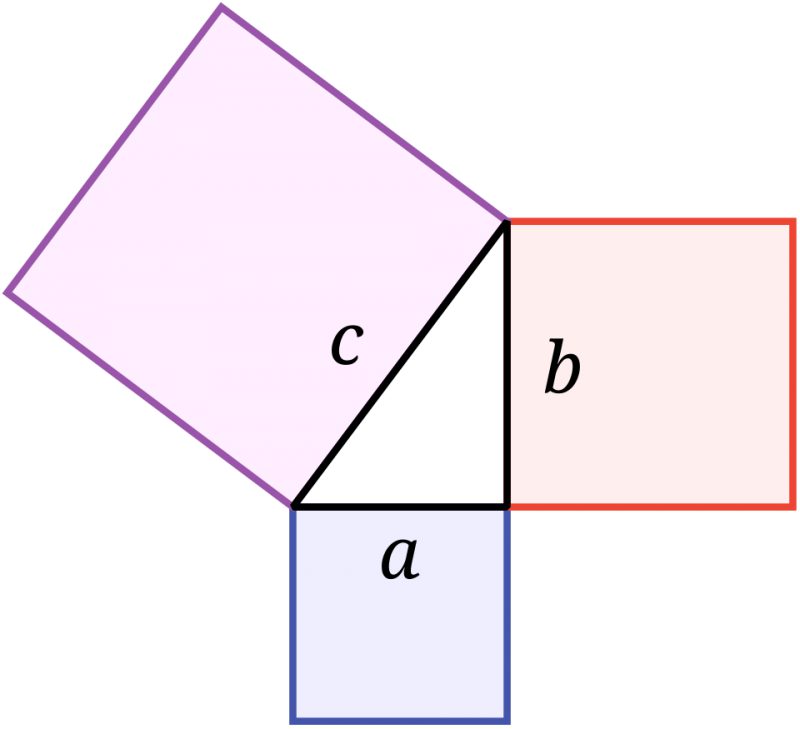
Statement
A right triangle with legs 3 cm and 4 cm has hypotenuse 5 cm, because 9 + 16 = 25. Whole-number triples like (3, 4, 5) and (5, 12, 13) are called Pythagorean triples.
History
The theorem bears Pythagoras's name, but Babylonians knew such triples over a thousand years earlier, as the clay tablet Plimpton 322 shows. Ancient India and China also knew the relation. In Japan it is called the "theorem of three squares".
Proofs
There are hundreds of proofs. An easy one to picture: place four equal right triangles inside a square of side a + b; the empty space can be arranged either as one square c² or as two squares a² and b².
Applications
Builders use a 3-4-5 rope to make right angles. Working out a TV screen's diagonal or the distance between two points on a map or in GPS uses this theorem.
Japanese – English terms
Key terms (Japanese – English – Vietnamese): 三平方の定理 (さんへいほうのていり) – Pythagorean theorem – định lí Pythagore; 直角三角形 (ちょっかくさんかくけい) – right triangle – tam giác vuông; 斜辺 (しゃへん) – hypotenuse – cạnh huyền; 直角 (ちょっかく) – right angle – góc vuông; 証明 (しょうめい) – proof – chứng minh; 定理 (ていり) – theorem – định lí.