
Core ideas · Mathematics
Fractions 分数
ぶんすう
A fraction a/b means dividing a whole into b equal parts and taking a of them. Fractions describe non-whole amounts like half a cake or three quarters of an hour.
- Parts
- Numerator and denominator
- Taught in
- Primary school
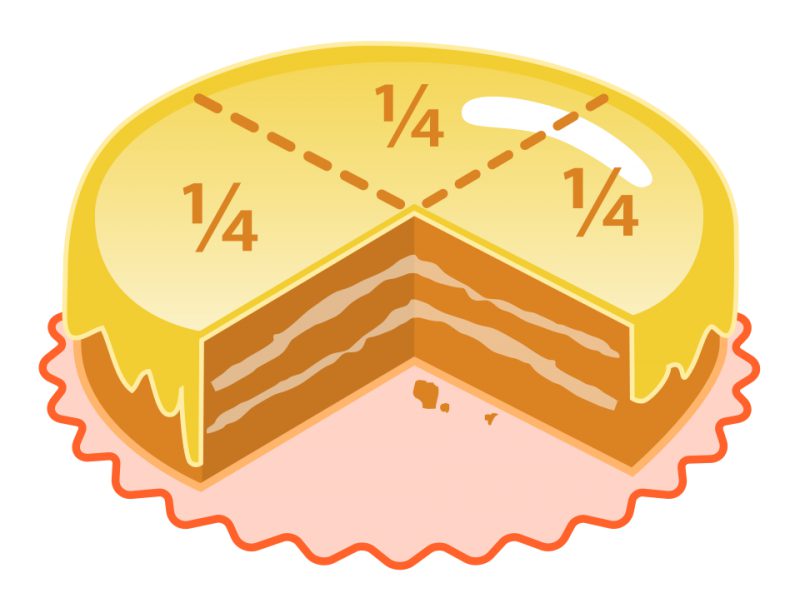
Numerator and denominator
In 3/4, the denominator 4 says the whole is cut into 4 equal parts and the numerator 3 says we take 3. The denominator can never be 0. Note that Japanese reads the denominator first: "yon-bun no san".
Equivalent fractions and simplifying
1/2, 2/4 and 3/6 are the same amount. Dividing top and bottom by a common factor simplifies, e.g. 6/8 = 3/4. To add 1/2 + 1/3 we use a common denominator: 3/6 + 2/6 = 5/6.
Fractions, decimals and percentages
1/4 = 0.25 = 25%. Some fractions give terminating decimals, others repeating ones like 1/3 = 0.333… Every rational number can be written as a fraction.
In everyday life
Recipes ("half a cup of sugar"), discounts ("one third off"), splitting a bill and map scales all use fractions.
Japanese – English terms
Key terms (Japanese – English – Vietnamese): 分数 (ぶんすう) – fraction – phân số; 分子 (ぶんし) – numerator – tử số; 分母 (ぶんぼ) – denominator – mẫu số; 約分 (やくぶん) – simplifying a fraction – rút gọn phân số; 通分 (つうぶん) – common denominator – quy đồng mẫu số; 小数 (しょうすう) – decimal – số thập phân.