
Core ideas · Mathematics
Logarithm 対数
たいすう
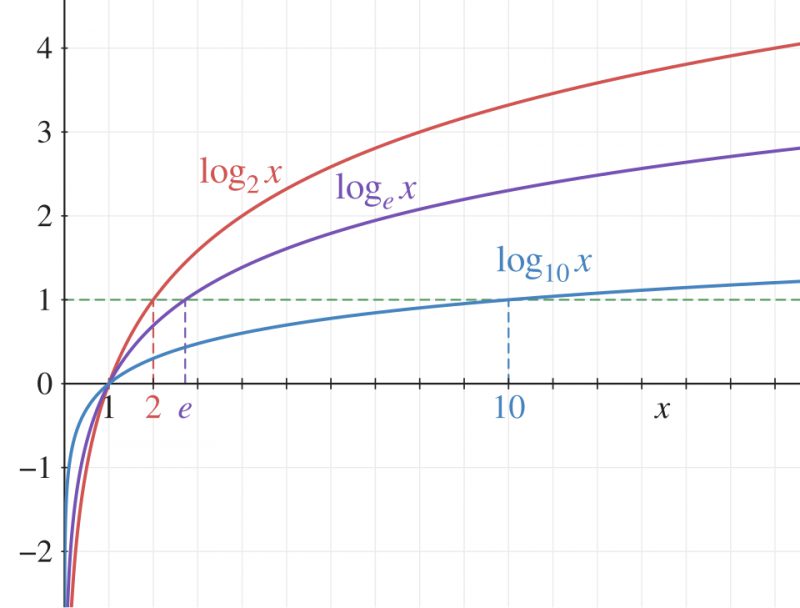
A logarithm answers "to what power must the base be raised to get this number?" For example log₁₀1000 = 3 because 10³ = 1000. Logarithms turn multiplication into addition.
- Inventor
- John Napier (1614)
- Common bases
- 10, e, 2
- Applications
- Earthquake magnitude, decibels, pH
Definition
If aˣ = b then x = logₐb. Since 2⁵ = 32, log₂32 = 5. The logarithm undoes exponentiation, as division undoes multiplication.
Key property
log(a × b) = log a + log b. Before calculators, scientists used log tables and slide rules to turn big multiplications into additions, saving huge effort in astronomy and navigation.
Logarithmic scales
Many scales are logarithmic because quantities vary so widely: sound in decibels, acidity in pH, earthquakes in magnitude. One step in magnitude means roughly 32 times more energy.
e and the natural logarithm
The logarithm with base e ≈ 2.718 is the natural logarithm, ln x. It arises in compound interest, population growth and radioactive decay. In Japanese e is called "Napier's number".
Japanese – English terms
Key terms (Japanese – English – Vietnamese): 対数 (たいすう) – logarithm – lôgarit; 底 (てい) – base – cơ số; 指数 (しすう) – exponent – số mũ; 累乗 (るいじょう) – power – lũy thừa; 自然対数 (しぜんたいすう) – natural logarithm – lôgarit tự nhiên; ネイピア数 (ネイピアすう) – Euler's number e – số e.