
Mechanics & energy · Physics
Newton's three laws of motion 運動の法則
うんどうのほうそく
Newton's three laws (1687) explain why things move: objects keep their state without a force, force causes acceleration by F = m × a, and forces always come in pairs.
- Formulated by
- Isaac Newton
- Published
- 1687 (Principia)
- Applications
- Vehicles, bridges, rockets
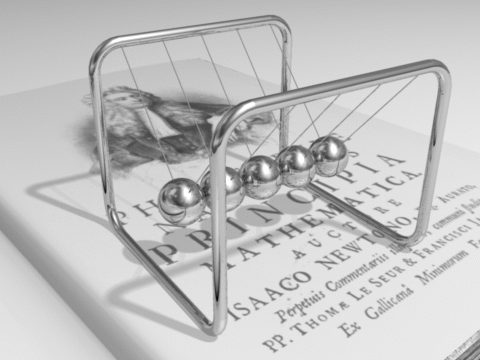
First law: inertia
When a bus brakes hard, passengers lurch forward because their bodies tend to keep their velocity. That is inertia. The first law says: with zero net force, a resting object stays at rest and a moving one keeps moving in a straight line at constant speed.
Second law: F = m × a
Pushing an empty cart is much easier than a full one: the same force gives a heavier object less acceleration. The second law is written F = m × a. A 10 N force on a 2 kg object gives an acceleration of 5 m/s².
Third law: action and reaction
When you push a wall, the wall pushes back with an equal and opposite force. A rocket expels gas backward and the gas pushes the rocket forward. These two forces act on different bodies, so they do not cancel.
Japanese – English terms
慣性 (かんせい) – inertia; 力 (ちから) – force; 質量 (しつりょう) – mass; 合力 (ごうりょく) – resultant force; 作用・反作用 (さよう・はんさよう) – action and reaction; 運動方程式 (うんどうほうていしき) – equation of motion.