
Mechanics & energy · Physics
Gravity 万有引力
ばんゆういんりょく
Gravity is the attraction between all objects with mass. It keeps us on the ground, the Moon around Earth and the planets around the Sun.
- Law
- Law of universal gravitation (Newton, 1687)
- Modern theory
- General relativity (Einstein, 1915)
- Surface gravity
- About 9.8 m/s² at Earth's surface
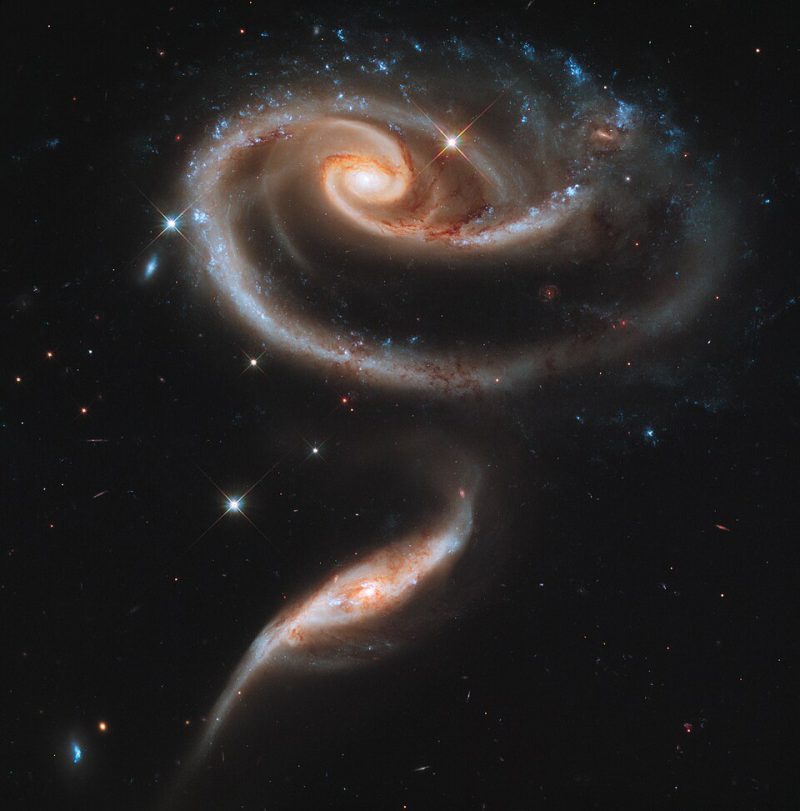
The law of universal gravitation
Newton realised the force that makes an apple fall also holds the Moon in orbit. The force between two bodies is F = G × m1 × m2 / r². Double the distance and the force drops to a quarter. G is tiny, so the pull between two people is practically unnoticeable.
Gravity and weight
Weight is the force with which Earth pulls an object: W = m × g. Your 60 kg mass is the same everywhere, but on the Moon, where gravity is about one-sixth as strong, your weight is much smaller.
Orbits and satellites
An orbiting satellite is constantly "falling", but it moves sideways so fast that the ground curves away before it lands. Gravity provides the centripetal force. Astronauts feel weightless because the whole station falls with them.
Japanese – English terms
万有引力 (ばんゆういんりょく) – universal gravitation; 重力 (じゅうりょく) – gravity; 重さ (おもさ) – weight; 軌道 (きどう) – orbit; 人工衛星 (じんこうえいせい) – artificial satellite; 向心力 (こうしんりょく) – centripetal force.