
Electricity, magnetism & light · Physics
Light and colour 光
ひかり
Light is the part of the electromagnetic spectrum our eyes can see. It reflects, refracts and disperses into rainbows, and the colours of things depend on how they absorb and reflect light.
- Visible wavelengths
- About 380–760 nm
- Related scientists
- Newton (dispersion), Huygens, Young
- Applications
- Glasses, cameras, optical fibre
Reflection and refraction
A flat mirror reflects light with equal angles of incidence and reflection. Light passing from air into water bends: chopsticks in a glass look broken. Lenses in glasses, magnifiers and cameras use refraction to form images. Optical fibres guide light by total internal reflection, carrying internet data under the sea.
Dispersion and rainbows
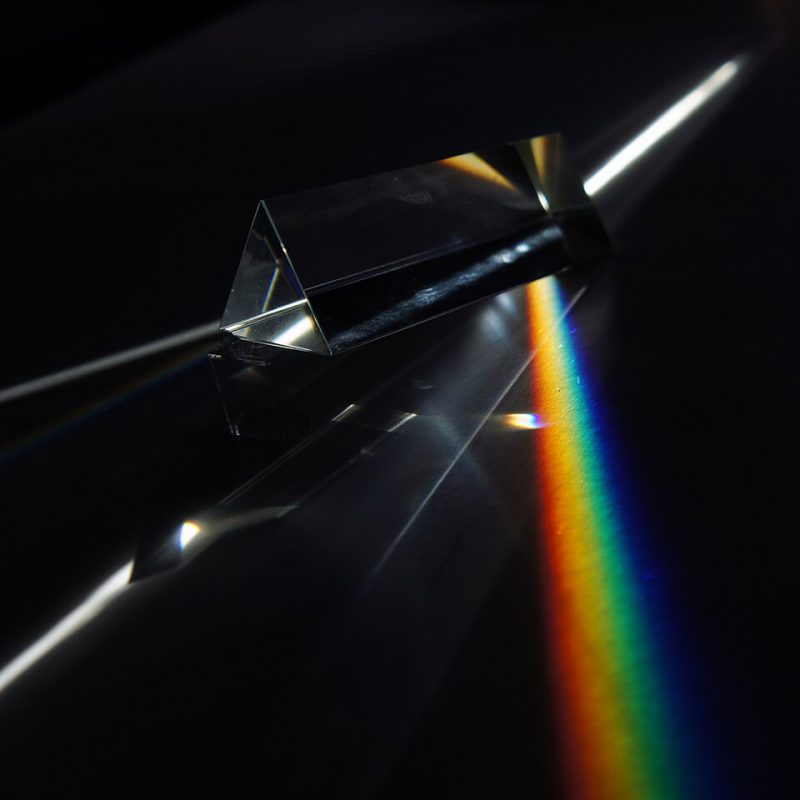
In 1666 Newton passed sunlight through a prism and got a band from red to violet, showing white light is a mixture of colours. Each colour has a slightly different refractive index and bends differently. Rainbows appear when raindrops act as tiny prisms.
Why objects have colour
Leaves look green because they absorb most red and blue light and reflect green. Phone screens make every colour from red, green and blue (RGB). The sky is blue because air scatters blue light more than red; at sunset light crosses more air, leaving reds and oranges.
Japanese – English terms
光 (ひかり) – light; 反射 (はんしゃ) – reflection; 屈折 (くっせつ) – refraction; 全反射 (ぜんはんしゃ) – total internal reflection; プリズム (ぷりずむ) – prism; 分散 (ぶんさん) – dispersion; 散乱 (さんらん) – scattering.