
Electricity, magnetism & light · Physics
Laser レーザー
れーざー
A laser is a special light source producing a monochromatic, coherent and highly directional beam through stimulated emission. Lasers are used in barcode scanners, fibre optics, eye surgery and metal cutting.
- Stands for
- Light Amplification by Stimulated Emission of Radiation
- First laser
- Theodore Maiman, 1960 (ruby laser)
- Theoretical basis
- Stimulated emission (Einstein, 1917)
How a laser works
Electrons in atoms are "pumped" to excited states. When a photon passes, it triggers an electron to drop and emit a second photon identical in frequency, phase and direction. Mirrors at each end of the cavity bounce the light back and forth to amplify it, and part escapes as the beam.
How it differs from a lamp
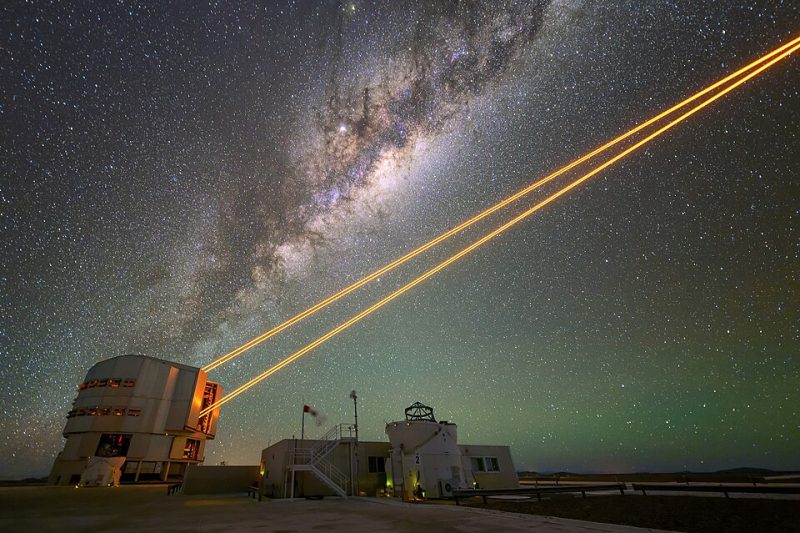
A light bulb emits many colours in all directions. A laser emits one colour (monochromatic), with waves in step (coherent), in a narrow beam that barely spreads. This concentrates energy on a tiny spot, enough to cut steel or read tiny marks on optical discs.
Everyday applications
Supermarket barcode scanners, optical mice, fibre-optic internet, laser printers, refractive eye surgery and laser rangefinders all use lasers. Safety note: never point a laser pointer at anyone's eyes.
Japanese – English terms
レーザー (れーざー) – laser; 誘導放出 (ゆうどうほうしゅつ) – stimulated emission; 励起状態 (れいきじょうたい) – excited state; 単色光 (たんしょくこう) – monochromatic light; 共振器 (きょうしんき) – resonator (cavity); 光子 (こうし) – photon.