
Stars & the cosmos · Earth & the universe
The Big Bang ビッグバン
びっぐばん
The Big Bang theory describes the universe beginning in an extremely hot, dense state about 13.8 billion years ago and expanding and cooling ever since.
- Key evidence
- Expansion, cosmic microwave background, light-element abundances
- Key contributors
- Lemaître, Hubble, Gamow
- CMB discovered
- 1965 (Penzias and Wilson)
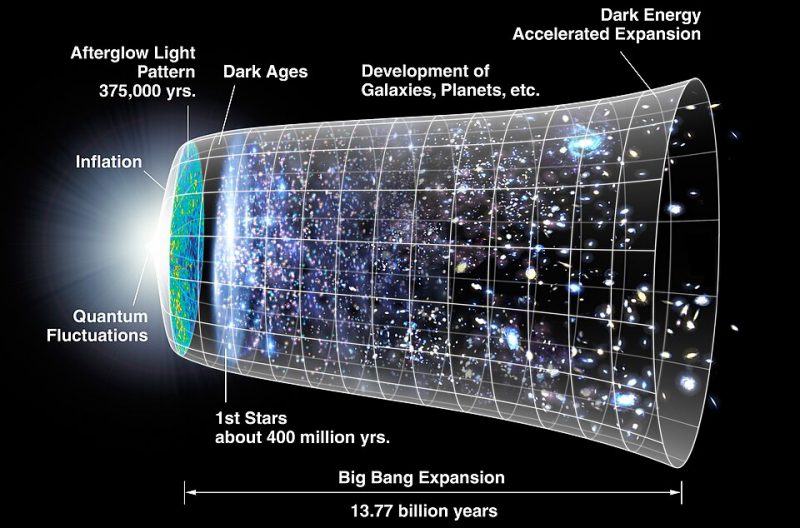
Not an ordinary explosion
The word explosion is misleading. The Big Bang was not a bomb going off at one point in space but the expansion of space itself everywhere. Picture dots on a balloon: as it inflates, every dot moves away from every other.
The evidence
In 1929 Hubble showed that more distant galaxies recede faster, meaning the universe is expanding. In 1965 the cosmic microwave background, leftover light from when the universe was about 380,000 years old, was discovered. Observed amounts of hydrogen and helium also match the theory.
Open questions
Observations show the expansion is speeding up, attributed to dark energy, and most matter appears to be invisible dark matter. What happened at the very first instant remains an unanswered question.
Japanese – English terms
Vocabulary: ビッグバン – Big Bang; 宇宙膨張 (うちゅうぼうちょう) – cosmic expansion; 宇宙背景放射 (うちゅうはいけいほうしゃ) – cosmic background radiation; 赤方偏移 (せきほうへんい) – redshift; 暗黒物質 (あんこくぶっしつ) – dark matter; ダークエネルギー – dark energy.