
The solar system · Earth & the universe
Solar System 太陽系
たいようけい
The Solar System is the Sun and everything bound to it by gravity: eight planets, dwarf planets, moons, asteroids and comets.
- Central star
- The Sun
- Planets
- 8
- Galaxy
- Milky Way
What it contains
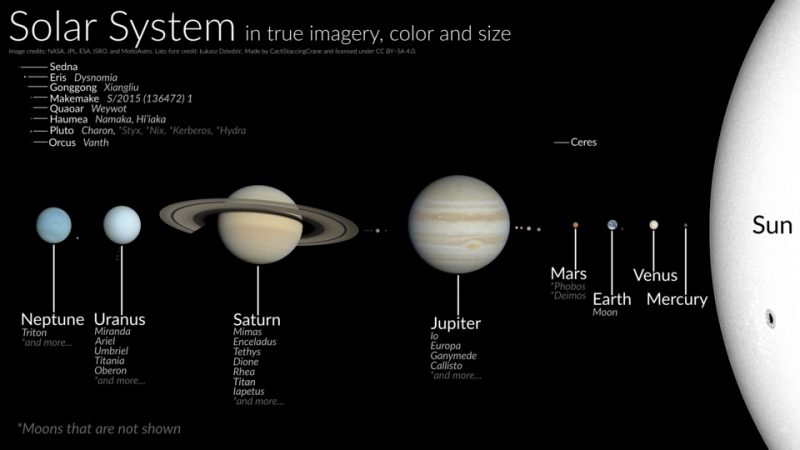
The Sun holds over 99% of the system's mass. Around it orbit four inner rocky planets (Mercury, Venus, Earth, Mars) and four outer giants (Jupiter, Saturn, Uranus, Neptune).
How it formed
About 4.6 billion years ago a cloud of gas and dust collapsed under gravity. The centre became the Sun, and the remaining spinning disk clumped into planets, a bit like a snowball growing as it rolls.
The outer regions
Between Mars and Jupiter lies the asteroid belt. Beyond Neptune is the Kuiper Belt, home of the dwarf planet Pluto, and farther still the hypothesised Oort Cloud, source of many comets.
Japanese – English terms
Vocabulary: 太陽系 (たいようけい) – Solar System; 惑星 (わくせい) – planet; 準惑星 (じゅんわくせい) – dwarf planet; 衛星 (えいせい) – moon / satellite; 公転 (こうてん) – revolution (orbit); 小惑星帯 (しょうわくせいたい) – asteroid belt.