
Planet Earth · Earth & the universe
Seasons and weather 季節と天気
きせつとてんき
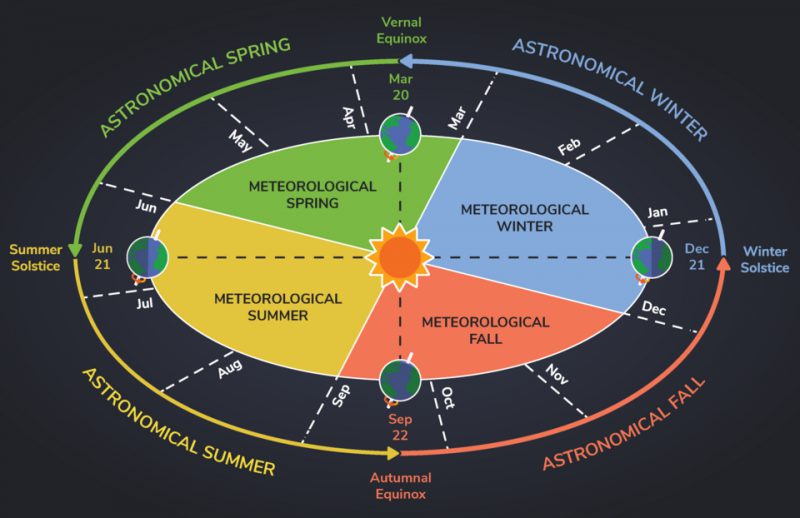
Seasons occur because Earth's axis is tilted as it orbits the Sun. Daily weather is shaped by air pressure, wind, humidity and air masses.
- Longest day (N. Hemisphere)
- Summer solstice, around 21 June
- Weather elements
- Temperature, pressure, humidity, wind, cloud, rain
- Weather vs climate
- Weather: short term; climate: long-term average
Why there are seasons
Many think summer is hot because Earth is closer to the Sun, but Earth is actually closest in early January. The real cause is the tilt: when the Northern Hemisphere leans toward the Sun, sunlight hits more directly and days are longer, giving summer. A flashlight pointed straight down makes a smaller, hotter spot than one aimed at an angle.
Seasons in Vietnam and Japan
Japan, in the temperate zone, has four distinct seasons plus the tsuyu rainy season in early summer and typhoons in late summer. Northern Vietnam has a cool winter from the northeast monsoon, while the south, near the equator, mainly has a rainy and a dry season driven by monsoons.
Everyday weather
High pressure usually brings clear skies, while low pressure and fronts bring clouds and rain. Warm, moist air rises, cools and forms thunderclouds. Modern forecasts combine satellite, radar and station data with numerical models run on supercomputers.
Japanese – English terms
Vocabulary: 季節 (きせつ) – season; 地軸 (ちじく) – Earth's axis; 夏至 (げし) – summer solstice; 冬至 (とうじ) – winter solstice; 梅雨 (つゆ) – rainy season (tsuyu); 高気圧 (こうきあつ) – high pressure; 天気予報 (てんきよほう) – weather forecast.