
Art, film & anime · 日本名人
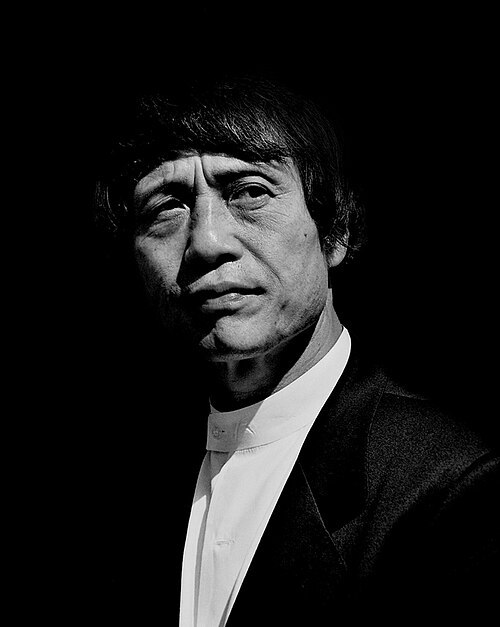
Andō Tadao 安藤忠雄
あんどう ただお
Andō Tadao (born 1941) is an Osaka architect known worldwide for exposed concrete, simple geometric volumes and the way he brings light, water and wind into his spaces. A former boxer who taught himself architecture, he won the Pritzker Prize in 1995. His best-known works include the Church of the Light, the Row House in Sumiyoshi and the museums on Naoshima.
- Hometown
- Osaka
- Nationality
- Japanese
- Field
- Architecture
Early life and self-education
Andō was born on 13 September 1941 in Osaka, one of twins, and was brought up by his grandmother in a working-class district. He spent hours watching the carpenters at a nearby workshop, learning to work wood – what he considers his first lesson in materials.
As a teenager he became a professional boxer and fought in Thailand, but gave it up once he realised he could not beat the best. He never attended university; instead he read architecture books, studied drawing at night, took correspondence courses in interior design and worked in design offices.
From 1965 he travelled through Europe, the United States and Africa to see the work of Le Corbusier, Mies van der Rohe, Frank Lloyd Wright and Louis Kahn, as well as the Parthenon and the Pantheon. Standing under the Pantheon's oculus, he has said, shaped his thinking about light.
Early works
He opened his own office in Osaka in 1969. The work that made his name was the Row House in Sumiyoshi (1976), a narrow concrete house on an old city plot, split into two volumes with an open-air courtyard in between. To go from the living room to the bedroom one must cross the courtyard, even in the rain – a controversial choice that expresses his idea of living close to nature. It won the Architectural Institute of Japan Prize in 1979.
Rokko Housing in Kobe (1983 and 1993) climbs a 60-degree slope in terraced boxes and survived the 1995 Great Hanshin earthquake. In the same period he designed many houses, shops and small commercial buildings across Kansai.
Landmark buildings
The Church of the Light (1989) in Ibaraki, Osaka, is a small concrete chapel whose altar wall is cut by a cross-shaped slit, so that daylight itself forms the cross. Related works include the Church on the Water in Hokkaido (1988) and the Water Temple on Awaji Island (1991), entered by descending through a lotus pond.
On Naoshima in Kagawa he has worked with Benesse since the late 1980s: Benesse House (1992), the largely underground Chichu Art Museum (2004) showing Monet, James Turrell and Walter De Maria, and the Lee Ufan Museum (2010). Naoshima became an international art destination as a result.
Abroad he designed the Pulitzer Arts Foundation in St. Louis (2001), the Modern Art Museum of Fort Worth (2002), and conversions of the Punta della Dogana in Venice (2009) and the Bourse de Commerce in Paris (2021) for the Pinault Collection. In Tokyo he built Omotesando Hills (2006) and 21_21 Design Sight (2007).
Style and philosophy
Andō's signature is exceptionally smooth exposed concrete (uchippanashi), with form-tie holes arranged as a regular pattern on panels roughly the size of a tatami mat. He uses basic geometry – squares, circles, straight lines – and thick walls to shut out the chaos of the city, then opens the building to sky, light and water.
Francesco Dal Co and other critics place him within "critical regionalism": Western modernism infused with traditional Japanese spatial sensibilities such as stillness, emptiness and awareness of the seasons. Winding routes make visitors slow down and experience space as a sequence.
He has his critics: some residents find his houses cold and inconvenient, and heavy concrete use is questioned for its environmental cost. Andō has replied that architecture should challenge people rather than simply indulge comfort.
Awards, teaching and public work
In 1995 he received the Pritzker Prize, the third Japanese laureate after Tange Kenzō and Maki Fumihiko, and donated the $100,000 award to children orphaned by that year's Hanshin earthquake. Other honours include the Alvar Aalto Medal (1985), RIBA Royal Gold Medal (1997), AIA Gold Medal (2002), Kyoto Prize (2002), Japan's Order of Culture (2010) and Commandeur of the Légion d'honneur (2021).
Despite having no degree, he was a professor at the University of Tokyo (1997–2003) and has taught at Yale, Columbia and Harvard. He led tree-planting projects such as the Sea Forest on a Tokyo Bay landfill and donated the Nakanoshima Children's Book Forest (2020) to Osaka. He has spoken in interviews about major cancer surgery, after which he kept working.
Influence and reception in Vietnam
The cross of light, smooth concrete walls and inner courtyards have become a common vocabulary of contemporary architecture throughout Asia. In Vietnam Andō is often cited in architecture schools and the design press as the model of the self-taught master, and many young Vietnamese architects working with exposed concrete, light wells and nature-oriented spaces are indirectly influenced by him. His autobiography, Tadao Ando: Architect, has been translated into several languages.
Japanese corner
Name: 安藤忠雄 (Andō Tadao). Vocabulary: 建築家 (kenchikuka, architect), 打ち放しコンクリート (uchippanashi, exposed concrete), 光の教会 (Hikari no kyōkai, Church of the Light), 住吉の長屋 (Sumiyoshi no nagaya, Row House in Sumiyoshi), 直島 (Naoshima), 地中美術館 (Chichu Art Museum), 独学 (dokugaku, self-taught), 中庭 (nakaniwa, courtyard).
文中词汇
- 安藤忠雄
- 建築家けんちくかarchitect
- 打ち放しコンクリート
- 光の教会
- 住吉の長屋
- 直島
- 地中美術館
- プリツカー賞
- 独学どくがくself-education; self-instruction; self-…
- 中庭なかにわcourtyard; quadrangle; middle court


