
Science & business · 日本名人
Hideki Yukawa 湯川秀樹
ゆかわ ひでき
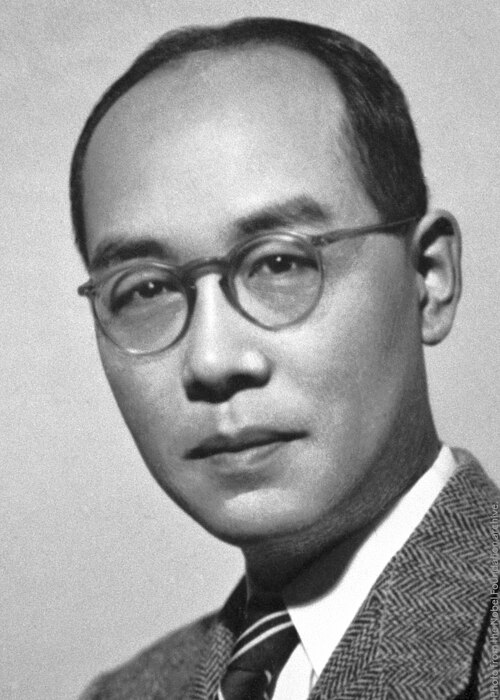
Hideki Yukawa (1907–1981) was a Japanese theoretical physicist who in 1934 proposed the meson theory to explain the nuclear force binding protons and neutrons. In 1949 he became the first Japanese Nobel laureate, and he devoted much of his later life to the movement against nuclear weapons.
- Birth name
- Hideki Ogawa
- Nationality
- Japanese
- Field
- Theoretical physics (elementary particles, nuclear force)
Family and early years
Hideki Yukawa was born Hideki Ogawa on 23 January 1907 in Azabu, Tokyo. His father, the geologist and geographer Ogawa Takuji, became a professor at Kyoto Imperial University the following year, so the family moved to Kyoto, where Hideki grew up. The family was remarkably scholarly: his elder brother Kaizuka Shigeki became a historian of China and his younger brother Ogawa Tamaki a sinologist, while the youngest, Masuki, was killed in the Second World War.
Taught classical Chinese by his grandfather, Hideki was a quiet boy who loved literature. He attended the Third Higher School and entered Kyoto Imperial University's physics department in 1926, graduating in 1929. His classmate throughout was Sin-Itiro Tomonaga, later Japan's second Nobel laureate (1965). In 1932 he married Sumi Yukawa and was adopted into her family, taking the Yukawa name.
The meson theory
By the early 1930s physicists knew the nucleus consisted of protons and neutrons, but not what force held them together, a force far stronger than the electric repulsion between protons yet acting only over tiny distances. In 1933 Yukawa became a lecturer at the new Osaka Imperial University, where he found an answer.
In November 1934 he proposed that the nuclear force arises from protons and neutrons exchanging a new particle, much as electromagnetism is linked to the photon. Because the force is so short-ranged, the particle must have mass, about 200 times the electron's, between the electron and the proton, hence the later name meson. His paper 'On the Interaction of Elementary Particles I' appeared in 1935 in the journal of the Physico-Mathematical Society of Japan; the potential he introduced is now called the Yukawa potential.
The idea attracted little notice at first. In 1937 American physicists found a cosmic-ray particle of roughly the predicted mass, but it proved to be the muon, which does not interact strongly. In 1947 Cecil Powell's group in Britain found the pi meson (pion), exactly as Yukawa described, and in 1948 pions were produced artificially in the Berkeley accelerator.
Nobel Prize and international career
Yukawa received his doctorate from Osaka Imperial University in 1938 and in 1939 became a professor at Kyoto Imperial University, succeeding his teacher Tamaki Kajūrō. He won the Imperial Prize of the Imperial Academy in 1940 and in 1943, aged 36, became the youngest recipient of the Order of Culture.
In 1948, at Robert Oppenheimer's invitation, he went to the Institute for Advanced Study in Princeton, and from 1949 he was a professor at Columbia University. That year he received the Nobel Prize in Physics for his prediction of the existence of mesons on the basis of theoretical work on nuclear forces. Coming four years after defeat, the news greatly heartened the Japanese public.
Returning in 1953, he became the first director of Kyoto University's Research Institute for Fundamental Physics (today the Yukawa Institute for Theoretical Physics), housed in the Yukawa Hall built to commemorate his prize. He retired in 1970. In later years he pursued non-local field theory and the idea of extended elementary particles, without the success he hoped for.
Scientist for peace
The atomic bombings of Hiroshima and Nagasaki in 1945, and the irradiation of the fishing boat Daigo Fukuryū Maru in the US hydrogen-bomb test at Bikini in 1954, led Yukawa to reflect deeply on scientists' responsibility. In 1955 he was the only Japanese signatory of the Russell–Einstein Manifesto calling for the renunciation of war and nuclear weapons.
He attended the first Pugwash Conference in Canada in 1957 and was president of the World Association of World Federalists from 1961 to 1965. In 1962 he and Tomonaga launched the Kyoto Conference of Scientists, and in 1975 they issued the Yukawa–Tomonaga Declaration, arguing that nuclear deterrence cannot bring lasting peace. He died of acute pneumonia and heart failure at his Kyoto home on 8 September 1981, aged 74; about ten days earlier he had written a final appeal for peace.
Character, thought and legacy
Yukawa was steeped in East Asian culture: he read Laozi and Zhuangzi, wrote waka poetry and many essays, and felt that classical Chinese thought helped him imagine new physical ideas. His autobiography Tabibito (The Traveler, 1958), recounting his youth and the road to the meson theory, is still widely read in Japan.
The meson theory launched particle physics in Japan and established the modern picture of forces carried by exchanged particles; although the strong force is now described more fundamentally by quantum chromodynamics, the Yukawa potential remains a basic tool of nuclear physics. Generations of Japanese physicists, from Sakata Shōichi to, indirectly, later laureates such as Nambu, Kobayashi and Masukawa, grew from the Yukawa tradition. Kyoto and Osaka universities both keep archives and exhibits about him.
Connections with Vietnam
In Vietnam Yukawa's name is familiar to students through physics textbooks, where the Yukawa potential and the meson appear in nuclear and particle physics, and he is often cited in articles on Japanese science as the founder, with Tomonaga, of Japan's Nobel tradition.
Language corner
His name is written 湯川秀樹 (Yukawa Hideki); 湯 means 'hot water' and 川 'river'. Vocabulary: 物理学 butsurigaku (physics), 中間子 chūkanshi (meson), 素粒子 soryūshi (elementary particle), 原子核 genshikaku (atomic nucleus), 核力 kakuryoku (nuclear force), 陽子 yōshi (proton), 中性子 chūseishi (neutron), 理論 riron (theory), ノーベル賞 (Nobel Prize), 平和 heiwa (peace).
中間 chūkan means 'middle', so 中間子 is literally 'middle particle', matching a mass between the electron's and the proton's.


