Literature · 日本名人
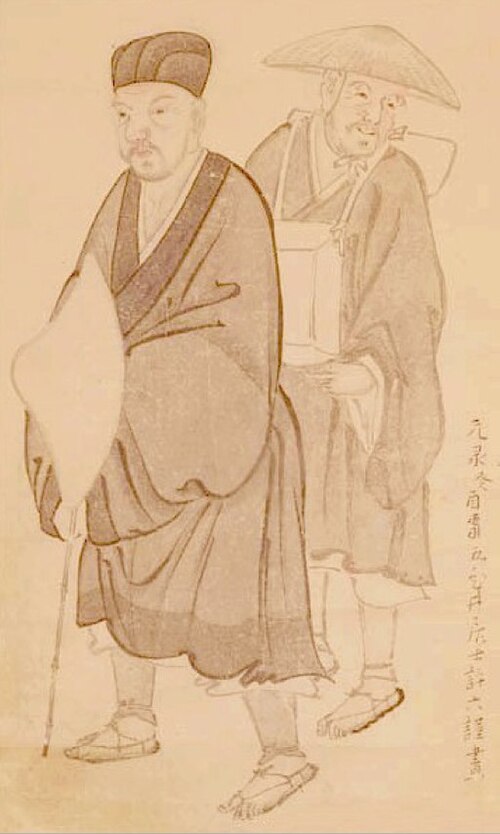
Matsuo Bashō 松尾芭蕉
まつお ばしょう
Matsuo Bashō (1644–1694) was the greatest poet of the Edo period, who raised haikai verse from wordplay to serious art and is revered as Japan's "saint of haikai" (haisei). His frog-and-old-pond haiku and the travel journal Oku no hosomichi (The Narrow Road to the Deep North) are among the most famous works in Japanese literature.
- Birthplace
- Ueno, Iga Province (now Iga, Mie)
- Real name
- Matsuo Munefusa (childhood name Kinsaku); earlier pen name Tōsei
- Field
- Haikai (linked verse, hokku), travel writing
Early life
Bashō was born in 1644 in Ueno, Iga Province (now Iga, Mie), into a family of musoku status, farmers ranking close to low samurai. His childhood name was Kinsaku, later Munefusa; some sources place his birth in nearby Tsuge. His father died in 1656.
As a young man he served Tōdō Yoshitada, son of a retainer of the Tsu domain. Yoshitada (poetic name Sengin) loved haikai, and the two studied under the poet and classical scholar Kitamura Kigin of Kyoto. Bashō's earliest surviving verses date from this time, signed Sōbō.
Yoshitada died suddenly in 1666. Bashō left service, and little is known of the following years; he probably spent time in Kyoto studying Japanese and Chinese classics.
Edo and the banana-plant hut
In 1672 he dedicated the verse-match collection Kai ōi at Ueno Tenmangū shrine and moved to Edo. There, as Tōsei, he joined the then-fashionable Danrin school with its playful, humorous style and became a haikai master with pupils. Records suggest he also worked on the Kanda waterworks to earn a living.
In winter 1680 he left the city centre for a simple hut in Fukagawa on the Sumida River. A pupil gave him a banana plant (bashō), which grew so well that the hut became known as Bashō-an, and the poet took the name.
The great fire of 1682 destroyed the hut, which his pupils rebuilt. These reclusive years at Fukagawa, influenced by Zen, Du Fu and Zhuangzi, turned him from wordplay toward a deeper poetics.
Journeys and travel journals
From 1684 Bashō undertook a series of long journeys, treating travel as both spiritual practice and creative work. His trip to Iga and the Kansai (1684–1685) is recorded in Nozarashi kikō (Journal of Bleached Bones in a Field), followed by Kashima kikō (1687), Oi no kobumi (1687–1688) and Sarashina kikō (1688).
His most famous journey began in spring 1689 (16 May by the Western calendar): with his disciple Kawai Sora he left Edo for the Tōhoku region and round the Japan Sea coast, reaching Ōgaki (Gifu) after some 150 days and about 600 ri (2,400 km). Oku no hosomichi, combining prose and haiku in the haibun form, was polished for years and published only in 1702, after his death.
On the way he wrote immortal verses such as "Summer grasses — / all that remains / of warriors' dreams" at Hiraizumi, and "Such stillness — / the cicadas' cry / soaks into the rocks" at Risshaku-ji (Yamadera).
Poetics: sabi, karumi and fueki ryūkō
"Old pond — / a frog jumps in, / sound of water," written in 1686, is often seen as the birth of the Shōfū style: rather than wordplay, it captures a moment of stillness broken, evoking nature and impermanence.
His disciples recorded key ideas: sabi (the beauty of loneliness and age), shiori (pervasive pathos), hosomi (slenderness, subtlety) and, late in life, karumi (lightness, simplicity, closeness to daily life). The principle of fueki ryūkō holds that good poetry must touch the eternal while always renewing itself.
The anthology Sarumino (The Monkey's Raincoat, 1691), compiled by Mukai Kyorai and Nozawa Bonchō, is regarded as the summit of the Bashō style. His leading pupils became known as the Ten Disciples (Shōmon jittetsu), including Takarai Kikaku, Hattori Ransetsu, Mukai Kyorai and Kagami Shikō.
Last years and death
After the Oku journey he lived for a time around Lake Biwa (Ōmi) and Kyoto, at his pupils' Genjū-an and Rakushisha, writing Genjū-an no ki (1690) and Saga nikki (1691). In 1691 he returned to Edo and the third Bashō-an.
In 1694 he set out westward one last time. He fell ill in Osaka and died on the 12th day of the 10th month (28 November 1694), aged 51 by traditional reckoning. His last poem is often given as "Sick on a journey — / my dreams go wandering / over withered fields."
As he wished, he was buried at Gichū-ji temple in Awazu, Ōtsu (Shiga), beside the grave of the warrior Kiso Yoshinaka, whom he admired.
Legacy
After his death Bashō was gradually deified as haisei; in the 18th and 19th centuries poets such as Yosa Buson led a "return to Bashō" movement. In the Meiji era Masaoka Shiki renamed the hokku "haiku" while criticising blind worship of Bashō and championing Buson, showing differing views of his legacy.
Today there is the Bashō Museum in Kōtō, Tokyo, near the site of the Bashō-an, a memorial hall in Iga, and countless verse stones (kuhi) along the Oku no hosomichi route. His poems have been translated into almost every major language and underlie the global haiku movement.
Connection with Vietnam
Bashō is the Japanese poet most widely introduced in Vietnam. Oku no hosomichi was translated by the scholar Vĩnh Sính as "Lối lên miền Oku", and the scholar Nhật Chiêu has written several books introducing haiku and Bashō. The old-pond poem appears in Vietnamese school literature curricula, and Vietnamese-language haiku clubs take Bashō as their model.
Japanese corner
The pen name 芭蕉 (bashō) means the Japanese banana plant (Musa basjoo). 松尾 (Matsuo) is "pine tail". In おくのほそ道, おく (奥) means the deep interior (the north) and ほそ道 (細道) a narrow road.
Vocabulary: 俳句 (haiku), 俳諧 (haikai), 発句 (hokku, opening verse of linked verse), 季語 (kigo, season word), 切れ字 (kireji, cutting words such as や and かな), 紀行 (kikō, travel journal), 古池 (furuike, old pond), 蛙 (kawazu/kaeru, frog), 旅 (tabi, journey), 侘び寂び (wabi-sabi), 俳聖 (haisei, saint of haikai).
古池や蛙飛びこむ水の音
— Matsuo Bashō
文中词汇
- 松尾芭蕉
- 俳句はいくhaiku; 17-mora poem, usu. in 3 lines of…
- 俳諧はいかいhaikai (collective name for haiku, haib…
- 発句ほっくfirst 17-syllable verse of a renga
- 季語きごseasonal word (in haiku)
- 切れ字きれじpunctuation words in haiku, renga, etc.…
- おくのほそ道
- 古池ふるいけold pool; old pond
- 紀行きこうtraveller's journal; traveler's journal…
- さびwasabi; Japanese horseradish
- かるみ
- 俳聖はいせいfamous haiku poet; the poet Basho