Literature · 日本名人
Murasaki Shikibu 紫式部
むらさきしきぶ
Murasaki Shikibu (c. 973 – c. 1014 or later) was a lady-in-waiting and writer at the mid-Heian court, author of The Tale of Genji, often called one of the world's earliest novels. She also left The Diary of Lady Murasaki and a collection of waka poems. Her real name is unknown; "Murasaki Shikibu" combines the heroine Murasaki of her tale with her father's court office.
- Real name
- Unknown; first known at court as Tō Shikibu
- Family
- Father: Fujiwara no Tametoki; husband: Fujiwara no Nobutaka; daughter: Daini no Sanmi (Kenshi)
- Field
- Prose fiction (monogatari), diary, waka poetry

Family and youth
Murasaki came from a minor branch of the powerful Fujiwara clan. Her great-grandfather was the poet Fujiwara no Kanesuke; her father, Fujiwara no Tametoki, was a scholar of Chinese and a poet who served as governor of Echizen and Echigo. Her mother died early and she was raised by her father. Her birth year is not recorded; scholars propose 970, 973 or 978, with 973 most widely accepted.
In her diary she recalls that when her father taught Chinese classics to her brother Nobunori, she listened and learned faster, prompting him to lament that she was not born a boy. Chinese learning was then a male domain, so her erudition was both rare and something she often tried to hide.
In 996 she accompanied her father to his post in Echizen (now Fukui Prefecture), her only known journey, returning to the capital Heian-kyō (Kyoto) after about a year.
Marriage and court service
Around 998 or 999 she married Fujiwara no Nobutaka, a distant relative much older than her who already had wives and children. They had a daughter, Kenshi, who became the noted poet Daini no Sanmi. Nobutaka died in 1001 during an epidemic; she is usually thought to have begun The Tale of Genji in the years of widowhood that followed.
Word of the early chapters reached the regent Fujiwara no Michinaga. At the end of 1005 or in 1006 she entered court as a lady-in-waiting (nyōbō) to Empress Shōshi, Michinaga's daughter and consort of Emperor Ichijō, and discreetly taught her the poetry of Bai Juyi.
She was first called Tō Shikibu (from Fujiwara and her father's office in the Shikibu ministry); later she became known as Murasaki, probably after her heroine Murasaki no Ue. Some suggest a liaison with Michinaga, but the evidence is thin.
The Tale of Genji
The Tale of Genji has 54 chapters, over a thousand pages in modern translations, with hundreds of characters spanning some 75 years. The main part follows Hikaru Genji ("Shining Genji"), son of an emperor and a low-ranking consort, reduced to commoner status with the surname Minamoto, and his loves – with his stepmother Fujitsubo, with Murasaki no Ue whom he raised from girlhood, and many others.
The last ten chapters, the "Uji chapters", turn to the next generation, Kaoru and Niou, in a darker, more sceptical key. Whether Murasaki alone wrote all 54 chapters is still debated.
The work is written mainly in kana, the script associated with women at the time, with nearly 800 waka poems. It is admired for psychological depth, delicate depiction of nature and court ritual, and mono no aware – the poignant awareness of beauty and impermanence, which the Edo scholar Motoori Norinaga saw as its essence.
Diary and poetry
The Diary of Lady Murasaki records life at Empress Shōshi's court around 1008–1010, centred on the birth of Prince Atsuhira (later Emperor Go-Ichijō) in 1008. Alongside lavish ceremonies are lonely, introspective passages about her alienation at court. A 1008 entry mentioning the Genji tale is the basis for celebrating its millennium in 2008.
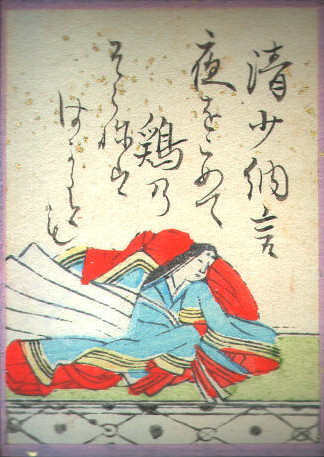
In the diary she criticises Sei Shōnagon, author of The Pillow Book and attendant to Empress Teishi, Shōshi's rival, as conceited and showing off her Chinese. She also recounts being mockingly nicknamed "the Lady of the Chronicles" (Nihongi no tsubone) after the emperor praised the Genji author's knowledge of history.
Her poetry collection Murasaki Shikibu-shū has about 120 poems, probably compiled by herself. About 60 of her poems appear in imperial anthologies, and poem 57 of the Ogura Hyakunin Isshu is hers.
Last years and legends
Her last years are poorly documented. She probably continued serving Shōshi after Emperor Ichijō's death (1011); some evidence suggests she lived until about 1014, other indications point to after 1019. A grave in the Murasakino area of Kyoto is traditionally attributed to her, but this is unconfirmed.
Many legends surround her: that she conceived the tale while gazing at the moon at Ishiyama-dera by Lake Biwa; medieval stories that she fell into hell for writing "lying" fiction, or conversely that she was an incarnation of the bodhisattva Kannon. Scholars regard these as legends, not history.
Legacy
The Tale of Genji deeply shaped Japanese waka, Noh, painting and decorative arts for a millennium. The 12th-century Genji Monogatari Emaki, a National Treasure held by the Gotoh Museum and the Tokugawa Art Museum, is the oldest surviving Japanese illustrated handscroll. Modern writers such as Yosano Akiko, Tanizaki Jun'ichirō and Setouchi Jakuchō produced modern Japanese versions.
Arthur Waley's English translation (1925–33) brought it to the world, followed by those of Edward Seidensticker and Royall Tyler. In 2000 Japan issued a 2,000-yen note whose reverse shows her and a Genji scroll scene. Kyoto celebrated the tale's millennium in 2008, and Uji has a Tale of Genji Museum. The 2024 NHK historical drama Hikaru Kimi e centres on her.
Connection with Vietnam
The Tale of Genji has been translated and published in Vietnamese and is a core text in courses on classical Japanese literature in Oriental and Japanese studies departments in Vietnam. Vietnamese scholars have also compared Heian women's literature with the work of Vietnamese women poets of the pre-modern era.
Japanese corner
Name: 紫式部 (Murasaki Shikibu). 紫 means purple; 式部 refers to the Shikibu ministry where her father held office. 源氏物語 is read Genji monogatari; 物語 (monogatari) means tale.
Vocabulary: 女房 (nyōbō, court lady; colloquially "wife" today), 平安時代 (Heian jidai), 仮名 (kana), 和歌 (waka), もののあはれ (mono no aware), 帖 (jō, counter for Genji chapters), 百人一首 (Hyakunin Isshu), 二千円札 (2,000-yen note).
文中词汇
- 紫式部むらさきしきぶJapanese beautyberry (Callicarpa japoni…
- 源氏物語げんじものがたりThe Tale of Genji (Heian-period classic)
- 紫式部日記
- 平安時代へいあんじだいHeian period (794-1185)
- 女房にょうぼうwife (esp. one's own wife)
- 仮名かなkana; Japanese syllabaries (i.e. hiraga…
- 和歌わかwaka; classic Japanese poem, esp. a tan…
- もののあはれ
- 宇治十帖
- 百人一首ひゃくにんいっしゅ(Ogura) Hyakunin Isshu; classical Japan…
- 二千円札