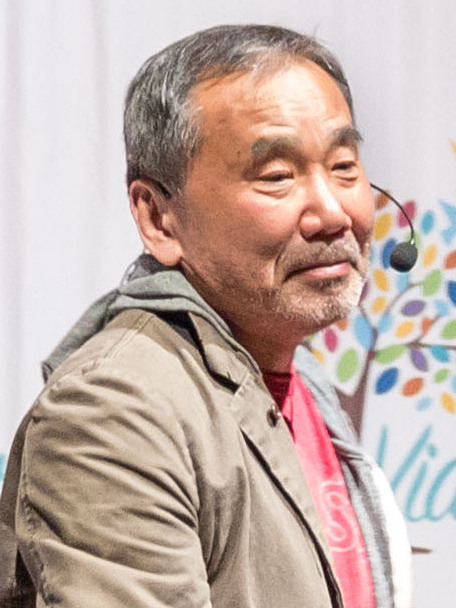
Literature · 日本名人
Kenzaburō Ōe 大江健三郎
おおえ けんざぶろう
Kenzaburō Ōe (1935–2023) was a Japanese novelist who won the 1994 Nobel Prize in Literature, the second Japanese laureate after Yasunari Kawabata. His work revolves around his disabled son Hikari, memories of war, the atomic bombings and his forested home village in Shikoku; he was also an engaged intellectual who opposed nuclear weapons and revision of Article 9 of the Constitution.
- Birthplace
- Ōse village, now Uchiko, Ehime Prefecture
- Nationality
- Japanese
- Education
- French literature, University of Tokyo

Early life
Ōe was born on 31 January 1935 in Ōse, a valley village in the forested mountains of Ehime Prefecture on Shikoku (now part of Uchiko). He grew up during the war; Japan's defeat in 1945 and the postwar turn to democracy, when he was ten, shaped his thinking for life. The forest village also became a mythical setting that recurs throughout his fiction.
He studied French literature at the University of Tokyo, influenced by Jean-Paul Sartre and existentialism and by his teacher, the French literature scholar Kazuo Watanabe.
Literary debut
Ōe began publishing while still a student. In 1958, aged 23, he won the Akutagawa Prize for the novella "The Catch" (Shiiku), about a captured Black American serviceman in a Japanese mountain village at the end of the Second World War, seen through a boy's eyes. Nagisa Ōshima filmed it in 1961.
His early work portrayed postwar youth as confined and suffocated, in prose dense with bodily and sexual imagery, a bold style that drew both attention and controversy.
Hikari and A Personal Matter
In 1963 Ōe's first son, Hikari, was born with a brain abnormality. The event changed his writing for good. A Personal Matter (1964) follows a young father torn between running away and accepting his disabled baby, ending with his choice to live with the child.
The figure of a disabled son runs through his later work. In real life Hikari grew up to become a composer whose albums were well received in Japan, and Ōe wrote repeatedly about their relationship as a theme of coexistence and hope.
Hiroshima, Okinawa and major works
Also in 1963 Ōe went to Hiroshima and met atomic-bomb survivors (hibakusha). His essay collection Hiroshima Notes (1965) records their dignity and became the basis of his lifelong opposition to nuclear weapons.
In 1967 he published The Silent Cry (Man'en gannen no futtobōru), in which two brothers return to their forest village and an 1860 peasant uprising is interwoven with the 1960 protests against the Japan–US Security Treaty; it is often considered his masterpiece. In 1970 he wrote Okinawa Notes on Okinawa's fate during and after the war.
Later works include the trilogy The Flaming Green Tree and a series of novels about the ageing writer Kogito Chōkō, among them The Changeling.
Nobel Prize and civic stance
In 1994 Ōe received the Nobel Prize in Literature. His lecture, "Japan, the Ambiguous, and Myself", deliberately answered Kawabata's 1968 "Japan, the Beautiful, and Myself", discussing Japan's divided position between East and West and between its wartime past and present.
Soon afterwards he declined the Order of Culture because it is bestowed by the Emperor, saying he recognised no authority or value higher than democracy. He was among the founders of the Article 9 Association (2004), which defends the Constitution's war-renouncing clause, and after the 2011 Fukushima nuclear disaster he urged Japan to abandon nuclear power, organising a mass rally in Tokyo in 2013.
In 2005 two retired military officers sued him for libel over passages in Okinawa Notes about the 1945 "mass suicides" of Okinawan civilians. In March 2008 the Osaka District Court dismissed the suit; the case reflected Japan's bitter debates over war memory.
Assessment and legacy
The Nobel committee praised him for creating an imagined world where life and myth condense into a picture of the human predicament. His prose is demanding, with long, Western-influenced sentences and layers of allusion to Dante, Blake and Yeats, admired by critics but daunting to many readers.
Politically, the left and the peace movement saw him as the conscience of postwar literature, while conservatives criticised his view of wartime history as one-sided. He died on 3 March 2023, aged 88.
Ōe in Vietnam
Ōe reached Vietnamese readers fairly early. "The Catch" was translated by Diễm Châu and published in Saigon by Trình Bầy in 1970. A Personal Matter, translated by Lê Ký Thương, appeared from Văn nghệ Publishing in Ho Chi Minh City in 1997, soon after his Nobel. In 2024 Nhã Nam and Literature Publishing House released The Silent Cry, translated by Vương Hải Yến.
Japanese corner
His name is written 大江健三郎 (Ōe Kenzaburō); 大江 means "great river", and 三郎 is a name traditionally given to a third son. The ō in Ōe is a long vowel: おおえ.
Vocabulary: 小説家 (novelist), 芥川賞 (Akutagawa Prize), ノーベル文学賞 (Nobel Prize in Literature), 被爆者 (atomic-bomb survivor), 障害 (disability), 共生 (coexistence), 憲法九条 (Article 9 of the Constitution), 反核 (anti-nuclear).
文中词汇
- 大江健三郎
- 小説家しょうせつかnovelist; fiction writer
- 芥川賞あくたがわしょうAkutagawa Prize (literary award)
- ノーベル文学賞ノーベルぶんがくしょうNobel Prize in Literature
- 飼育しいくbreeding; raising; rearing; keeping
- 個人的な体験
- 被爆者ひばくしゃperson exposed to radiation from a nucl…
- 障害しょうがいobstacle; impediment; hindrance; barrie…
- 共生きょうせいcoexistence; living together
- 憲法九条
- 反核はんかくanti-nuclear