History & politics · 日本名人
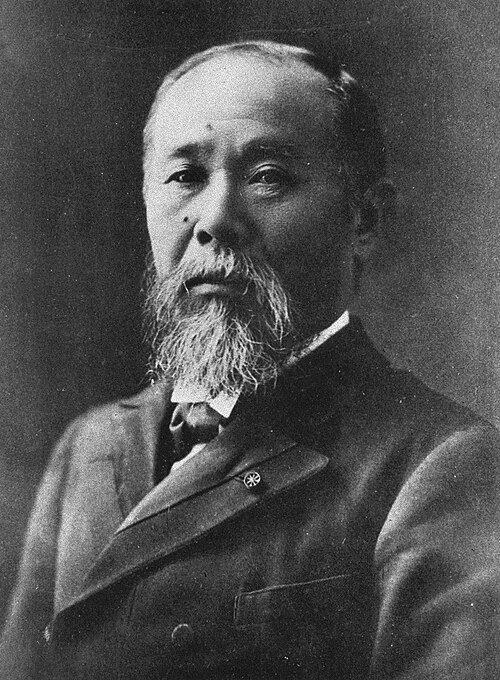
Sakamoto Ryōma 坂本龍馬
さかもと りょうま
Sakamoto Ryōma (1836–1867) was a Tosa activist of the late Edo period who brokered the Satsuma–Chōshū alliance and founded the trading and shipping company Kameyama Shachū (later Kaientai). Political ideas associated with him helped lead to the shogun's return of power to the emperor in 1867, but he was assassinated in Kyoto a month later, aged 31.
- Birthplace
- Kōchi, Tosa Domain (now Kōchi Prefecture)
- Status
- Gōshi (rural samurai), second son
- Period
- Bakumatsu (late Edo)

Early life
Ryōma was born on the 15th day of the 11th month of Tenpō 6 (3 January 1836) in Kōchi, the second son of a gōshi family. Gōshi were low-ranking rural samurai looked down on by Tosa's upper samurai, but the Sakamoto had merchant relatives in brewing and were well off. According to anecdote he was a timid, slow child, toughened by his elder sister Otome.
Around 14 he began fencing at a local school. In 1853 he went to Edo and entered the Chiba school of Hokushin Ittō-ryū swordsmanship. That year Perry's "black ships" arrived at Uraga and Ryōma was put on coastal guard duty – an experience that, like many young men of his day, made him an adherent of "revere the emperor, expel the barbarians". According to nippon.com he later became head student of the school and is said to have received a full licence.
Leaving Tosa and studying under Katsu Kaishū
In 1861 Ryōma joined Takechi Hanpeita's Tosa Loyalist Party. In 1862, however, he left his domain without permission (dappan) – a serious offence at the time – to act on his own.
In December 1862, introduced by Matsudaira Shungaku, former lord of Echizen, he met the shogunate's naval official Katsu Kaishū. Legend says he came intending to kill Katsu as an advocate of opening the country, but after hearing him describe the world asked to become his disciple. In 1863 Katsu was allowed to set up the Kobe Naval Training Centre, and Ryōma headed the private school attached to it. From then on he moved from "expel the barbarians" to opening the country, building a navy and trading abroad.
In 1865, when Katsu was dismissed and the Kobe centre closed, Ryōma and his comrades turned to Satsuma for protection.
Kameyama Shachū and the Satsuma–Chōshū alliance
In 1865, backed by Satsuma, Ryōma and his comrades set up Kameyama Shachū in Nagasaki, a body combining shipping, trade and politics, often called one of Japan's first joint-stock companies.
Satsuma and Chōshū were then enemies: Satsuma had defeated Chōshū in the 1864 Kinmon Incident, and Chōshū, punished by the shogunate, was barred from buying arms. Ryōma and Nakaoka Shintarō brought the two together: Kameyama Shachū bought foreign guns and ships for Chōshū in Satsuma's name, while Chōshū sold rice to Satsuma. In January 1866 in Kyoto Saigō Takamori and Kido Takayoshi concluded a secret alliance; according to nippon.com, Ryōma witnessed it and endorsed Kido's six-point record of the agreement.
The very next night shogunate officers raided him at the Teradaya inn in Fushimi and he was wounded in the hand, saved by a warning from his lover Oryō. The two then married and went to Kirishima in Satsuma to recover – a trip often called Japan's first honeymoon.
Kaientai, the Eight-Point Plan and the return of power
In 1866 Ryōma commanded a Kameyama Shachū ship supporting Chōshū against shogunate forces. In 1867 Tosa pardoned his desertion, and Kameyama Shachū was reorganised as the Kaientai (Maritime Support Force) under Tosa's patronage. That year the Iroha-maru, chartered by the Kaientai, was sunk in a collision with a ship of Kii domain; Ryōma negotiated on the basis of international maritime law and won compensation.
On a voyage from Nagasaki to Kyoto in mid-1867 he is said to have presented Gotō Shōjirō of Tosa with an eight-point plan later called the Senchū Hassaku: return political power to the court, create a two-chamber assembly, appoint men of talent, revise the unequal treaties, draft a basic legal code, expand the navy and more. No original survives and some scholars think the text took shape later, but similar ideas appear in the Eight Principles for a New Government that Ryōma himself wrote.
Through Gotō and the former lord Yamauchi Yōdō, Tosa urged shogun Tokugawa Yoshinobu to surrender power. On the 14th day of the 10th month of Keiō 3 (November 1867) Yoshinobu agreed to the return of power to the emperor, ending more than 260 years of Tokugawa rule.
Assassination
On the evening of the 15th day of the 11th month of Keiō 3 (10 December 1867) – his birthday – Ryōma was on the upper floor of the Ōmiya, a soy-sauce shop in Kawaramachi, Kyoto, with Nakaoka Shintarō when assassins burst in and cut them down. Ryōma died almost at once; Nakaoka two days later. He was buried in Higashiyama, now the cemetery of Kyoto Ryōzen Gokoku Shrine.
Who did it is still debated. The most widely accepted view blames the Kyoto Mimawarigumi, a shogunate patrol force, based on later testimony by its member Imai Nobuo; other theories point to the Shinsengumi, Kii domain or even Satsuma.
Ideas, image and legacy
Ryōma never held high office and died before the Meiji government was formed, yet he is remembered as someone who looked beyond domain boundaries, saw Japan as a whole and valued maritime trade. Many of his letters survive, including several to his sister Otome, revealing a humorous, frank personality.
His fame grew in the Meiji era and above all after Shiba Ryōtarō's novel Ryōma ga Yuku (1962–1966), which fixed the image of a free-spirited visionary. Many historians note that this popular picture is partly dramatised and that his role in some events may be overstated.
Today he regularly tops polls of Japan's favourite historical figures. Kōchi has a bronze statue of him gazing out to sea at Katsurahama, the prefectural Sakamoto Ryōma Memorial Museum (opened 1991), and Kōchi Ryōma Airport. The NHK drama Ryōmaden (2010) also drew wide attention.
Connections with Vietnam
Ryōma had no direct connection with Vietnam. Still, Vietnamese readers exploring why Japan modernised so quickly in the late 19th century – the very thing that drew patriots like Phan Bội Châu to Japan – usually meet his name alongside Saigō Takamori and Katsu Kaishū. Novels and manga about Ryōma are also a popular way for learners of Japanese to get to know the Bakumatsu era.
Japanese corner
His name is written both 龍馬 and 竜馬 (竜 is the simplified form of 龍); Shiba's novel uses 竜馬. In Kōchi people fondly say 龍馬さん. The phrase "日本を今一度せんたくいたし申候" ("I mean to wash Japan clean once more") comes from his 1863 letter to his sister Otome.
Vocabulary: 幕末 (bakumatsu, end of the shogunate), 志士 (shishi, patriot activist), 脱藩 (dappan, leaving one's domain), 薩長同盟 (Satchō dōmei, Satsuma–Chōshū alliance), 海援隊 (Kaientai), 船中八策 (Senchū hassaku, Eight-Point Plan), 大政奉還 (taisei hōkan, return of power to the emperor), 暗殺 (ansatsu, assassination).
日本を今一度せんたくいたし申候
— Sakamoto Ryōma