Science & business · 日本名人
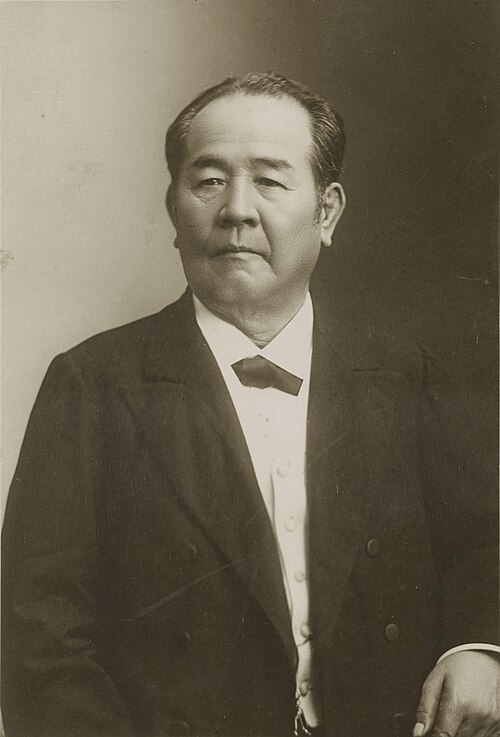
Sakichi Toyoda 豊田佐吉
とよだ さきち
Sakichi Toyoda (1867–1930) was a Japanese inventor and industrialist known as Japan's "king of inventors". He built a series of looms, most famously the Type G automatic loom (1924), and founded Toyoda Automatic Loom Works, the root of the Toyota group. The principle of jidoka — a machine that stops itself when something goes wrong — grew out of his inventions.
- Birthplace
- Yamaguchi village, Tōtōmi Province (now Kosai, Shizuoka)
- Nationality
- Japanese
- Field
- Loom invention, industry
Early life
Sakichi Toyoda was born in 1867, the last year of the Edo period, in Yamaguchi village in Tōtōmi Province, now part of Kosai, Shizuoka. His family farmed, and his father Ikichi was a carpenter who taught him the trade — a skill that later let Sakichi build his first wooden looms by hand.
Home weaving was common in his village, and he watched women, including his mother, toil at manual looms. He was an avid reader and organised a study group for local youths; many accounts say Samuel Smiles's Self-Help, popular in Meiji Japan, shaped his spirit of self-reliance.
In 1890 he visited the Third National Industrial Exhibition in Ueno, Tokyo, spending days studying domestic and foreign textile machinery, which strengthened his resolve to become an inventor.
The first looms
In 1891, aged 24, Toyoda received his first patent, for the Toyoda wooden hand loom, which let weavers work faster and produce more even cloth. Business was hard at first, and he repeatedly had to start over.
In 1896 he completed the Toyoda power loom, regarded as Japan's first powered loom. Its wooden frame with iron parts kept it cheap enough for small mills, and it stopped automatically when a weft thread broke. Output and quality rose sharply, making his name known in the textile trade.
Over the next two decades he kept improving his designs and set up his own companies and mills, including Toyoda Boshoku (spinning) in Nagoya in 1918, followed by a mill in Shanghai where he tested his machines under real production conditions.
The Type G automatic loom
Toyoda's greatest achievement was the Type G automatic loom, completed in 1924 with his son Kiichiro. It changed shuttles automatically without stopping and halted itself when a warp or weft thread broke, so one worker could tend many looms.
Toyoda Automatic Loom Works was officially registered on 18 November 1926 in Kariya, Aichi, to build it. In 1929 the company signed an agreement transferring the Type G patent rights to Britain's Platt Brothers, a leading loom maker, for production and sales outside Japan, China and the United States — Japanese technology exported to the birthplace of the Industrial Revolution.
According to many accounts, the proceeds helped Kiichiro fund an automobile research department within the company, the seed of Toyota Motor.
Ideas: jidoka and the inventor's spirit
His machines shared one idea: a machine should detect abnormalities and stop itself, so it never produces defects and workers need not watch every machine. Toyota later called this jidoka (自働化, "automation with a human touch", written with the 'person' radical), one of the two pillars of the Toyota Production System alongside Just-in-Time.
The "5 Whys" method — asking "why" repeatedly to reach a problem's root cause — is also commonly attributed to him and spread through Toyota. In 1935, after his death, his successors summed up his spirit in the Toyoda Precepts, stressing creative research, practicality and service to society.
Throughout his life he built, failed and rebuilt by hand, and believed inventions must serve real production, testing machines in his own mills before selling them.
Later years and legacy
Sakichi Toyoda died on 30 October 1930 at 63, a year after the Platt Brothers deal. He did not live to see the first Toyota car, but Kiichiro founded Toyota Motor in 1937 on the loom company's foundation.
Toyoda Automatic Loom Works is now Toyota Industries, still making looms as well as forklifts and car air-conditioning compressors. The Toyota Commemorative Museum of Industry and Technology in Nagoya stands on the site of his former mill, and his birthplace in Kosai has a memorial house.
In 1985, marking a century of Japan's patent system, the Japan Patent Office named him one of Japan's Ten Great Inventors. The Toyota Century, launched in 1967, was named for the centenary of his birth. He is seen as a model of the self-taught Meiji inventor who mechanised Japanese weaving.
Connection with Vietnam
Toyoda had no direct link with Vietnam, but his legacy is visible there: Toyota Motor Vietnam (a joint venture set up in 1995) operates a plant in Phuc Yen, Vinh Phuc, and concepts such as jidoka, kaizen and the 5 Whys are taught in many Vietnamese factories. Vietnamese trainees and engineers at plants in Aichi are usually introduced to the Toyota Production System from day one.
Japanese corner
His name is written 豊田佐吉, read Toyoda Sakichi. Note the family name is Toyoda, while the car brand became トヨタ (Toyota) in 1936–37 — easier to say, and eight strokes in katakana, a lucky number.
Vocabulary: 織機 (shokki) loom; 自動織機 (jidō shokki) automatic loom; 発明王 (hatsumei-ō) king of inventors; 特許 (tokkyo) patent; 自働化 (jidōka) Toyota-style automation, distinct from ordinary 自動化; 改善 (kaizen) improvement; なぜなぜ分析 5 Whys analysis; 杼 (hi) shuttle.