Science · 世界名人
Alan Turing アラン・チューリング
あらん・ちゅーりんぐ
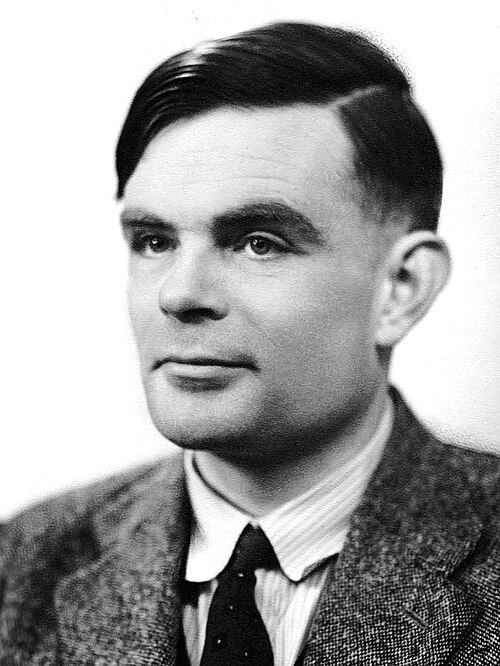
Alan Turing (1912 – 1954) was an English mathematician and logician regarded as a founder of computer science and artificial intelligence. His "Turing machine" (1936) defined what it means to compute, and his codebreaking work on Enigma at Bletchley Park made a major contribution to the Allied victory in World War II. Convicted for homosexuality in 1952, he died two years later.
- Birthplace
- Maida Vale, London, England
- Nationality
- British
- Education
- King's College, Cambridge; PhD, Princeton (1938)
Early life and education
Alan Mathison Turing was born in London on 23 June 1912. His father served in the Indian Civil Service, so as children Alan and his brother were often boarded with families in England. At Sherborne School he was seen as lopsidedly devoted to science and mathematics; the headmaster wrote that if he was to be solely a scientific specialist, he was wasting his time at a public school.
At Sherborne he formed a close bond with a fellow pupil, Christopher Morcom, whose sudden death in February 1930 affected him deeply and, biographers suggest, turned his mind to questions about mind and matter.
He entered King's College, Cambridge, in 1931 to read mathematics, graduated with distinction in 1934, was elected a fellow of the college in 1935 at just 22, and won the Smith's Prize in 1936.
The Turing machine
In 1936 Turing published "On Computable Numbers", answering David Hilbert's Entscheidungsproblem — whether there is a mechanical method to decide the truth of any mathematical statement. His answer was no.
To show this he imagined an abstract machine that reads and writes symbols on an endless tape according to a table of rules — now called the Turing machine. He also described a "universal machine" that can imitate any other such machine when given its description, the core idea of the stored-program computer. Alonzo Church at Princeton reached an equivalent result by a different route at about the same time.
From 1936 to 1938 Turing studied at Princeton under Church, earning a PhD with a thesis on ordinal logics, before returning to Cambridge.
Bletchley Park and Enigma
On 3 September 1939, the day Britain declared war on Germany, Turing began full-time work at Bletchley Park, Britain's secret codebreaking centre. Building on the Polish "Bomba", he designed the far more powerful Bombe to find the daily settings of the German Enigma cipher machine.
He led the team attacking German naval Enigma (Hut 8), the hardest variant and the one linked to the U-boats threatening Atlantic supply lines. In late 1942 he travelled to the United States to share techniques. He also worked on speech encipherment and contributed to the attack on the Lorenz cipher used by the German high command.
The effect of Enigma decryption on the war's outcome is hard to measure; some historians estimate it shortened the war in Europe by about two years, but this is an estimate and debated. The work stayed secret for decades, so during his lifetime the public knew almost nothing of his role.
Computers and artificial intelligence
After the war, at the National Physical Laboratory, Turing designed the ACE (Automatic Computing Engine), one of the first detailed designs for an electronic stored-program computer; it was approved in early 1946 but not completed under his direction. In 1948 he moved to Manchester University as deputy director of the computing laboratory and wrote software for the Manchester Mark 1.
In 1950 he published "Computing Machinery and Intelligence" in Mind, opening with the question "Can machines think?". Rather than argue over definitions, he proposed an "imitation game": if an interrogator cannot tell machine from human through written answers, the machine may be called intelligent. This "Turing test" remains central to debates about AI.
In his last years he turned to mathematical biology. "The Chemical Basis of Morphogenesis" (1952) showed how chemical reactions and diffusion could produce patterns such as stripes and spots — now called Turing patterns, a pioneering work in non-linear dynamics. He was elected a Fellow of the Royal Society in 1951.
Prosecution and death
Sex between men was then a crime in Britain. In 1952, after reporting a burglary at his home, Turing acknowledged a relationship with a man and was prosecuted for "gross indecency". Convicted on 31 March 1952, he accepted a year of oestrogen injections (so-called chemical castration) instead of prison, and lost his security clearance for government cryptographic work.
On 7 June 1954 he was found dead at his home in Wilmslow from cyanide poisoning, aged 41. The inquest ruled suicide. Some, including his mother, believed it might have been an accident caused by chemicals from experiments he conducted at home; the question cannot now be settled.
Legacy and rehabilitation
In 1966 the Association for Computing Machinery created the Turing Award, now regarded as the "Nobel Prize of computing". In 2009 Prime Minister Gordon Brown apologised for the "appalling" way he had been treated, and in 2013 Queen Elizabeth II granted him a pardon. In 2017 the so-called "Alan Turing law" pardoned thousands of men convicted under the old laws.
Since 2021 his portrait has appeared on the Bank of England £50 note. His life inspired the play Breaking the Code and the film The Imitation Game (2014). He is today both an icon of computer science and a symbol of the struggle for LGBT rights.
Japanese corner
His name is written アラン・チューリング. The Imitation Game was released in Japan as 『イミテーション・ゲーム/エニグマと天才数学者の秘密』.
Key words: チューリングマシン (Turing machine), チューリング・テスト (Turing test), 暗号解読 (codebreaking), 計算機科学 (computer science), 人工知能 (artificial intelligence), 数学者 (mathematician), 第二次世界大戦 (World War II).